How Investigative Capabilities Help Countries Strengthen AML/CFT Effectiveness and Move Off the FATF Grey List
Introduction to Malware Binary Triage (IMBT) Course
Looking to level up your skills? Get 10% off using coupon code: MWNEWS10 for any flavor.
Enroll Now and Save 10%: Coupon Code MWNEWS10
Note: Affiliate link – your enrollment helps support this platform at no extra cost to you.

TL;DR
- The Financial Action Task Force (FATF) measures outcomes such as investigations, prosecutions and asset recovery. These outcomes depend on the operational ability of financial intelligence units, law enforcement and regulators to detect, investigate and disrupt illicit financial activity.
- Modern investigative technology strengthens that ability by connecting financial transactions, accounts, people and companies to reveal the hidden networks behind financial activity. Investment in these capabilities is one of the clearest ways a government can show real commitment to fighting financial crime.
- Countries leave the FATF grey list by demonstrating effective AML/CFT investigations, not by introducing new legislation, publishing more compliance guidance or gathering more data.
Being placed on the FATF grey list (a.k.a. Jurisdictions under Increased Monitoring) puts a government under sustained pressure to prove it can fight financial crime. The grey list identifies countries with strategic deficiencies in their anti-money laundering (AML) and counter-terrorist financing (CFT) frameworks that have committed to fix those weaknesses under an agreed action plan. Governments respond the way you would expect. They strengthen laws, tighten reporting and build out compliance frameworks. The problem is that none of it counts until the system delivers. The FATF is not measuring intent. It is measuring whether a country’s institutions can actually detect, investigate and disrupt money laundering and terrorist financing.
This article explains what the FATF expects, why legislation alone falls short and how investigative capabilities powered by advanced technology help governments demonstrate meaningful progress.
What are the FATF grey and black lists?
The FATF grey list and black list are the two ways the Financial Action Task Force publicly flags jurisdictions whose defenses against financial crime fall below the global standard. The grey list names countries that have acknowledged strategic deficiencies and committed to resolve them within agreed timeframes. As of June 2026, 22 jurisdictions have been placed on the list. The black list, formally High-Risk Jurisdictions subject to a Call for Action, names the most serious cases. This is where the FATF calls on members to apply enhanced due diligence and, in the gravest situations, countermeasures. Currently only 3 countries appear on the black list.
The practical difference matters. Grey-listed countries are actively working with the FATF, and the FATF does not call for blanket enhanced due diligence against them. It asks members to factor the listing into their own risk analysis. Black-listed countries face far harsher consequences. For any government, the grey list is the warning stage and the window to act.
The FATF alongside the OECD and the Egmont Group
The FATF does not work alone. It sets the global AML/CFT standard through its 40 recommendations and assesses countries against them, however it sits within a wider architecture for financial transparency. The FATF is hosted at the Organization for Economic Co-operation and Development (OECD) in Paris, which anchors it in the broader international effort on tax transparency and illicit finance. The Egmont Group connects financial intelligence units worldwide so they can share intelligence across borders. Regional bodies such as MONEYVAL carry out evaluations alongside the FATF. Together these organizations shape the standards, the intelligence sharing and the peer review that define what an effective AML/CFT system looks like.
What being on the FATF grey list means for a country
Being placed on the FATF grey list signals elevated financial crime risk to banks, investors and correspondent banking partners worldwide, and the economic cost can be significant. Banks apply heavier scrutiny to transactions involving grey-listed jurisdictions, which slows cross-border payments and raises the cost of doing business. Foreign investment tends to decline. Reputation suffers. Research has linked grey listing to measurable declines in capital inflows. In short, a listing makes a country a riskier place to do business, and that is precisely why governments have a strong incentive to get off it quickly.
Bosnia and Herzegovina is a recent example. In June 2026, the FATF added the country to the grey list after its evaluation, and Bosnia made a high-level political commitment to work with the FATF and MONEYVAL to strengthen its AML/CFT regime. Its action plan is instructive because it is almost entirely operational. The FATF is looking for visible operational outcomes, from beneficial ownership transparency and international cooperation to better use of suspicious transaction reports and increased investigations and prosecutions.
The FATF asked Bosnia to ensure timely availability of accurate beneficial ownership information, to make systematic use of international cooperation between law enforcement and regulatory authorities across borders, to provide targeted feedback on the quality of suspicious transaction reports and to demonstrate an increase in money laundering investigations and prosecutions. Every one of those items is about doing, not legislating.
Why legislation alone does not satisfy the FATF
Countries do not leave the FATF grey list by passing laws. They leave by proving their systems actually detect, investigate and disrupt financial crime. This is the single most important shift in how the FATF works, and it catches many governments off guard.
The FATF assesses two different things.
- Technical compliance measures whether a country’s laws and regulations match the 40 recommendations.
- Effectiveness measures whether those laws produce results in practice, and it is judged through the mutual evaluation against a set of outcome-focused criteria.
A country can score well on technical compliance and still fail on effectiveness. Passing a beneficial ownership law counts for little if authorities cannot actually identify who owns and controls a company when an investigation demands it.
That is why the FATF measures outcomes, not activity. It looks for a sustained increase in money laundering investigations and prosecutions, for the tracing and recovery of criminal assets and for financial intelligence that competent authorities genuinely use. Filing more reports or completing more inspections does not move the needle. Demonstrating that the system turns information into enforcement does. Building that capacity depends on sharp investigative analysis, not on statute alone.
Connected intelligence reveals what siloed investigations miss
Financial crime today is operated by sophisticated criminal networks, terrorists, extremists and rogue states, but most government investigations are still siloed and struggle to piece together the full picture from fragmented data sources. That gap is where criminals operate. Criminals deliberately separate the operational tasks: the people from the companies, the transactions from the assets, the money from the jurisdiction it lands in. The investigator’s job is to reconnect what was intentionally kept apart.
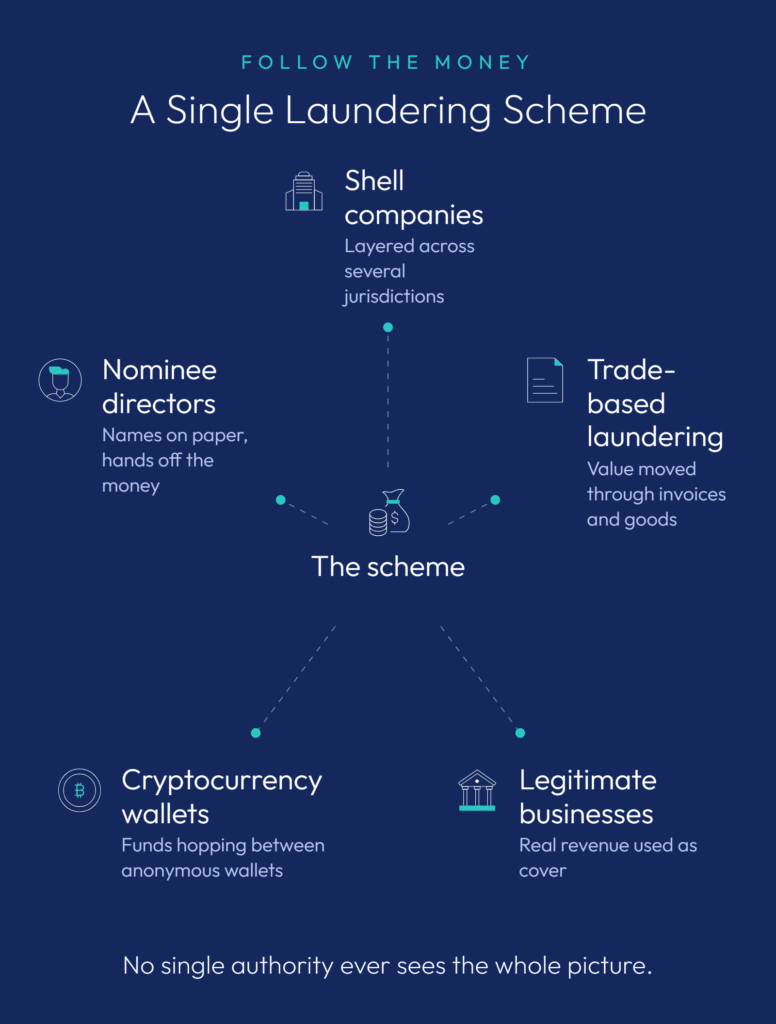
A single laundering scheme can span shell companies across several jurisdictions, nominee directors, trade-based laundering, cryptocurrency wallets and legitimate businesses used as cover. No single authority ever sees the whole picture. A single laundering scheme can span shell companies across several jurisdictions, nominee directors, trade-based laundering, cryptocurrency wallets and legitimate businesses used as cover. No single authority ever sees the whole picture.
The fragmentation is structural. The financial intelligence unit holds suspicious transaction reports. Tax authorities hold filings. Customs sees trade. Regulators supervise institutions. Police investigate underlying crimes. Prosecutors build cases. Each body holds one piece and none holds the full puzzle.
Criminal organizations, terrorists, extremists and rogue states understand this and deliberately design their operations around institutional boundaries. The response cannot be more disconnected systems and more manual review. It has to be connected intelligence, where investigators see relationships instead of isolated records and networks instead of single transactions.
The investigative capabilities that strengthen AML/CFT effectiveness
Strengthening AML/CFT effectiveness depends on giving investigators the capabilities to turn fragmented data into connected intelligence, and modern technology is what makes that possible at scale. Decision intelligence brings data, analytics and collaboration into one environment, so investigators can move quickly through the steps the FATF Recommendations expect in practice.

The process starts with a suspicious transaction reported to the Financial Intelligence Unit (FIU). The decision intelligence platform brings every relevant record into one investigative workspace, from beneficial ownership to tax and asset registries. It resolves entities and maps networks to reveal who truly owns the companies and controls the accounts behind the case. It ends with the evidence prosecutors need to trace, freeze and recover assets and secure a conviction. A decision intelligence platform for financial crime is the practical solution to moving quickly and efficiently through the steps which can help towards restoring the country’s financial reputation.
Multi-source data fusion: intelligence disciplines and government records
The foundation is fusing sources that normally sit apart, across intelligence disciplines and government holdings alike. A complete investigative picture pulls together:
- FININT (financial intelligence): transaction data, suspicious transaction reports and the money trail itself.
- OSINT (open-source intelligence), including business intelligence (BizINT): corporate registries, ownership and commercial data, adverse media, sanctions and PEP screening, plus the wider open-source footprint of a person or company.
- SIGINT (signals intelligence): is intelligence produced from electronic signals coming from apps, devices, networks, locations and other electronic communications.
- Government databases: tax, customs, immigration and asset registry data that investigators can lawfully access during a case.
- Internal and law enforcement records: police reports, case files and criminal intelligence already held within the agency.
Fusing these sources, and enriching them with beneficial ownership data, gives investigators context that no single source provides. Layering in criminal intelligence and blockchain analytics extends the same picture to organized-crime networks and cryptocurrency flows that would otherwise stay invisible.
Entity resolution and beneficial ownership
Once the data is fused together, entity resolution does the quiet heavy lifting. It reconciles records that list the same person or company in slightly different ways across systems, jurisdictions and languages. This helps an investigator to see one real actor rather than a dozen fragments. Entity resolution is central to beneficial ownership investigation and UBO identification, uncovering who truly controls a company behind layers of nominees. It maps directly to the FATF’s beneficial ownership standard, the exact deficiency flagged for Bosnia, and turns scattered tax, asset and account records into a single real-world actor an investigation can act on.
AI-driven detection and guided investigations
Artificial intelligence does more than manage large volumes of data. AI-driven pattern recognition and anomaly detection surface suspicious indicators and separate genuine signals from noise, so analysts spend their time on real cases instead of chasing false positives, the single biggest drain on most AML operations.
Its bigger advantage is finding what rules miss. Fixed rules only catch patterns someone already defined, while machine learning surfaces suspicious behavior that fits no existing rule. This is how emerging laundering typologies get caught. Applied across fused data, AI does not just flag a transaction. It helps expose the network of entities behind it, rather than creating an isolated report.
Speed matters too, since AI analyzes vast volumes of structured and unstructured data in near real time and keeps that analysis current as new information arrives, leaving less time for funds to move. Just as important, detection has to be explainable. The FATF and supervisors expect AML decisions to be auditable. So, AI that shows why it reached a conclusion, not a black box, is what lets an agency defend its findings and prove its system works.
How NEXYTE supports combatting AML/CFT effectiveness
NEXYTE is Cognyte’s decision intelligence solution for financial crime, and it delivers value from day one. It comes ready to use, with preloaded OSINT and intelligence from integrated financial intelligence sources and built-in investigative methodologies, so agencies can run connected, intelligence-led investigations without a long build.
An analyst or investigator starts from a single entity or alert, and NEXYTE automatically enriches it, fusing data sources and government records with beneficial ownership data into one picture. Entity resolution and link analysis connect the people, companies, transactions, wallets and ownership behind the case to help investigators find hidden relationships. AI surfaces anomalies and high-risk relationships and help investigators prioritize leads and blockchain analytics extends the same picture to cryptocurrency. From there, built-in collaboration tools, Decision Flows and an intelligence co-pilot guide the next investigative steps that supports the operational decision at the end. The result is what the FATF ultimately looks for: how the agency is implementing tools it can use to act upon financial crimes.
Conclusion
The real test of an AML/CFT system is not how much information it holds. It is what investigators can do with it. Getting off the FATF grey or black list is not simply about enacting stricter regulatory requirements or publishing more compliance guidance. It is about demonstrating that a country’s law enforcement and regulatory ecosystem can effectively detect, investigate and act upon illicit activity. By building stronger investigative capabilities supported by advanced technology, fusing fragmented data, applying AI and enabling collaboration across agencies, governments can strengthen AML/CFT effectiveness and show real, measurable progress toward FATF expectations.
FAQ
What is the FATF grey list?
The FATF grey list, officially called Jurisdictions under Increased Monitoring, is a list of countries with strategic deficiencies in their anti-money laundering and counter-terrorist financing systems that have committed to fix them under an agreed action plan. Grey-listed countries are actively working with the FATF and report on their progress at each plenary meeting.
What is the difference between the FATF grey list and the FATF black list?
The grey list covers countries that have acknowledged deficiencies and committed to resolve them, and the FATF does not call for blanket enhanced due diligence against them. The black list, officially High-Risk Jurisdictions subject to a Call for Action, covers the most serious cases. This is when the FATF calls on all jurisdictions to apply enhanced due diligence and, in extreme cases, countermeasures.
What are the consequences of a FATF grey listing?
Grey listing raises the perceived financial crime risk of a country, which leads to heavier scrutiny from banks and financial institutions, slower and costlier cross-border payments, reduced foreign investment and reputational damage. These effects give governments a strong incentive to create an action plan and exit the list quickly.
How does a country get off the FATF grey list?
A country gets off the FATF grey list by substantially completing its agreed action plan and proving the reforms work in practice, then passing an FATF on-site assessment. That proof is operational: real investigations, prosecutions, asset recovery and the effective use of financial intelligence. Building strong investigative capabilities is central to demonstrating the progress the FATF expects.
How can technology help a country get off the FATF grey list?
Technology solutions can help a country get off the FATF grey list by turning fragmented data into the operational results the FATF measures. A decision intelligence platform provides investigators and analysts with the capabilities tofuse financial, open-source and government data, resolve entities to reveal who really owns and controls companies, apply AI to surface suspicious networks and work from a single investigative picture. These capabilities help authorities conduct investigations more effectively, secure more prosecutions and trace the assets that prove AML/CFT effectiveness, which is what ultimately moves a country off the list.
Take the next step
See how our decision intelligence platform, NEXYTE, helps agencies and regulators strengthen AML/CFT effectiveness and demonstrate progress against FATF expectations. Request NEXYTE’s financial crime demo.
Resources
Revised Guidance on AML/CFT and Financial Inclusion
The post You Can’t Legislate Your Way Off the FATF Grey List appeared first on Cognyte.
Article Link: https://www.cognyte.com/blog/fatf-grey-list-investigative-capabilities/