Key Findings
Introduction to Malware Binary Triage (IMBT) Course
Looking to level up your skills? Get 10% off using coupon code: MWNEWS10 for any flavor.
Enroll Now and Save 10%: Coupon Code MWNEWS10
Note: Affiliate link – your enrollment helps support this platform at no extra cost to you.
- Antidetect browsers obscure the digital identity of their users, enabling a single operator to silently manage thousands of isolated accounts across multiple platforms (including Facebook, TikTok, Instagram, and YouTube), while evading detection systems that look for scams and coordinated inauthentic behavior.
- Threat actors abuse these platforms, taking over accounts and using them for financial fraud, phishing and malware distribution. These accounts can also be used to coordinate influence operations, which becomes an even greater concern ahead of elections.
- Social platforms primarily detect coordinated activity at the account and behavioral layer. Antidetect browsers run below the surface enabling them to remain undetected.
- The three main antidetect browsers we discuss in this report are Kameleo, AdsPower, and MultiLogin.
- These tools already use AI integration, from built-in automation templates to offering a dedicated MCP server that pipes LLM-generated content directly into pre-warmed account profiles at machine speed. Running a large-scale social media operation now requires only a credit card instead of a technical team.
Introduction
Antidetect browsers conceal their users’ digital identities, enabling a single operator or small team to simultaneously run thousands of isolated accounts across multiple platforms such as Facebook, Instagram, TikTok, YouTube, Twitter/X, Discord, LinkedIn, Reddit, and many more, without triggering the detection systems employed by those platforms.
In this report, we highlight three main tools: Kameleo, AdsPower, and MultiLogin. We selected these specifically on the basis of documented references across underground forums and criminal marketplaces, indicating active adoption beyond their stated commercial purposes. Confirmed use cases include:
- Account takeover operations in which session cookies harvested by infostealer malware are injected into clean browser profiles to assume control of banking accounts and cryptocurrency wallets without triggering authentication alerts.
- Carding operations in which stolen payment credentials are tested across e-commerce platforms under the guise of distinct legitimate users.
- Fraudulent loan applications submitted under fabricated identities.
- Bulk creation of artificial accounts used to generate fraudulent advertising revenue at scale.
As documented in Anthropic’s September 2026 Threat Intelligence Report, attackers used antidetect browsers in a fraud campaign that targeted cryptocurrency exchanges and financial marketplaces. They combined antidetect browser profiles, residential proxies, automated CAPTCHA-solving, and identity-verification bypass tools to create large numbers of verified accounts while avoiding onboarding security checks. These accounts were later used in fraud operations.
The risk posed by antidetect browsers is greater because these accounts pass KYC verification, build legitimate activity histories, and appear benign during transactions. As a result, fraud detection systems that rely on user behavior or device identity often cannot identify these accounts as suspicious until after fraudulent activity has already occurred.
The antidetect browsers documented in this research are commercially available, legally registered platforms with documented legitimate use cases in digital marketing, e-commerce, and privacy protection. When deployed by threat actors, the same infrastructure that enables financial fraud at scale is equally applicable to Coordinated Inauthentic Behavior (CIB), the term used to describe organized manipulation campaigns in which false identities are central to the operation and adversarial methods are used to evade detection.
Meta’s most recent transparency reporting explicitly flagged this as a growing concern, with Russia, Iran, and China identified as the three leading sources of such activity globally.
The Identity Obfuscation Stack – How antidetect browsers defeat social media platform detection at every layer

Figure 1 – The five layers through which antidetect browsers defeat platform detection methods.
While antidetect browsers are not a new phenomenon, their threat potential has increased with the integration of AI. Previously, their operational impact was constrained by the manual effort required to run and maintain large account networks at scale. AI-assisted content generation, automated persona management, and machine-speed distribution pipelines now enables a single actor with a subscription and a prompt to do the work of a coordinated team.
In the following sections, we provide a technical breakdown of each tool, examining capabilities documented on their own platforms, underground forum references, and the specific features that position them as an emerging threat.

Figure 2 – Comparison of popular antidetect tools.
Defeating Platform Detection: The Identity Layer No Platform Can See
Companies like Meta, TikTok, and Google have spent billions of dollars building behavioral and identity detection systems to identify abuse of their platforms for scams, financial fraud, and coordinated inauthentic activity. Antidetect browsers are engineered to defeat every signal on which those systems rely.
Every antidetect browser uses fingerprint spoofing. When a browser connects to a website, it exposes dozens of identifying parameters that the website can collect to build a browser fingerprint, including canvas rendering output, WebGL vendor and renderer strings, font enumeration behavior, screen resolution, time zone, user agent, and hardware identifiers. Platforms cross-reference these signals to determine whether two accounts originate from the same device. Antidetect browsers intercept and fabricate each of these parameters individually, assigning a unique combination to every profile.
The criminal ecosystem surrounding these tools extends well beyond their commercial vendors. As seen in Figure 3, a threat actor on a Russian-language underground forum advertised an AiTM engine as a commercial service, with built-in functionality to export harvested session credentials directly into antidetect browsers. The post confirms that the pipeline from credential harvesting to antidetect-assisted account takeover is a documented, commercially available and actively traded workflow with dedicated tooling, published instructions, and an active buyer community.
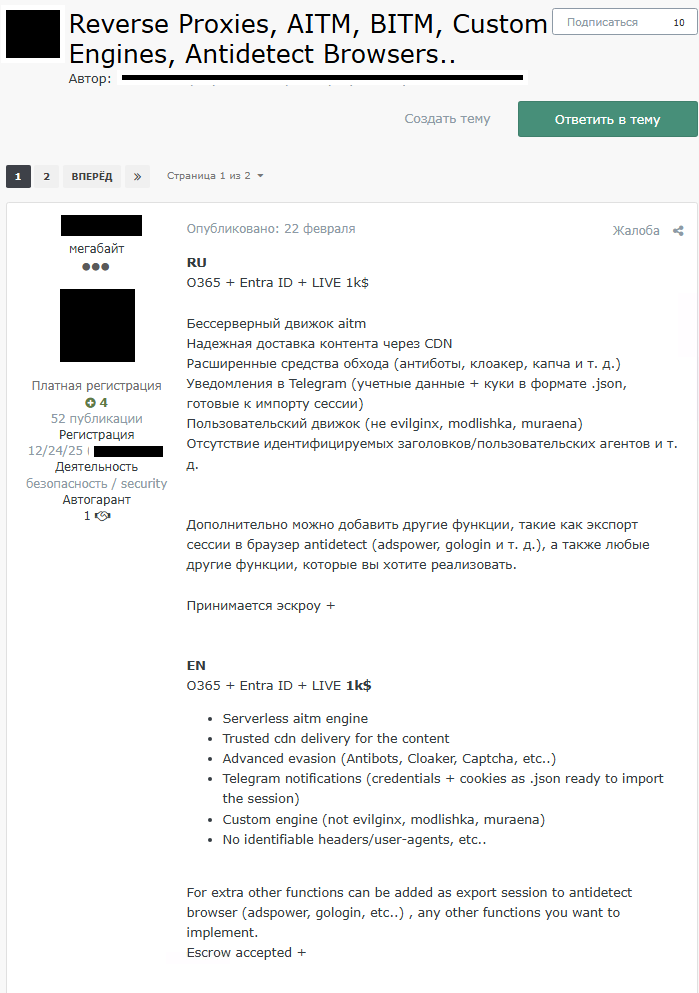
Figure 3 – An AiTM engine advertised as a commercial service on a Russian-language underground forum, with built-in functionality to export harvested session credentials directly into antidetect browsers.
Kameleo
Modifying browser engines at the source level rather than applying surface overrides, Kameleo produces fingerprints drawn from real device signatures, making them significantly harder to flag as anomalous. Its adoption within criminal ecosystems is evidenced by its repeated appearance across the most active Russian-language hacking forums. As seen in Figure 4, Kameleo is listed alongside other antidetect browsers in a post by a proxy seller on an underground forum, advertising residential proxy services explicitly marketed for account farming, CAPTCHA bypass, and shield evasion against security systems including DataDome, the same platform for which Kameleo’s own blog publishes dedicated bypass guides.
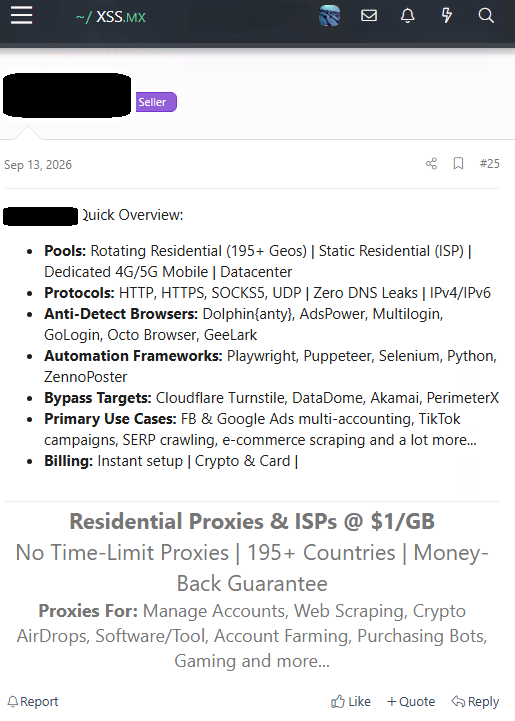
Figure 4 – A proxy seller on an underground forum listing Kameleo as part of a complete operational stack. The service is explicitly marketed for account farming and bulk account management.
Kameleo’s engineering team published a guide detailing how to automate Facebook likes across multiple accounts simultaneously using precisely this fingerprint manipulation. As seen in Figure 5, evading platform detection is not a side effect but the tool’s primary operational value.
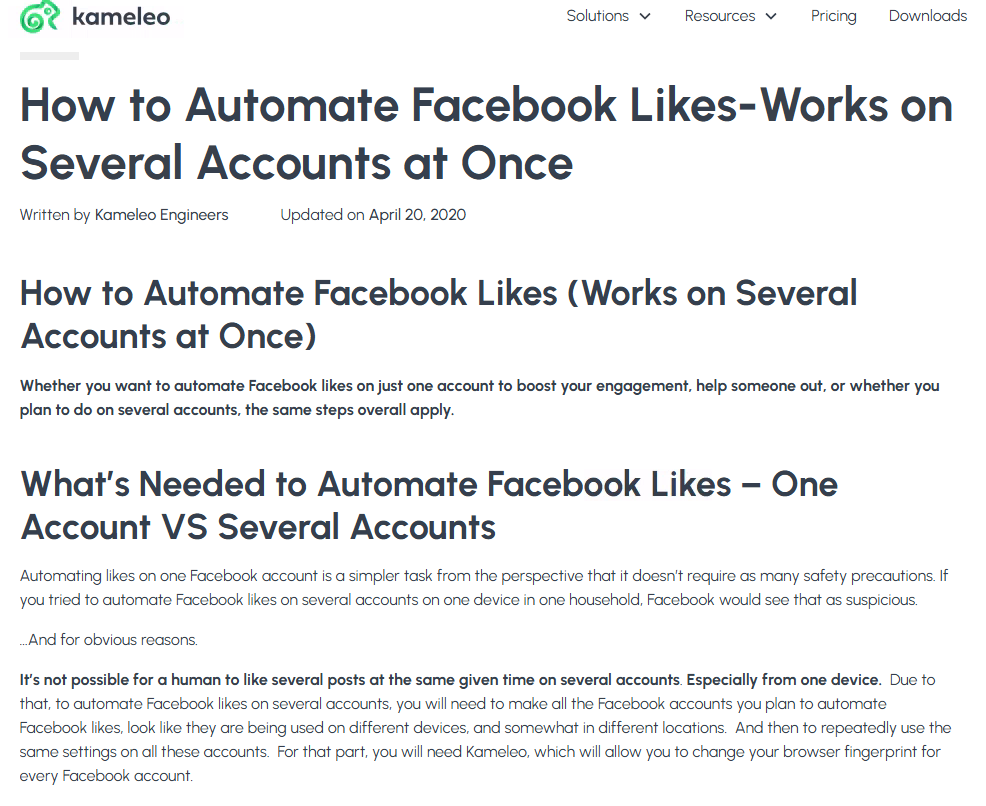
Figure 5 – Kameleo’s guide on how to automate Facebook likes across multiple accounts simultaneously using browser fingerprint manipulation.
Beyond fingerprinting, Kameleo suppresses WebRTC, a protocol that can leak a device’s real IP address even when a proxy is active, and provides explicit configuration options to prevent non-proxied UDP connections. The documentation frames this not as a privacy feature but as a counter to a known de-anonymization vector used by platform security teams.
At the session layer, Kameleo’s dedicated cookie injection API accepts complete cookie objects including session IDs, refresh tokens, and authentication flags, allowing a pre-authenticated session state to be inserted into a profile before it is launched. The platform sees the profile as an already-authenticated user, with no login event occurring to trigger anomaly detection. As independently documented by threat intelligence research and confirmed by security researchers, this workflow is established and active in the criminal ecosystem. Figure 6 shows a recruitment post on a Russian-language underground forum advertising a multifunctional infostealer with RAT capabilities explicitly designed to operate within antidetect browser environments, listing Kameleo, AdsPower, and MultiLogin among 21 compatible platforms capable of harvesting session cookies, authentication tokens, cryptocurrency wallets, API keys, and 2FA credentials.
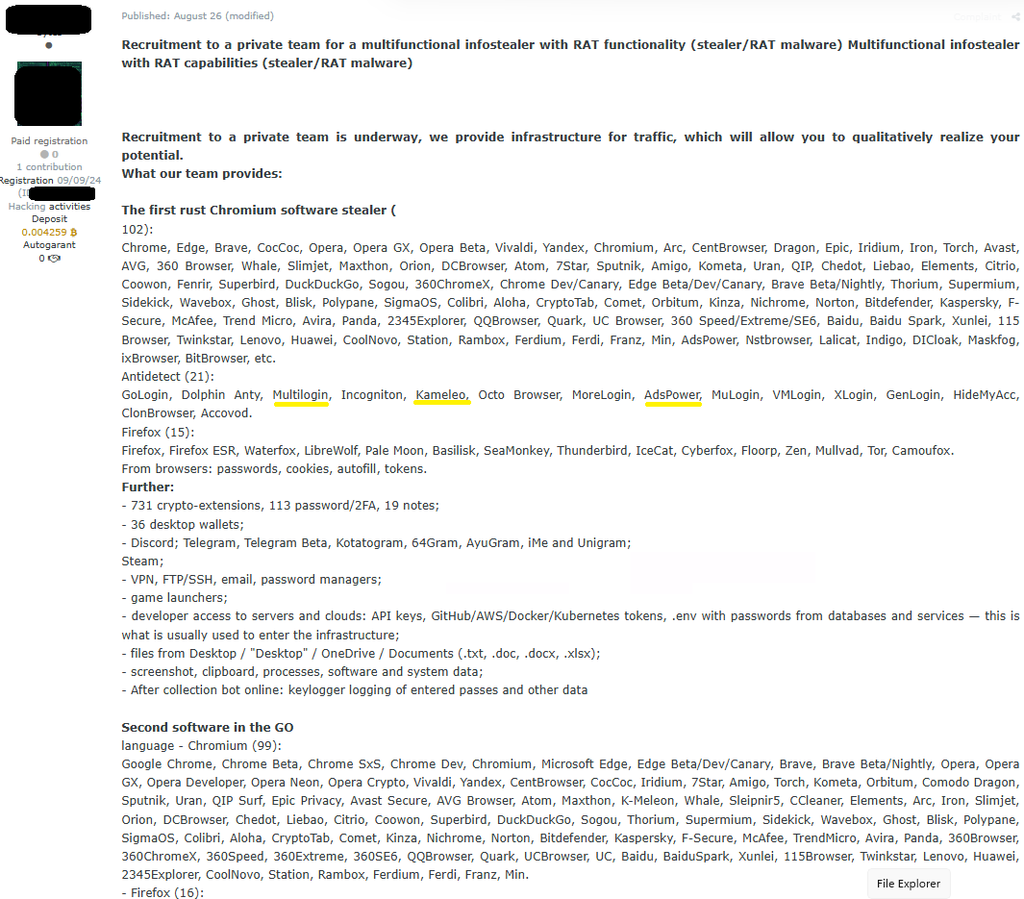
Figure 6 – A recruitment post on a Russian-language underground forum lists 21 browsers including Kameleo, AdsPower, and MultiLogin as compatible platforms.
As seen in Figure 7, a threat actor on a Russian-language underground hacking forum explicitly introduces Kameleo as a component of Browser-in-the-Middle phishing kits targeting credentials across Google, Microsoft, Facebook, and financial platforms. In a Browser-in-the-Middle attack, the phishing server instructs the antidetect browser to create a new profile for the victim, assigned a residential proxy in their country and a clean device fingerprint. The victim’s credentials, entered on the phishing page, are passed in real time into the real login page of the target service through an automation framework. The target platform sees a login attempt from a consistent, locally coherent device with a residential IP address in the expected country, none of the signals that would trigger a security challenge or step-up authentication.
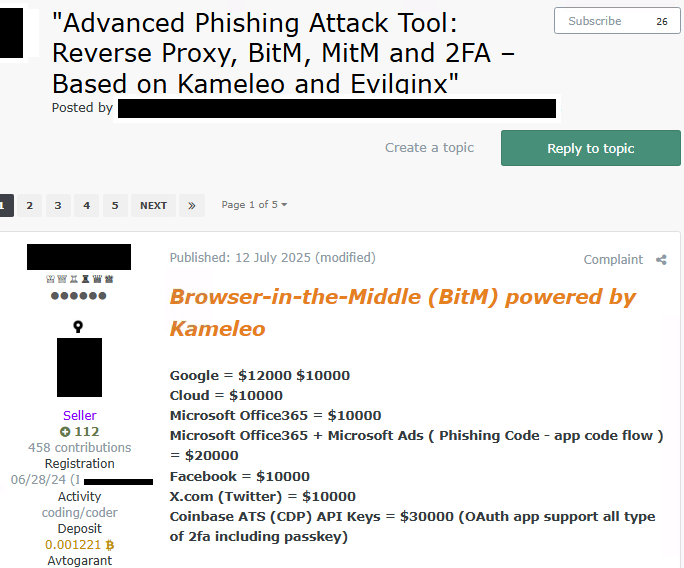
Figure 7 – A post on a Russian-language underground hacking forum introducing Kameleo as a component of Browser-in-the-Middle phishing kits targeting credentials across Google, Microsoft, Facebook, and financial platforms.
AdsPower
Chinese in origin and subsequently registered across multiple jurisdictions and localized into more than 20 languages, AdsPower applies fingerprint spoofing logic across more than 20 configurable parameters per profile and advertises a 99.2% ban avoidance rate. As seen in Figure 8, its proxy editor provides a built-in catalog of compatible third-party residential and rotating proxy providers, assignable directly within the profile creation interface. Figure 9 illustrates the granularity of fingerprint control available, with each profile’s WebRTC handling, time zone, geolocation, and language individually configurable to ensure the synthetic identity is consistent across every detectable signal.
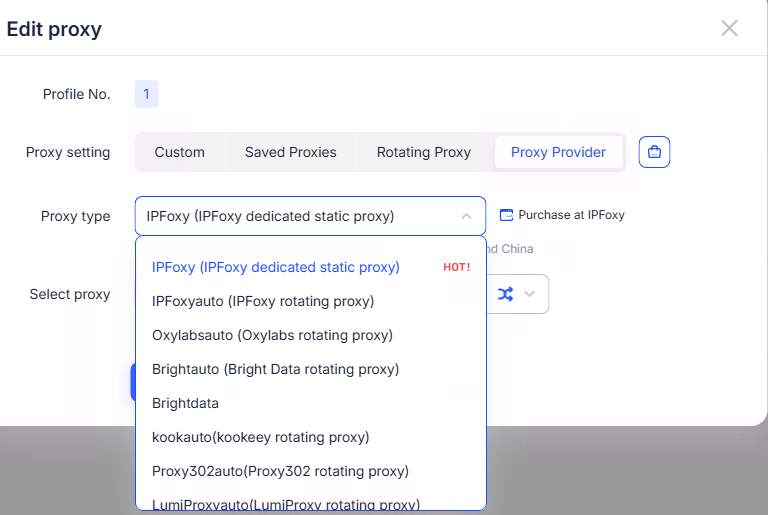
Figure 8 – AdsPower’s proxy integration interface lists compatible third-party residential and rotating proxy providers available within the platform.
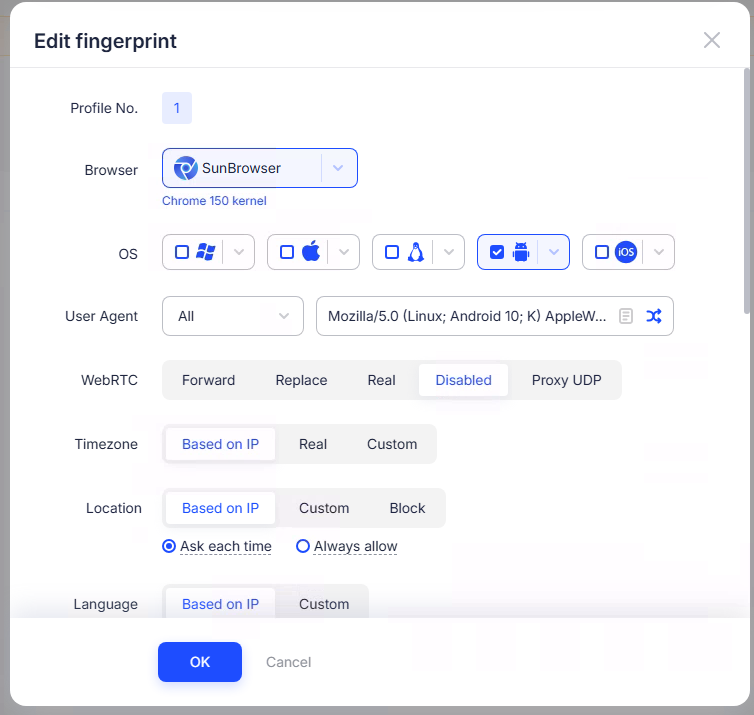
Figure 9 – AdsPower’s fingerprint editor displaying granular per-profile identity parameters including WebRTC, timezone and location derived from the assigned proxy IP.
The scale of AdsPower’s intended use is reflected in its pricing structure, with published tiers supporting up to 5,000 distinct profiles as seen in Figure 10, and enterprise arrangements available on request. As seen in Figure 11, its account editor supports platforms spanning social media, e-commerce, financial services, and professional networks including Facebook, Amazon, LinkedIn, X, PayPal, and Google.

Figure 10 – AdsPower’s pricing table reflects the intended operational scale, with enterprise tiers supporting more than 5,000 profiles available upon request.
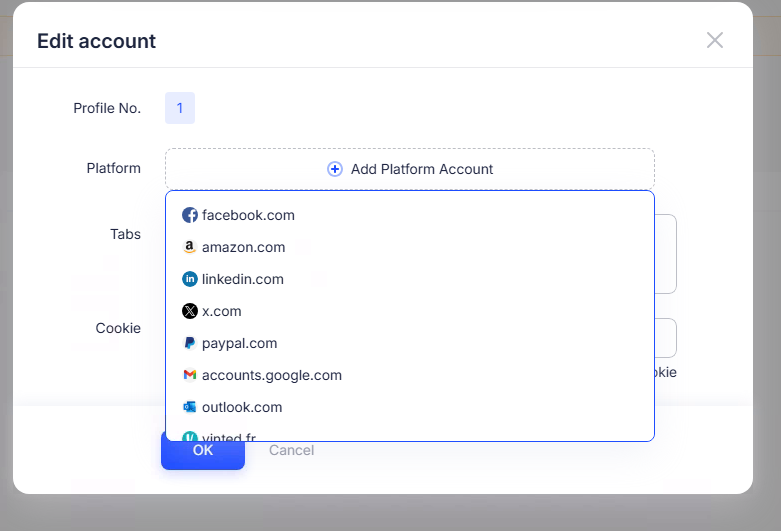
Figure 11 – AdsPower’s account editor shows supported platforms available for bulk profile management, including Facebook, Amazon, LinkedIn, X, PayPal, and Google.
Scalability is further addressed through a built-in RPA engine and a dedicated Marketplace, as seen in Figure 12, offering pre-built templates for automated liking, commenting, direct messaging, follower scraping, and AI-assisted engagement across hundreds of profiles simultaneously. The multi-window synchronizer replicates identical actions across hundreds of profiles from a single input, while account warming automation builds synthetic activity histories over weeks to reduce platform suspicion before deployment.

Figure 12 – AdsPower’s RPA Marketplace lists pre-built automation templates for bulk account activity across major platforms, including automated liking, commenting, direct messaging, follower scraping, and AI-assisted engagement.
On the AI front, AdsPower advertises a dedicated Model Context Protocol server enabling direct integration with large language model workflows, creating a pipeline in which AI-generated content can be produced, injected into pre-warmed account profiles, and distributed across platforms in a fully automated sequence requiring no human involvement. A companion feature, the Cookie Robot, automates cookie warming on TikTok and Twitter/X accounts prior to operational use. The RPA Marketplace is the delivery mechanism for this pipeline, with ready-to-deploy workflows designed to operate in direct combination with AI-generated content, resulting in an end-to-end operation at a scale and speed previously associated only with state-sponsored actors.
As seen in Figure 13, AdsPower’s own published scraping guide explicitly acknowledges that scraping Facebook constitutes a violation of the platform’s terms of service and may result in legal action, before advising users that an antidetect browser can help bypass these limitations.
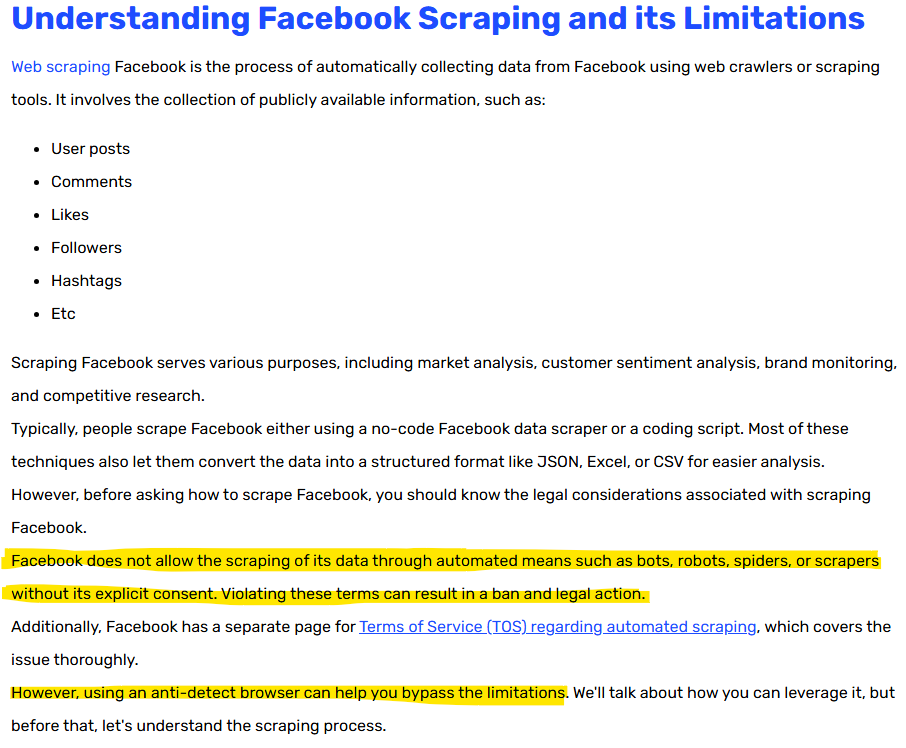
Figure 13 – AdsPower’s official scraping guide advises users that an antidetect browser can help bypass scraping limitations.
MultiLogin
MultiLogin operates as a fully featured antidetect browser platform, offering isolated browser profiles with unique device fingerprints covering canvas output, WebGL parameters, fonts, timezone, screen resolution, and user agent, with each profile maintaining separate cookies, local storage, and session data. The platform supports automation through Selenium, Playwright, and Puppeteer, enabling fully scripted, headless operation of multiple profiles simultaneously. MultiLogin has been referenced on Exploit, a Russian-language underground hacking forum, in a thread dedicated to antidetect browsers, indicating active discussion and adoption of the platform within criminal communities (see Figure 6).
MultiLogin extends its multi-account capability into the mobile layer through a phone farming infrastructure that replaces physical Android devices with cloud-hosted equivalents. Every cloud Android profile maintains its own persistent mobile device parameters, with proxies assigned per profile to control location and network identity. MultiLogin’s own documentation states that most account bans in phone farm environments occur due to multiple accounts sharing the same device signals, storage, or network patterns, and positions its product as the solution to this detection problem, an explicit acknowledgment that the platform is designed to defeat association detection at the mobile layer.
According to their website, virtual phone number provisioning through partner integrations enables SMS-based account verification without physical SIM cards or mobile devices. Each virtual number is paired with a mobile device fingerprint profile, enabling the rapid creation of large volumes of accounts that appear to originate from distinct mobile devices across different geographic locations.
MultiLogin maintains a dedicated web scraping solution page and publishes operational guides for scraping platforms including Facebook, LinkedIn, Amazon, and Twitter, with its built-in residential proxy infrastructure marketed as enabling scraping operations that bypass bot detection and IP-based rate limiting. Its stated use cases listed on its own website include ticket scalping automation, a practice explicitly illegal in multiple jurisdictions and prohibited by major ticketing platforms, with the platform’s infrastructure documented as tested daily against major ticketing services for compatibility. MultiLogin additionally lists AI Quick Actions Automation among its documented product capabilities, indicating a degree of AI integration into its operational workflow.
As seen in Figure 14, MultiLogin’s payment infrastructure accepts cryptocurrency alongside credit card payments and regional systems including SberPay and YooMoney. Notably, YooMoney has been designated on the OFAC Specially Designated Nationals list since April 2022 under Executive Order 14024 as a Sberbank subsidiary, and SberPay operates as a product of Sberbank, itself under comprehensive OFAC blocking sanctions since February 2022. The acceptance of these payment methods, alongside cryptocurrency, enables anonymous and potentially sanctions-non-compliant transactions. MultiLogin offers 24/7 support through dedicated Telegram channels staffed by human representatives and is tested daily against more than 50 major social media platforms to ensure continued compatibility. Taken together, MultiLogin’s mobile infrastructure, AI automation layer, scraping capabilities, criminal community presence, and payment infrastructure make it one of the most operationally complete platforms in this category.
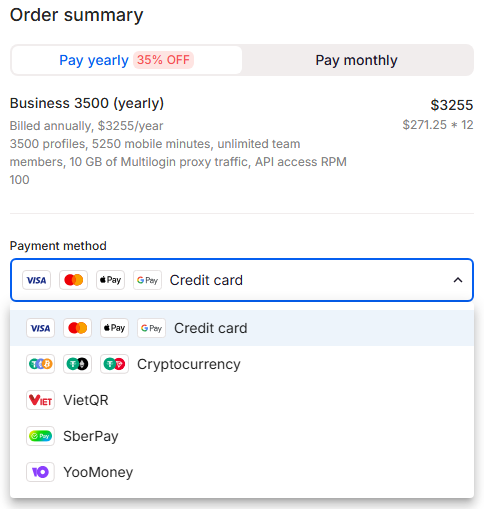
Figure 14 – MultiLogin’s payment infrastructure accepts a variety of different payment services.
AI-Powered Campaign Infrastructure
The most consequential recent development is AI integration directly into the operational stack. AdsPower advertises a dedicated Model Context Protocol server enabling direct integration with large language model workflows, creating a pipeline in which AI-generated content can be produced, injected into pre-warmed account profiles, and distributed across platforms in a fully automated sequence requiring no human involvement. A companion feature, the Cookie Robot, automates cookie warming on TikTok and Twitter/X accounts prior to operational use, simulating browsing behavior to establish account credibility before the content distribution phase begins.
The RPA Marketplace mentioned in the previous section is the delivery mechanism for this pipeline. Available templates contain ready-to-deploy workflows maintained and updated by the vendor, designed to operate in direct combination with AI-generated content. This creates an end-to-end influence operation pipeline that requires no active operator presence once the campaign is initiated. The result is a single automated workflow that places coordinated influence operation capacity within reach of any sufficiently motivated actor, regardless of resources or technical expertise.
Web Scraping as Operational Intelligence
The web scraping capabilities documented across these platforms serve a function that extends well beyond data collection. Scraped data is the intelligence layer that makes the operation more precise. Several of the tools we reviewed maintain dedicated scraping solution pages describing capabilities including fingerprint rotation, CAPTCHA bypass, and headless browsing designed to extract data from platforms including LinkedIn, Amazon, Facebook, and Twitter while evading their anti-scraping defenses. As seen in Figure 13, the AdsPower published scraping guide explicitly acknowledges that scraping Facebook constitutes a violation of the platform’s terms of service and may result in legal action, before advising users that an antidetect browser can help bypass these limitations.
The combination of well-farmed personas and targeted scraping capabilities enables a precision influence operation at scale.
Workflow:
- An artificial account, warmed up over several weeks of simulated activity, accumulates sufficient credibility to be accepted into a closed group on a social media platform.
- Once inside, the platform’s scraping infrastructure extracts available information on every member, including names, profile data, religious affiliations, political interests, age, geographic markers, and engagement patterns.
- The harvested dataset becomes the targeting intelligence for a bulk coordinated campaign, allowing artificial personas to engage each member with content calibrated to their specific profile, amplify narratives that resonate with the group’s demonstrated interests, and simulate the kind of peer validation that drives genuine behavioral change.
A Sophisticated and Professionally Maintained Ecosystem
The commercial availability of these tools reflects a fundamental shift in the influence-operation threat landscape: what was once the domain of well-resourced state actors and advanced persistent threat groups is now accessible to any motivated individual with a credit card. These are all professionally maintained, customer-supported, multilingual software platforms with pricing pages, knowledge bases, release notes, and dedicated sales teams. The only barrier to running a large-scale coordinated inauthentic operation is not a user’s technical sophistication but the need to pay a subscription fee.
The language coverage and market reach of these tools reflects the scale of their intended user base. AdsPower is available in 20 languages. MultiLogin supports English, Chinese, Russian, Vietnamese, and Portuguese, and is tested daily against more than 50 platforms. Kameleo maintains a public blog catalog of dedicated technical guides on bypassing Cloudflare bot detection, defeating DataDome, and solving Cloudflare Turnstile challenges, which are all security systems deployed specifically to identify and block automated or inauthentic browser sessions.
The customer support infrastructure surrounding these tools mirrors that of legitimate enterprise software, with MultiLogin offering 24/7 support through dedicated Telegram channels staffed by human representatives. As seen in Figure 14, MultiLogin’s payment infrastructure accepts cryptocurrency alongside credit card payments and regional systems including SberPay and YooMoney, both Russian payment services.
As seen in Figure 15, independent threat actors have developed and are actively selling purpose-built antidetect solutions on underground forums, complete with feature documentation, technical support, and monthly subscription pricing. This particular tool targets Android devices specifically, offering automated geolocation spoofing, device ID replacement, Wi-Fi environment manipulation, and Play Integrity bypass at 100 USD per month, reflecting the breadth of threat actor demand across different device categories and operational requirements.
As seen in Figure 16, the downstream commercial activity built on this infrastructure extends to farmed platform accounts advertised for sale on underground forums alongside explicit instructions to access them using antidetect browsers. Cryptocurrency is the default payment method. These posts confirm a mature commercial underground market in which these antidetect tools function as the operational backbone of a broader fraud and influence ecosystem.

Figure 15 – An antidetect tool designed for Android devices advertised on an underground forum, offers automated geolocation spoofing, device ID replacement, and Play Integrity bypass at 100 USD per month.
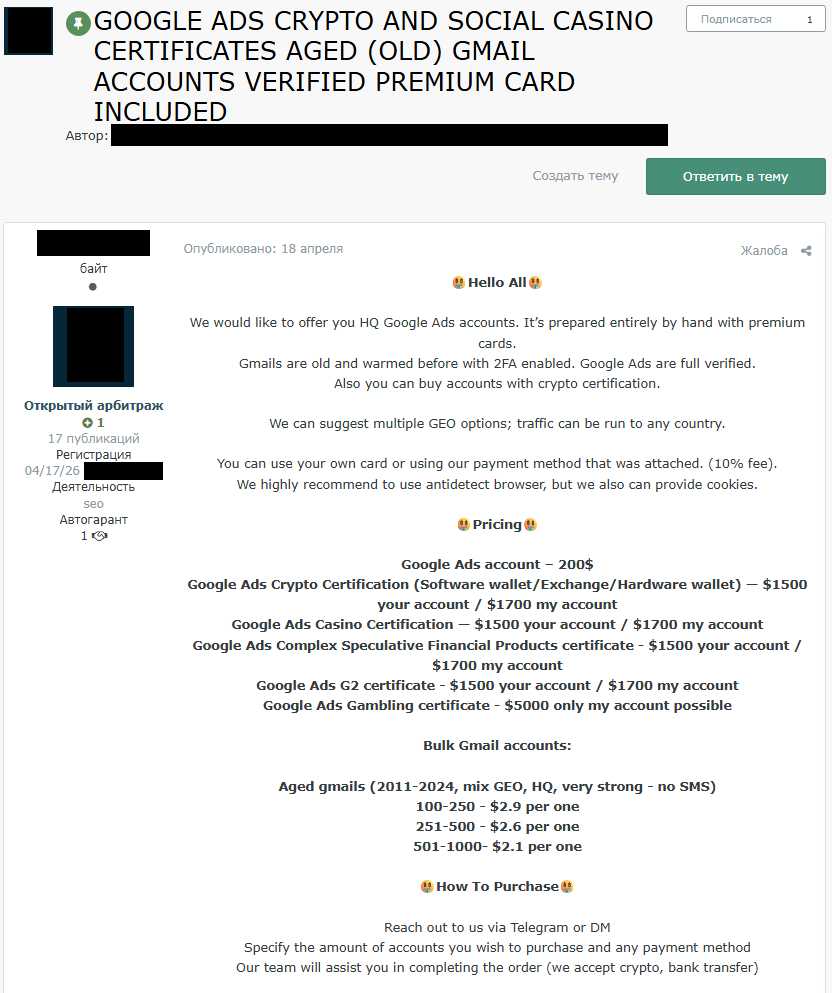
Figure 16 – Farmed Google Ads accounts advertised for sale on an underground forum.
Conclusion
The antidetect browser ecosystem represents a sophisticated, commercially mature, and increasingly AI-driven infrastructure that has fundamentally lowered the barrier to running scam and fraud operations, as well as coordinated inauthentic operations at scale. These commercially maintained tools are available in dozens of languages, backed by customer support teams, tested daily against the world’s largest social media platforms, and are now integrated with LLM pipelines that remove the human operator from the execution layer. The coupling of identity spoofing infrastructure, automated content distribution, and AI-assisted persona management represents a threat surface that platform detection systems may struggle to address, particularly in the context of elections taking place across multiple countries.
The infrastructure we documented is commercially available today. Its capabilities are not constrained by technical sophistication, national resources, or operational scale. The question is no longer whether these tools are being actively used for fraud, account takeover, and coordinated manipulation, but whether the detection, enforcement, and awareness frameworks across every layer of the ecosystem are prepared to counter them.
Recommendations
Security and threat intelligence teams:
- The detection priority should shift from the account and behavioral layer, where these tools are already designed to appear invisible, to the network and infrastructure layer.
- Indicators include residential proxy infrastructure operating at scale, WebRTC suppression patterns, anomalous cookie injection sequences, and known antidetect browser user agent strings in web traffic logs.
- Account warming patterns, simulated by these tools over several weeks, may be indistinguishable from legitimate organic behavior without cross-referencing device fingerprint consistency over time.
Social media platforms:
- Antidetectbrowser infrastructure should be treated as a first-class priority.
- The capabilities operate below existing detection thresholds, and infrastructure-layer signals may be the only reliable detection surface available.
- Platforms should consider actively acquiring and reverse engineering antidetect tools to map their proxy patterns, fingerprint rotation behaviors, and detection bypass mechanisms, and use those findings to recalibrate banning logic specifically against these tools’ TTPs.
CISOs and companies:
- The risk posed by antidetect browser infrastructure extends well beyond influence operations.
- Silent account takeover using cookie injection workflows can bypass multi-factor authentication without generating a login event.
- Organizations are advised to review whether their session monitoring infrastructure can detect pre-authenticated session anomalies, and to incorporate antidetect-specific attack scenarios into red team exercises and threat models.
- Threat actors can leverage antidetect browsers to replicate victim device fingerprints and geolocation to execute unauthorized transactions without triggering behavioral anomaly detection.
- Fraud detection systems that rely on device consistency and session continuity signals should be specifically reviewed for resilience against fingerprint spoofing and session injection at the identity infrastructure layer.
The post The Risk of AI-Powered Antidetect Browsers in Online Fraud and Influence Operations appeared first on Check Point Research.
Article Link: The Risk of AI-Powered Antidetect Browsers in Online Fraud and Influence Operations - Check Point Research