
Introduction to Malware Binary Triage (IMBT) Course
Looking to level up your skills? Get 10% off using coupon code: MWNEWS10 for any flavor.
Enroll Now and Save 10%: Coupon Code MWNEWS10
Note: Affiliate link – your enrollment helps support this platform at no extra cost to you.
TL;DR
- An OSINT framework is an operating model, not a toolset. It can include but is not limited to these four main pillars: data sources, technology capabilities, analytical methodologies and organizational structure.
- Cognyte’s Wide OSINT framework is based on decades of experience working with law enforcement agencies, intelligence agencies and governments. It extends beyond web data to a diverse array of Publicly Available Information and Commercially Available Information.
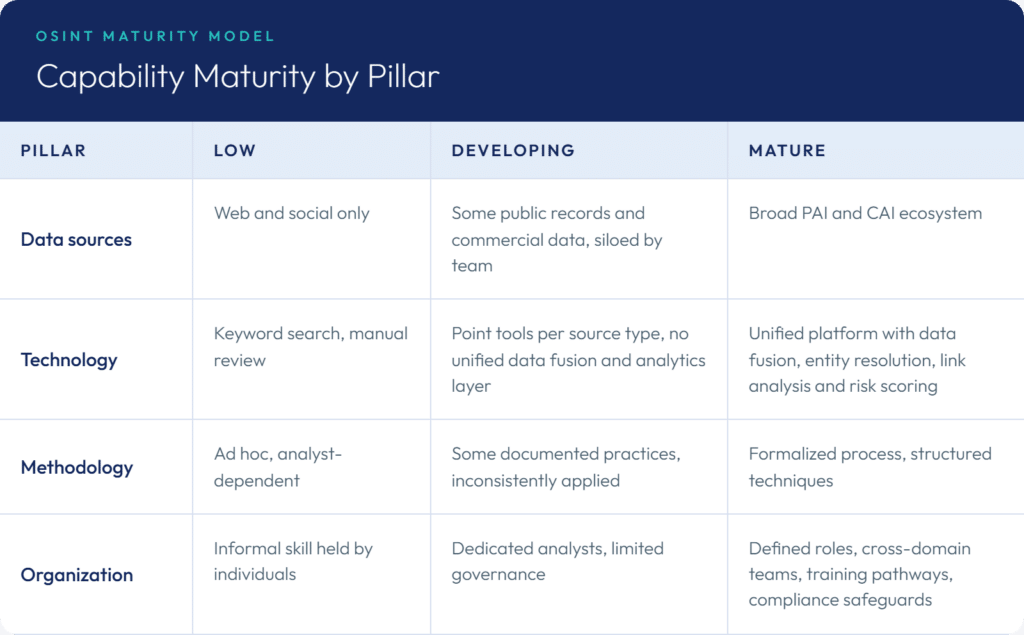
- Used as a maturity model, the four pillars let agencies benchmark each dimension as low, developing or mature and find where capability actually breaks down.
An OSINT framework is the operating model an agency uses to turn publicly available information into valuable intelligence. It defines which sources an agency analyzes, what technology is used, how analysts decipher the results and how the function is staffed and governed. This ultimately impacts how much value it provides to an agency’s investigations and intelligence analysis.
National security and intelligence organizations are combating terror threats and state-backed actors. Law enforcement agencies are investigating criminal networks, illicit trade and money laundering, while military intelligence units are analyzing border threats. All of these rely on open sources at some level. However, many agencies focus on the volume of data they analyze rather than the investigative questions they need to answer. They also tend to focus on web and social data while ignoring the wealth of other sources that hold valuable intelligence.
This article lays out Cognyte’s four-pillar Wide OSINT model covering data sources, technology capabilities, analytical methodologies and organizational structure, including a maturity benchmark for each pillar. Adopting this framework can help agencies improve their OSINT capabilities and establish a uniform framework to be used across all teams.
What does “Wide OSINT” mean?
Wide OSINT means working with the full range of open sources rather than the web-centric slice most programs default to. In practice, many agencies equate OSINT with web intelligence (WEBINT), analyzing social platforms, forums and messaging apps on a case by case basis.
Cognyte’s Wide OSINT approach differs from traditional WEBINT in three ways:
- Breadth: Wide OSINT works with all open sources rather than social media, the web and messaging platforms alone. Our approach reaches the financial, regulatory, media and geospatial data where critical signals often sit.
- Priority: Traditional approaches measure success by how much data is gathered, not by what is learned. Wide OSINT starts with the investigative or intelligence question and analyzes only the data relevant to answering it.
- Scope: A WEBINT only approach suits tightly defined short-term tasks such as verifying an online alias. Wide OSINT supports strategic and complex analysis, including helping to connect online suspect personas to real-world identities, activities and assets.
When agencies work on web and social sources alone, signals in corporate registries, judicial filings, sanctions databases, maritime and aviation tracking, commercial financial datasets and satellite imagery might not enter the picture. This means valuable clues and evidence may be missed. In a Wide OSINT approach, all open data sources can be relevant including:
- Commercial databases like Moody’s, LexisNexis, Dun & Bradstreet, etc.
- Publicly accessible intelligence databases and watchlists, such as OpenSanctions and Interpol Red Notices
- Public records, such as court filings, property records and business registrations
- Automatic Identification System (AIS) and shipping data
- News articles and media reports
- Government publications and white papers
- Academic research papers
Based on Cognyte’s decades of experience, the Wide OSINT framework was developed to help analysts with an approach that can support both tactical investigations and long-term strategic investigations.
The Four Pillars of Cognyte’s Wide OSINT Framework
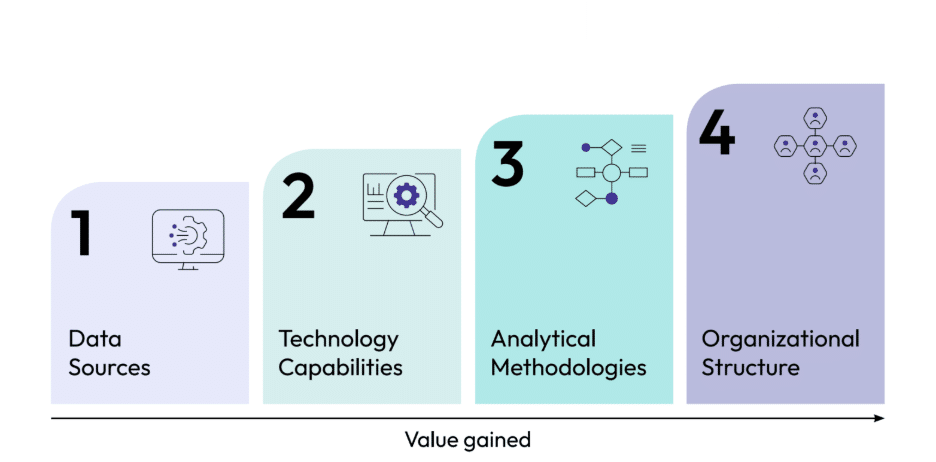
Cognyte’s Wide OSINT framework covers four areas, sequenced by the value each one adds: data sources, technology capabilities, analytical methodologies and organizational structure. Each pillar builds on the one before it, and the value compounds. Data creates reach, technology makes it usable, methodology turns it into intelligence and organizational structure sustains it.
Pillar 1: What OSINT data sources should a mature program use?
The first pillar is breadth of reach. A mature program draws from a wide range of sources rather than a single domain.
- Publicly Available Information (PAI) covers government records, corporate and beneficial ownership registries, judicial filings, sanctions databases and watchlists, property records, procurement data and flight or maritime tracking.
- Commercially Available Information (CAI) covers subscription financial and corporate databases, commercial satellite imagery and licensed datasets.
Web and social sources remain essential, including surface, deep and dark web content, messaging platforms and regional or non-English media.
The point of breadth is not volume. The sources an analyst or investigator accesses matter depending on the case.
The difference is:
- Relevance over reach. A sanctions investigation may focus on corporate registries and maritime tracking, while a public safety assessment focuses on local news and geolocated social content.
- Integrate broader datasets. Government records, corporate registries, commercial databases and geospatial feeds from PAI and CAI need to be part of the standing source base, providing a more complete picture on every case.
Maturity question: Are you drawing from three sources or thirty?
Pillar 2: What technology capabilities does Wide OSINT require?
The second pillar is the technology that makes it practical and feasible for a team to leverage a wide breadth of sources. Manual keyword searching does not scale past a handful of sources, and adding sources without adding processing capability simply moves the bottleneck onto the analyst.
The technology capabilities that matter here are the ability to process and analyze structured and unstructured data, AI-assisted translation for multilingual material, entity resolution, link and network analysis, anomaly detection and configurable risk scoring.
Entity resolution deserves particular attention, because it governs analyst productivity more directly than any other capability. Determining whether a name in a corporate filing is the same person as a near-identical name in a court record is foundational work, while doing it manually consumes hours that should go toward analysis.
Traditional OSINT tools are typically built for web and social media data, and are not designed to fuse or analyze communications, financial or geospatial sources. Decision intelligence platforms powered by AI are the layer where data fusion unifies open sources with other intelligence, and analytics are automatically applied across the combined data layer.
Even advanced SIGINT capabilities face capacity limits, particularly in foreign operations, and with most communications data now encrypted, extracting value from SIGINT requires network intelligence systems not every agency can access. A decision intelligence platform lets agencies work open sources alongside SIGINT in one environment rather than treating them as separate workflows.
Cognyte’s NEXYTE decision intelligence platform is designed to support modern Wide OSINT teams, shifting analysts from data wrangling to insight generation. The platform does this through automated entity resolution, link analysis, anomaly detection and customizable risk scoring, in a shared workspace where teams work investigations together.
Maturity question: Is your technology processing faster than your analysts can absorb, or slower?
Pillar 3: What OSINT methodology turns open source data into intelligence?
A mature OSINT methodology helps teams follow a standardized intelligence process based on best practices, rather than improvising with each investigation. It guides analysts through acquisition, processing, analysis and dissemination against defined requirements. The methodology incorporates structured analytic techniques, link analysis, geo-temporal correlation, timeline reconstruction and risk scoring. Analysts can then correlate findings across domains to test hypotheses rather than simply seek confirmation of an initial assumption.
Provenance validation matters more here than in any other discipline, because open material is actively seeded with false content, particularly on social platforms and leak sites. Confirming something across several different types of sources builds more confidence than digging deeper into one.
Output format matters too. Findings that reach decision makers as link charts, risk heatmaps and network visualizations get acted on. Raw source dumps do not.
Maturity question: Do analysts follow a repeatable methodology across every OSINT investigation, or does the analyst start from scratch for each investigation?
Pillar 4: How should an agency structure its OSINT function?
The fourth pillar is organizational and it’s where most programs fail, because tooling can be procured by agencies while structure has to be built.
A mature OSINT function requires defined roles rather than a skill a few analysts happen to have. It requires cross-domain teams spanning analysis, data engineering, subject-matter expertise and mechanisms for sharing findings across units rather than trapping them in individual cases.
The structure requires training pathways with defined skill expectations from beginners to experts. It should cover data acumen and technical aptitude alongside substantive, language and cultural knowledge. It requires legal, ethical and compliance safeguards, plus governance over data holdings. Both the US intelligence community and State Department INR (Bureau of Intelligence and Research) strategies treat governance and workforce development as first-order goals rather than supporting details, which is a strong signal for any agency building a program.
Finally, it requires the right success metrics. Programs measured by volume of data processed optimize for volume. Programs measured by insights delivered optimize for insight.
Maturity question: Is OSINT a function, or just something a few analysts are good at?
How mature is your OSINT framework?
Cognyte’s Wide OSINT framework doubles as a maturity model, letting agencies assess where their open source capability stands. Many agencies find they are mature in one or two areas and low in the rest, and the weakest pillar sets the ceiling for the whole program.
The most common imbalance is broad source access paired with limited technology. When an agency lacks automation and advanced analytics capabilities, adding more sources can overwhelm analysts with manual work without generating better insights for decision makers.
FAQs
What is the difference between OSINT and WEBINT?
WEBINT is web intelligence, the analysis of social media, forums, messaging platforms and web content. It is one part of OSINT, not a synonym for it. Agencies that treat the two as equivalent limit themselves to a narrow slice of open data and miss insights that can be found in financial, regulatory, geospatial and public record sources. Wide OSINT covers the full range of sources.
How do agencies keep Wide OSINT legally and ethically compliant?
Compliance is a structural question, not a case-by-case one. It requires legal, ethical and compliance safeguards built into the function, governance over which datasets are held and how they may be used, and centralized catalogs for PAI and CAI so licensing terms are known before data reaches an analyst.
Is an OSINT framework the same as the OSINT Framework tool directory?
No. The widely referenced OSINT Framework website is a categorized directory of free investigative tools. It is a useful reference for practitioners, but it is a resource index rather than an operating model, and it addresses none of the organizational, methodological or governance questions an agency has to answer.
Ready to build Wide OSINT capabilities?
Cognyte’s Wide OSINT framework gives agencies a way to evaluate their current open source capabilities, map which gaps exist and understand which technology capabilities they require to put it into practice.
Read The Power of Wide OSINT Analysis for the detailed framework, the agency types and use cases it applies to. Learn from 3 real cases where combining open sources broke investigations that single-source analysis could not.
Sources
The post The OSINT Framework Every Agency Needs: A Four-Pillar Model for Law Enforcement and Intelligence Agencies appeared first on Cognyte.
Article Link: https://www.cognyte.com/blog/osint-framework-four-pillar-model/