In the last few days of October 2025 in Asia, gift-giving between top political leaders has drawn a lot of attention—and laughter. One moment, which surprised many of us, was when Chinese President Xi Jinping showed humor during his gift exchange with South Korean President Lee Jae Myung. It is rare to see a Chinese leader “speaking off the cuff in public.” On this occasion, President Xi joked about backdoors in cellphones—yes, backdoors that can monitor or access the information in mobile devices.
During his first state visit to South Korea after 11 years, Xi presented two Chinese-made Xiaomi brand smartphones—the world’s third-largest smartphone brand—to South Korean President Lee Jae Myung. When Lee asked delightedly about the quality of communication and the security of the phone, Xi smiled and said, “You can check if there is a backdoor.”
President Xi is undoubtedly fully aware that the United States and its allies have warned that Chinese technology may contain backdoors—what the US National Institute for Standards and Technology defines as “undocumented ways of gaining access to a computer system.” These could be used for data collection, espionage, and surveillance. However, this time Xi laughed it off with the South Korean president, implying that it is an open secret that countries spy on each other. As a declassified 1986 CIA document says, “Spying on Allies – It’s a Tradition.”
In fact, five years ago in 2020, some researchers did check Xiaomi smartphones and discovered one model collecting excessive amounts of data. Rather than a phone with backdoors, “It’s a backdoor with phone functionality,” one researcher put it.1
Xi’s humor regarding Xiaomi’s backdoor reminds us of another case from five years ago involving a Chinese multinational electronics company—TCL, the world’s second-largest TV manufacturer. In 2020, two vulnerabilities were discovered in TCL Android TVs by an Australian security researcher, hacker, and freelance developer nicknamed Sick Codes. Acting Secretary of U.S. Homeland Security Chad Wolf called out the issue in December 2020, stating that “TCL incorporated backdoors into all of its TV sets, exposing users to cyber breaches and data exfiltration,” implying intentional action by TCL.2
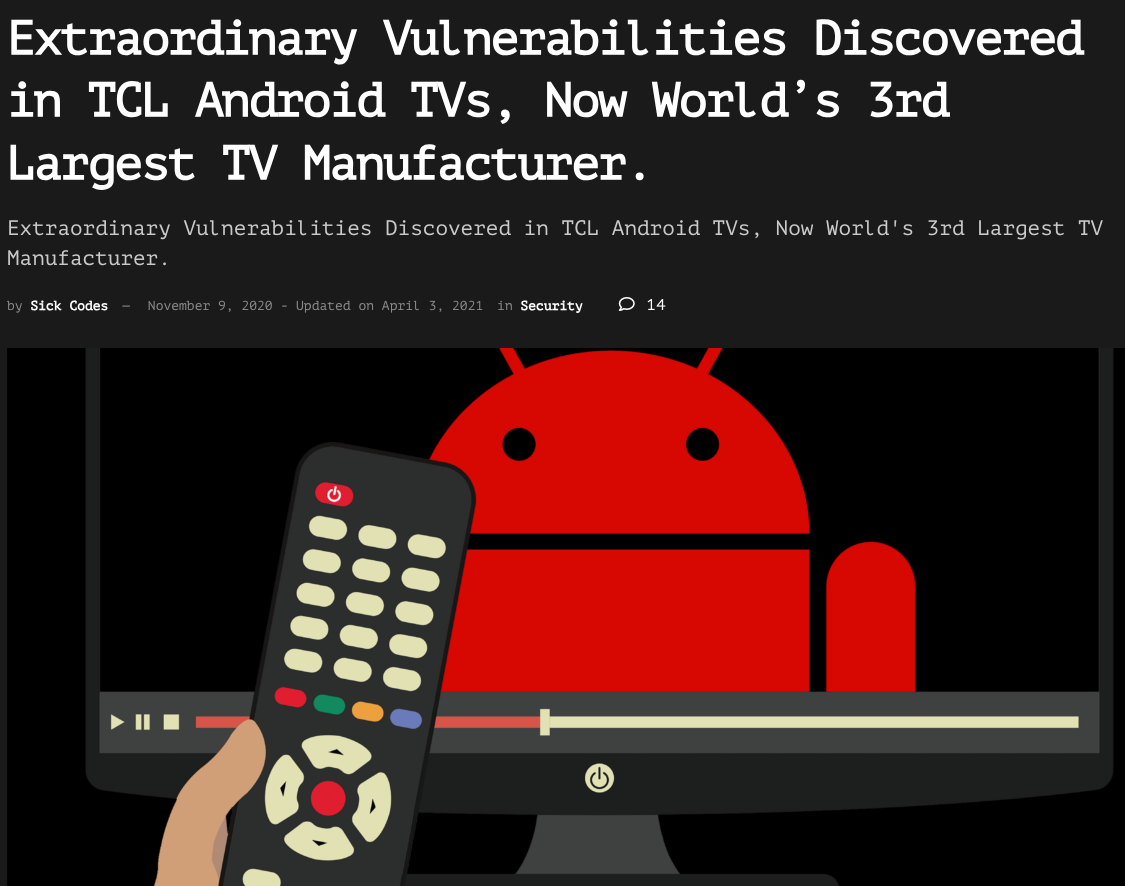
For the present report, the Natto Team had the opportunity to discuss the TCL backdoor incidents with Sick Codes. Sick Codes’ first-hand experience—from discovering the two vulnerabilities in TCL Android TVs to reporting them to the company, and the incident being reported worldwide before the company could address it—is enlightening for understanding a key milestone in how the Chinese state manages vulnerabilities.
From the Natto Team’s perspective, the 2020 TCL backdoor incident seems to have had a profound impact on the Chinese government and on Chinese companies with a global presence. The incident arguably taught them how to handle vulnerabilities in their products exposed by overseas independent researchers. It also drove home to them the importance of harnessing and nurturing the skills of their own vulnerability researchers. Most importantly, a year after the TCL backdoor incident, in September 2021, China implemented its “Regulations on the Management of Network Product Vulnerabilities,” which require companies to report vulnerabilities to the Chinese Ministry of Industry and Information Technology (MIIT) within forty-eight hours of discovery. According to Microsoft’s 2022 Digital Defense Report, the regulations allegedly “might enable elements in the Chinese government to stockpile reported vulnerabilities toward weaponizing them.” The Natto Team has reported here, here and here on how the Chinese state approach to vulnerability researchers has evolved. The 2020 TCL backdoor incident may be a key piece that helps us understand the puzzle of changing Chinese policies.
Many subscribers and readers of Natto Thoughts often consider our research and analysis as an enjoyable story time. Some even suggest getting popcorn ready for reports from Natto Thoughts. If that’s the case, this piece deserves a bucket full of popcorn. We guarantee it.
CVE-2020-27403: When a Good-Faith Hacker Runs Into a Black Hole
In September 2020, Sick Codes was doing what he does best—researching security flaws in TV sticks, small portable devices that plug into TVs’ HDMI ports to make them “smart” by connecting to WiFi and running an operating system to access streaming services. While working on this project and finding “how dismal the security was on these devices,” Sick Codes wondered, “What is so special about Android Smart TVs?” He didn’t actually own an Android TV, but one of his friends had a TCL Android Smart TV. It was the first time Sick Codes had heard of TCL. Later, he realized that TCL was the world’s third-largest TV manufacturer that year.
On October 16, 2020, when Sick Codes got his hands on the TCL Android TV, he was surprised by what he saw. An Nmap scan discovered 14 open TCP (Transmission Control Protocol) ports. An “open port” in an Nmap scan means a service is actively listening and accepting connections on that port. “Why does a TV need so many open ports?” Sick Codes wondered. Further testing revealed that the entire file system of the TV was downloadable as a web service—“What kind of manufacturer publishes the whole file system of a device?”
Sick Codes immediately recognized this as a system vulnerability in the TCL Android TV. On October 17, he drafted the first CVE Request and sent it to the MITRE Corporation, which manages the Common Vulnerability and Exposures (CVE) List. Meanwhile, he sent a copy of the draft advisory to TCL’s [email protected] email address, requesting confirmation of receipt, but the email bounced. Sick Codes then submitted a contact form via TCL’s website, requesting immediate support and escalation to the security department. Little did he expect it would be almost impossible to get TCL’s attention regarding the vulnerability. From October 16 to October 26, Sick Codes contacted TCL through:
Direct messaging to TCL’s Twitter (now X) accounts
The Live Chat function of TCL’s customer support
Calling Customer Support and requesting to forward the report to TCL’s security or engineering team
Posting on https://community.disclose.io to ask for contact with TCL’s security team. John Jackson, a researcher with Shutterstock, replied and joined the effort
Sending emails to TCL’s security team
Forwarding emails to TCL’s Customer Privacy team
Forwarding emails to TCL’s partner
At one point, Sick Codes wrote an email to TCL stating that “We are not interested in bug bounty money,” but that he needed their attention to the vulnerability. In the end, it took 13 days for TCL to reply to the initial report from Sick Codes and two weeks to confirm receipt of the security report.
CVE-2020-28055: TCL Said They Fixed It, but Another Vulnerability Was Found
When TCL confirmed receipt of Sick Codes’s advisory report, its security team also stated that the vulnerability had been fixed on October 29, 2020. This was striking to Sick Codes. It meant that TCL did a “silent patch” without any notification, alert or request for user authorization. He asked: Why did it take two weeks to reply, and how was it so easy to fix? Would the TV function as expected without this overly permissive directory allowing anyone on the same network to download files from the TV?
With these questions in mind, later the same day, Sick Codes searched for the specific changes made by the TCL Security team. This time, he discovered that several critical files within the TV file system were writable by arbitrary users or potentially malicious apps or APKs (Android Package Kits), which could perform fake system upgrades. Sick Codes then notified TCL that he had found a second vulnerability.
When Two Vulnerability Discoveries Become a TCL Backdoor Incident: Market Share Dropped 15 Percent
After finally reaching TCL at the end of October 2020, Sick Codes actively communicated with the TCL Security Team about his research, explaining the two vulnerabilities and the disclosure process, and requesting fixes. However, the responses from TCL were inconsistent.
Finally Sick Codes went public, publishing his story about the vulnerabilities in TCL Android TVs on November 9, 2020. He also disclosed the two vulnerabilities through the MITRE Corporation on November 10, 2020. Soon, media reports picked up the story with headlines like “TCL Android TVs may have ‘Chinese backdoor’—protect yourself now,” and “TV maker TCL denies back door, promises better process.”
The incident quickly escalated. On December 21, 2020, Acting US Department of Homeland Security (DHS) Secretary Chad F. Wolf gave a speech about the China challenge at a think tank event. Wolf mentioned, “DHS is reviewing entities such as the Chinese manufacturer TCL,” which “illicitly collect data on American consumers or steal intellectual property.” After Wolf’s speech, TCL’s stock price plummeted nearly 15 percent in one day.
A Cruel Wake-Up Call for TCL
For TCL, as the world’s third-largest TV manufacturer in 2020, any event that shakes its stock price and market share can be devastating. To save the market, two days after Acting DHS Secretary Wolf’s speech, TCL’s Chairman of the Board and Executive Director spent his own money to buy up stock, increasing his holdings by 2 million shares. The stock price rebounded by 4 percent. Although the stock price may have stopped dropping, the TCL backdoor incident seems to have had a profound impact on Chinese companies aiming to expand their global market. Following the incident, TCL established the TCL Security Response Center (SRC) in March 2021. Sick Codes commented that the TCL SRC now has “one of the most comprehensive Bug Bounty programs I’ve seen.”
A research presentation on the TCL backdoor incident from Hainan University Belt and Road Research Institute (海南大学一带一路研究院), shared with the Natto Team by Sick Codes, confirms China’s lessons learned from the incident. The Hainan University Belt and Road Research Institute, established in 2019, is a think tank ranked among the top three research institutes focusing on China’s Belt and Road Initiative, a global infrastructure development strategy. Specifically, the institute’s International Data and Public Opinion Research Center (国家数据与舆论研究中心) conducted the research. This research center was founded in January 2021, on the heels of the TCL revelation, suggesting that its founders realized the importance of global public opinion for the international reputation—and market share—of Chinese companies. The center claims to have provided research reports to China’s State Council, the General Office of the Chinese Communist Party (CCP) Central Committee, the Ministry of Foreign Affairs, the Permanent Mission of China to the United Nations, and other state and Party organizations. They also share their products with the China bureau of the Financial Times (FT). An FT journalist put Sick Codes in contact with a researcher at the center.
The researcher, Hu Rong (胡蓉), interviewed Sick Codes on March 31, 2021. She sent Sick Code her Powerpoint report in April. Her report provided a clear timeline of the incident, from Sick Codes’ starting his TCL research in September 2020 to his praise for the impressive TCL Security Response Center. Then Hu Rong analyzed how the incident escalated to a crisis that led to the US DHS “accusing TCL of incorporating backdoors into all its TVs.” Hu Rong enumerated key problems that TCL failed to address or understand:
Slow Initial Response: TCL reacted sluggishly in the early stages; frontline personnel failed to recognize the severity and did not escalate to senior management.
Poor Communication: Internal and external communication was disorganized, lacking clear objectives and unified execution.
Underestimation of Independent Researchers: TCL severely underestimated the professional capabilities and public influence of “white hat hackers” and independent security researchers.
Lack of Established Response Mechanisms: TCL lacked proper channels for engaging with third-party security researchers, unlike most major international tech companies that have established bug bounty programs at the time of the report.
Inadequate External Situation Assessment: TCL failed to promptly clarify and respond to sensitive terms like “backdoor,” at a time of of U.S.-China tech decoupling–the process of reducing the economic and technological interdependence between the two countries–and Western suspicion of Chinese tech companies,
Missed Opportunity: Sick Codes reached out on October 16 (two months before the DHS statement) offering to delay public disclosure to give TCL time to fix the issue, but TCL’s inadequate response wasted this goodwill.
Narrative Control Failure: Vague, non-technical terms like “backdoor” with strong negative implications became difficult to counter once amplified in media coverage.
Overall, the report concluded with lessons learned and response strategies from both technical and strategic perspectives:
Technical:
Improve product quality and supply chain resilience
Enhance cybersecurity R&D and response capabilities
Establish comprehensive internal organizational structures and crisis management coordination mechanisms
Strategic:
Better assessment of big-picture and small-scale situations
Analysis of overseas market public opinion and policy trends
Research and relationship-building with Expert Opinion Leaders (EOLs) across relevant fields
Develop influence strategies
Impact on the Ecosystem: The Story Continues
At this point, the Natto Team cannot determine whether the TCL backdoor incident research report from Hainan University Belt and Road Research Institute ever reached top officials of the CCP and Chinese government. However, after a thorough search, we could not locate the research presentation or report on the Hainan University website or any other Chinese websites, despite evidence of its existence. Nevertheless, we have traced some subsequent actions stemming from the TCL backdoor incident.
Lists of Cybersecurity Influencers
Natto Team research uncovered a report co-authored by researcher Hu Rong and published on April 22, 2021, a month after her interview of Sick Codes. The April report is titled “Big Data Analysis: Who Poses the Greatest Cybersecurity Threat to China’s Technology Companies Internationally?” It examines the international cybersecurity landscape facing Chinese technology companies by identifying and analyzing key influential figures in the global cybersecurity community who could potentially impact Chinese tech firms’ security and reputation. The report mentions the TCL backdoor incident as part of the context of the problem. Drawing on international media reports and data from Twitter (now X) users and applying social relationship analysis models, machine learning, and sentiment analysis tools, the report complies two lists — “International Cybersecurity Influential Figures 500” and “International Core Cybersecurity Influential Figures 100”—and enumerates five categories of key figures:
Media reporters and authors
Independent technical researchers and “white hat hackers”
Think tank researchers and scholars
Corporate executives
Freelance cybersecurity enthusiasts
To illustrate, the report lists two to three names in each category as samples. All the sample names are well-known experts in the field: Brian Krebs, Kim Zetter, Cory Doctorow, Chareles Miller, Adam Segal, Richard Bejtlich, Katie Moussouris, Jeff Moss, Graham Cluley, Victor Gevers, Matt Tait, Naomi Wu, Graham Cluley, and Kevin Mitnick. Because “cybersecurity has become a primary battleground in international geopolitics and the tech cold war,” the report further emphasizes the importance of “understanding and monitoring” these influential cybersecurity figures for:
Early warning of potential threats
Understanding global cybersecurity trends ahead of mainstream media
Risk management and reputation protection
Proactive crisis prevention
Obviously, China now understands the importance of the professional capabilities and public influence of “white hat hackers” and independent security researchers internationally—enough to compile a list of them. The Chinese government has an incentive not only to monitor these experts but also to gain them as allies in improving the security of Chinese products and portraying Chinese efforts in a positive light.
The Vulnerability Management Regulations and Focus on Vulnerability Research for Domestic Products
In a previous report, drawing on over a year of research, the Natto Team highlighted emerging trends in China’s vulnerability research ecosystem in the past two years. These include:
A more structured and diverse ecosystem
Domestic hacking contests with prize pools that surpass those of their Western counterparts
A growing emphasis on finding vulnerabilities in Chinese, rather than just foreign, products
As to why we have seen the gradual shift toward probing the security of Chinese-made products, we assessed two likely motives: strengthening the security of domestic products as part of the shift away from reliance on U.S. technologies, and leveraging vulnerabilities in Chinese products for domestic law-enforcement operations. The 2020 TCL backdoor case provides another insight into this shift.
Chinese companies learned that the discovery of vulnerabilities in their products—whether these were intentional “backdoors” or inadvertent technical flaws—could hurt their reputation, market share, and profitability, and leave them caught in the crossfire of US-China tensions. Therefore, knowing your own products’ vulnerabilities is crucial. The Chinese government also learned the importance of nurturing China’s own vulnerability researchers; the Natto Team has documented efforts along those lines here and here.
Finally, the Chinese government recognizes the importance of controlling information about vulnerabilities, not only to manage Chinese companies’ security improvements but also potentially to use them offensively. The Natto Team assesses that the 2020 TCL backdoor case is likely one of the catalysts that prompted the 2021 vulnerability management regulations that required Chinese researchers to report vulnerabilities promptly to the Chinese government.
Final note—we asked Sick Codes: “Do you think TCL purposely left the ‘backdoors’ or were they just software flaws?” “Software flaws,” Sick Codes answered. Although whether something is a “backdoor” or a “vulnerability” is sometimes debatable, Sick Codes added. He summarizes his opinion as, “A door in the back of a product is a backdoor. It’s open to anyone who has found it, intentionally or unintentionally.”
Natto Thoughts is a reader-supported publication. Your paid subscription supports access for all and serves as a token of appreciation for the efforts of the Natto Team.
The Trump administration initially blacklisted Xiaomi products but the company successfully sued to remove it from the blacklist. See the New York Time report here.
A vulnerability is a flaw, weakness, or misconfiguration in software, hardware, or process that can be exploited to compromise confidentiality, integrity, or availability. A backdoor is a deliberately introduced method or mechanism that allows unauthorized access to a system, bypassing normal authentication or controls. One can be unintentional, and the other is intentional. All backdoors are vulnerabilities, but not all vulnerabilities are backdoors.
Introduction to Malware Binary Triage (IMBT) Course
Looking to level up your skills? Get 10% off using coupon code: MWNEWS10 for any flavor.
Enroll Now and Save 10%: Coupon Code MWNEWS10
Note: Affiliate link – your enrollment helps support this platform at no extra cost to you.
Article Link: What a “Narrative Control Failure” Taught the Chinese Government About Managing Vulnerabilities and Vulnerability Researchers