4EverAble2Shell is an N-central zero-day exploit chain that lets an unauthenticated remote attacker run commands as root on an on-premises N-able N-central server. An independent researcher released a proof of concept (PoC) early on November 12, 2026, and attackers used it to install cryptocurrency miners on at least 21 servers within hours.
Introduction to Malware Binary Triage (IMBT) Course
Looking to level up your skills? Get 10% off using coupon code: MWNEWS10 for any flavor.
Enroll Now and Save 10%: Coupon Code MWNEWS10
Note: Affiliate link – your enrollment helps support this platform at no extra cost to you.
The chain works against fully patched servers when the Legacy API is turned on and reachable from the internet. N-able is restricting some N-central features while it develops further remediation.
Key Takeaways
- Root without credentials: 4EverAble2Shell gives unauthenticated attackers root on on-premises N-able N-central servers that have the Legacy API enabled and exposed to the internet
- Hotfix 2 does not stop it: 19 of the 21 compromised servers identified on November 12, 2026, were already running N-central 2026.4 Hotfix 2
- No fix yet: N-able has not released a build that fixes the chain; disabling the Legacy API is the main control
- Agent2Shell raises the stakes: A companion exploit set targets managed Windows endpoints with SYSTEM-level command execution, though no exploitation of it has been reported
| Attribute | Details |
|---|---|
| CVE ID | No CVE for the N-central chain; first stage linked to CVE-2026-90436 (Apache Axis 1.x) |
| CVSS | 9.8 (CVSS v3.1, CISA ADP) for CVE-2026-90436; no official score for the full chain |
| Affected Products | N-able N-central, on-premises, with the Legacy API enabled and internet-facing |
| Affected Versions | Confirmed on 2026.4 Hotfix 2 (build 2026.4.1.26) and build 2025.3.1.9; full range not published |
| Fixed In | None |
| Exploitation Status | Exploited in the wild since November 12, 2026 (cryptomining) |
| Patch Available | No; disable the Legacy API |
| Discovered By | Chain: Sean Bales (independent researcher); Apache Axis flaw: José Apari-Pantigozo (OKIOK) |
What Is 4EverAble2Shell?
4EverAble2Shell is a two-stage exploit chain against N-able N-central, the remote monitoring and management (RMM) platform many managed service providers use. An unauthenticated attacker who can reach the server gains command execution as root. Researcher Sean Bales published it early on November 12, 2026, as a follow-up to his earlier “Able2Shell” disclosure.
How Does 4EverAble2Shell Relate to Able2Shell and Hotfix 2?
Able2Shell came first. Bales published 33 critical N-central flaws, and on November 9, 2026, N-able took hosted N-central offline in response. N-able then released N-central 2026.4 Hotfix 2 (build 2026.4.1.26) on November 10, fixing seven CVEs. Two days later, Bales released 4EverAble2Shell, which works against servers running Hotfix 2.
Which CVE Is Behind 4EverAble2Shell?
No CVE covers the N-central chain as a whole. The first stage is tied to CVE-2026-90436, a critical flaw in the end-of-life Apache Axis 1.x SOAP engine, disclosed on November 6, 2026. The second stage, a local privilege escalation in N-central, has no CVE as of yet.
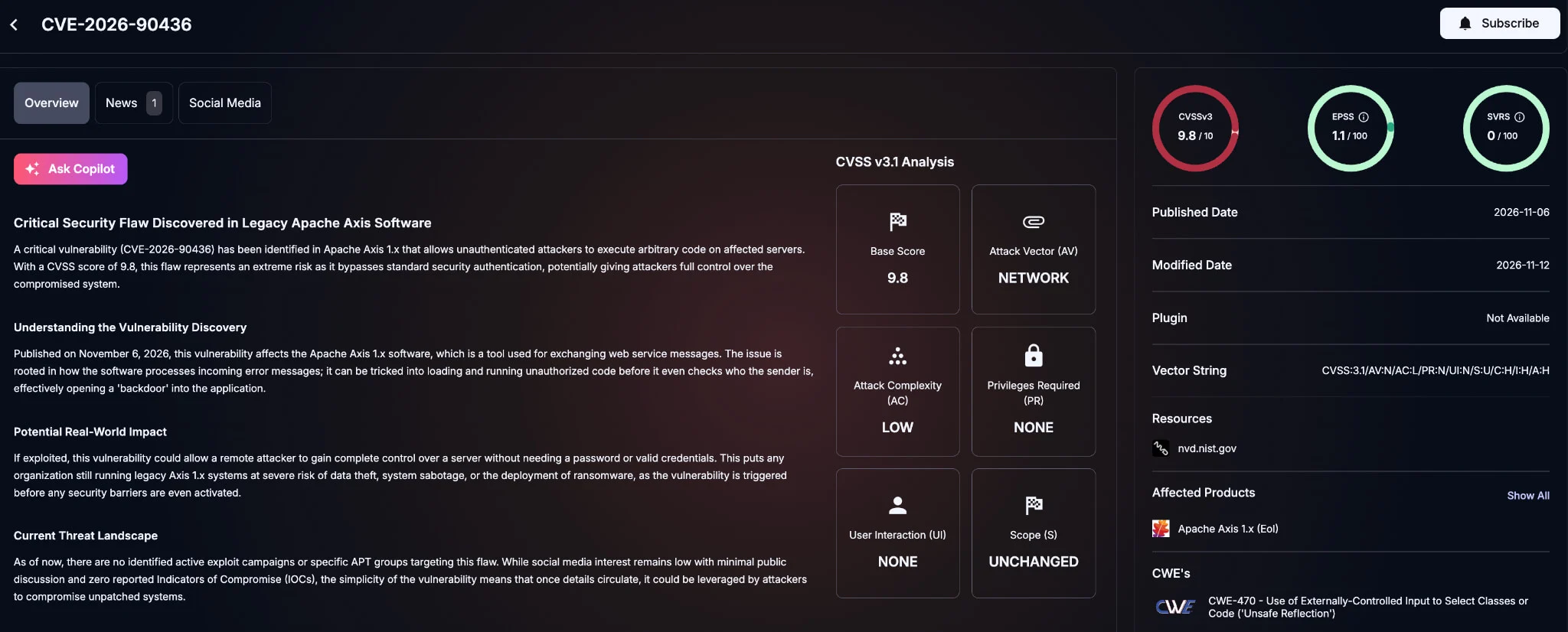 SOCRadar Vulnerability Intelligence card for CVE-2026-90436
How Does the 4EverAble2Shell Exploit Chain Work?
The attack has two steps. First, a crafted SOAP fault sent to the bundled Apache Axis component makes it load a Java class named by the attacker, giving command execution as the low-privileged nable service account. Second, a weakness in an N-central helper script escalates that access to root. CVE-2026-90436 alone does not grant root.
Which N-central Deployments Are Affected?
N-able says the server attack requires a non-default configuration: the Legacy API must be enabled and exposed to the public internet. The Legacy API is off by default, and N-able does not recommend enabling it. Version alone does not determine exposure, because compromised servers ranged from build 2025.3.1.9 to Hotfix 2.
| Deployment | Status |
|---|---|
| On-premises, Legacy API enabled and internet-facing | Exposed, including servers on Hotfix 2 |
| On-premises, Legacy API disabled | Not exposed to the server chain, per N-able |
| Hosted N-central | Not affected by the server chain, per N-able |
| Managed Windows agents (Agent2Shell) | Under assessment |
Are N-able Hosted N-central Customers Affected?
N-able says hosted N-central is not affected by the 4EverAble2Shell server chain. The Legacy API is off by default on hosted servers, and as a precaution N-able has turned off the Microsoft Intune integration there while it validates additional protections. Hosted customers still need to upgrade their N-central agents and probes, and should watch N-able’s status page for restored features.
Does Hotfix 2 Protect N-central Against 4EverAble2Shell?
No. Hotfix 2 fixes seven earlier CVEs, but 19 of the 21 compromised servers identified on November 12, 2026, were running build 2026.4.1.26. Researchers who tracked the attacks state plainly that applying Hotfix 2 is not enough on its own. Servers should stay on Hotfix 2 and also have the Legacy API disabled.
Is 4EverAble2Shell Being Exploited in the Wild?
Yes. Sensors logged exploitation attempts from 08:24 UTC on November 12, and one honeypot captured a full chain at 09:16 UTC. By 12:50 UTC, a mining pool listed 21 rigs named after N-central servers, located in the United States, South Africa, Canada, the UK, Germany, France and Sweden.
What Are Attackers Installing on Compromised N-central Servers?
The only payload seen so far is the XMRig Monero miner. Attackers download a shell script named jup.sh, install the miner with systemd or cron persistence and limit it to half of the CPU cores to avoid notice. Root access to an RMM server allows far more than mining, so a match should be treated as a full compromise.
Is 4EverAble2Shell a Zero-Day?
Yes. Attackers exploited 4EverAble2Shell within roughly five hours of the public proof of concept, and N-able had no fix available then or as of November 13, 2026. Exploitation of a flaw before the vendor ships a patch meets the zero-day definition, regardless of how the vendor labels the issue.
What Is Agent2Shell?
Agent2Shell is a companion exploit set released alongside 4EverAble2Shell. It bundles more than ten zero-days that, per the researcher, let an attacker run commands as NT AUTHORITY\SYSTEM on Windows endpoints managed by an N-central agent. One report says the attacker must know the target appliance ID. No Agent2Shell exploitation has been reported for now.
Is 4EverAble2Shell in CISA’s KEV Catalog?
Not yet. The N-central chain has no CVE, which CISA requires for a Known Exploited Vulnerabilities entry, and CISA has not announced an addition for CVE-2026-90436. Earlier N-central flaws, including CVE-2026-18556, were added to KEV in August 2026 after exploitation.
What Indicators of Compromise Should Defenders Look For?
Researchers published network, file, persistence and process indicators from the observed attacks, and N-able said that it had identified additional indicators and is working with affected customers. A missing match does not prove a server is clean.
Network:
- 157.20.241[.]16 (ports 8080 and 19202 to 19418)
- 139.99.69[.]109:10128
- 79.76.51[.]56:39100
Web requests:
- POSTs to /dms/services/ServerUI carrying a SOAP fault with an exceptionName field
- User agent python-requests/2.31.0
Files:
- /tmp/.xvd or /var/tmp/.xvd
- serverchild-* files in /var/opt/n-central/tmp/
- /var/opt/n-central/flag/flag_default.json as a symlink
Persistence:
- /etc/systemd/system/xvd.service
- /etc/cron.d/xvd
- Crontab line ending in # xvkeep
Process:
- Command lines containing –rig-id nc_ or –donate-level 1
SHA-256:
- fc4c01fd11bc301cf312830460cfdccc3af9dcfe50c910b86d6a1117bc76c747 (privilege escalation script)
What Should Teams Do If an N-central Server Matches These Indicators?
Treat the server as fully compromised, not as a cleanup job. Isolate it, preserve logs and disk evidence, then rebuild from a known-good installation. Rotate every credential stored in or used by N-central, and review managed endpoints for new admin accounts, tasks, scripts and remote sessions since November 11, 2026, or since November 8 for servers not on Hotfix 2.
How Do Administrators Disable the N-central Legacy API?
N-able has published knowledge base steps for turning off the Legacy API on on-premises servers, available through its customer support portal and status page. After disabling it, confirm the change took effect and check that integrations relying on the old API have alternatives, since N-able expects some functionality to be affected.
What If the Legacy API Cannot Be Disabled Right Away?
Take the server off the internet as a short-term measure. Put the N-central web and SOAP endpoints behind a VPN or trusted management network, but do not rely on IP allowlisting alone. Monitor for POSTs to /dms/services/ServerUI containing SOAP faults, and hunt for the published indicators until the Legacy API is off.
Should Windows Endpoints Managed by N-central Be Checked?
Yes, especially behind any server that was exposed. Review SYSTEM-level PowerShell with encoded commands launched by the N-able agent, unexpected changes to the Windows Software Probe binaries or service, and new admin accounts since November 11, 2026. Encoded agent PowerShell is common in normal RMM use, so treat it as a lead.
What Should N-central Customers Do Right Now?
- Disable the Legacy API: Follow N-able’s guidance on every on-premises server; this removes exposure to the known server chain
- Cut internet exposure: Put N-central web and SOAP endpoints behind a VPN until a fixed build is available, without relying on IP allowlisting alone
- Keep Hotfix 2 in place: Stay on build 2026.4.1.26 and upgrade agents and probes, while remembering that it does not stop 4EverAble2Shell
- Hunt on every exposed server: Check for the network, file, persistence and process indicators listed above before assuming a server is clean
- Rebuild compromised servers: Reinstall from a known-good build and rotate all credentials stored in N-central
- Review managed endpoints: Look for new accounts, tasks and remote sessions created since November 11, 2026, or since November 8 behind servers that were not on Hotfix 2
- Track N-able’s status page: Watch for the follow-up fix and for restored hosted features such as the Intune integration
How Can SOCRadar Help Track N-central Exposure?
Protecting RMM infrastructure starts with knowing which management consoles are exposed and which threats need immediate attention. Here’s how SOCRadar can help:
- SOCRadar Exposure Management helps teams find internet-facing N-central servers and other RMM consoles across their own estate or their MSPs’ infrastructure.
- SOCRadar Cyber Threat Intelligence tracks new exploits, KEV changes and vendor updates for 4EverAble2Shell as they appear.
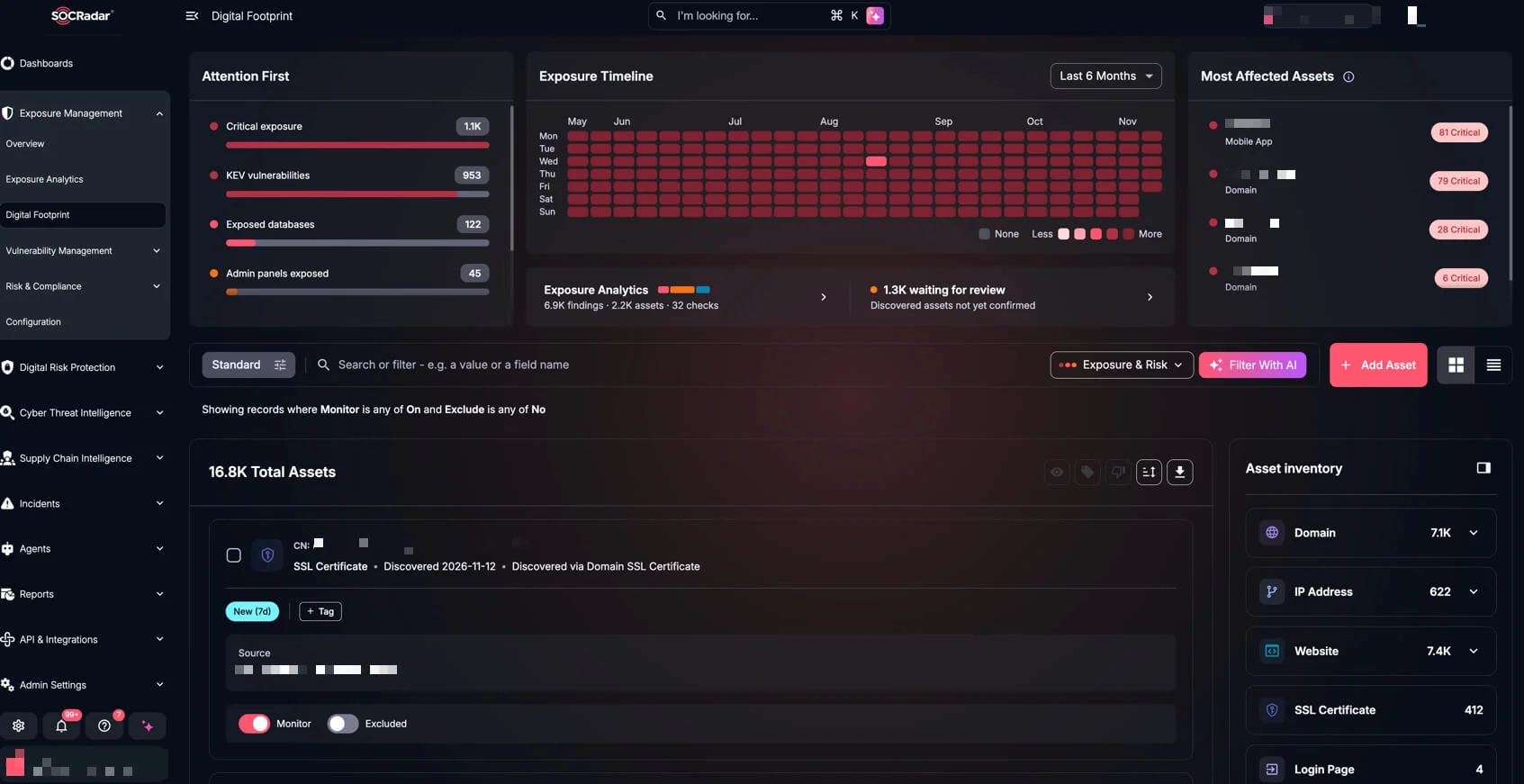 Digital Footprint, SOCRadar Exposure Management module
Together, these capabilities help teams prioritize exposed systems for investigation and keep remediation decisions informed as the threat evolves.

Article Link: https://socradar.io/blog/4everable2shell-at-a-glance/