Introduction
Earlier this evening I saw a tweet appear which claimed Monero has been hacked and a malicious binary (instead of the real one) has been served:
Warning Monero users: If you downloaded Monero in the past 24 hours you may have installed malware. Monero's official website served compromised binaries for at least 30 minutes during the past 24 hours. Investigations are ongoing. https://t.co/geqA4dIPar— dark.fail (@DarkDotFail) November 19, 2019
Post on Reddit:
https://www.reddit.com/r/Monero/comments/dyfozs/security_warning_cli_binaries_available_on/
Github issue:
https://github.com/monero-project/monero/issues/6151
Linux binary
Thanks to user nikitasius I was able to retrieve the malicious binary:
https://github.com/monero-project/monero/issues/6151#issuecomment-555511805
This binary is an ELF file with the following properties:
The seed will be sent to: node.hashmonero[.]com.
cryptonote::simple_wallet::send_to_cc
As you may have guessed, this will send data off to the CC or C2 (command and control) server - this will be stolen funds.
Sending funds to the C2 is handled using an HTTP POST request to the following C2 servers:
As far I can see, it doesn't seem to create any additional files or folders - it simply steals your seed and attempts to exfiltrate funds from your wallet.
Windows binary
The C2 server 45.9.148[.]65 also hosts a Windows binary with the following properties:
The Windows version is essentially doing the same things as the Linux version - stealing your seed and wallet funds - the function names are just different, e.g. _ZN10cryptonote13simple_wallet9send_seedERKN4epee15wipeable_stringE.
Detection
Monero team statement
The Monero team has issued a statement as follows:
Warning: The binaries of the CLI wallet were compromised for a short time:
On AlienVault:
https://www.reddit.com/r/Monero/comments/dyfozs/security_warning_cli_binaries_available_on/
Github issue:
https://github.com/monero-project/monero/issues/6151
Linux binary
Thanks to user nikitasius I was able to retrieve the malicious binary:
https://github.com/monero-project/monero/issues/6151#issuecomment-555511805
This binary is an ELF file with the following properties:
- MD5: d267be7efc3f2c4dde8e90b9b489ed2a
- SHA-1: 394bde8bb86d75eaeee69e00d96d8daf70df4b0a
- SHA-256: ab9afbc5f9a1df687558d570192fbfe9e085712657d2cfa5524f2c8caccca31
- File type: ELF
- Magic: ELF 64-bit LSB shared object, x86-64, version 1 (GNU/Linux), dynamically linked (uses shared libs), for GNU/Linux 3.2.0, from 'x)', not stripped
- File size: 27.63 MB (28967688 bytes)
When comparing the legitimate file and this ELF file, we notice the file size is different, and a few new functions have been added:
cryptonote::simple_wallet::send_seed
This function is immediately called after either opening or creating a new wallet, as can be seen in Figure 1 and 2 below.
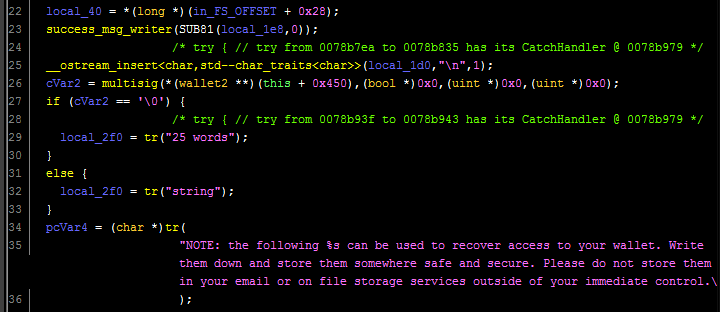 |
| Figure 1 - Create wallet (legitimate) |
 |
| Figure 2 - Call new seed function |
The seed will be sent to: node.hashmonero[.]com.
cryptonote::simple_wallet::send_to_cc
As you may have guessed, this will send data off to the CC or C2 (command and control) server - this will be stolen funds.
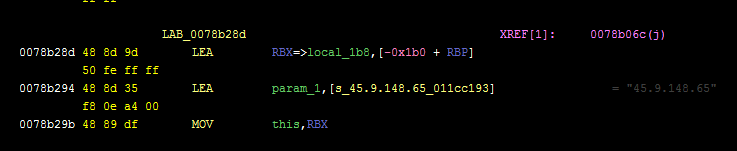 |
| Figure 3 - Send to cc |
Sending funds to the C2 is handled using an HTTP POST request to the following C2 servers:
- node.xmrsupport[.]co
- 45.9.148[.]65
As far I can see, it doesn't seem to create any additional files or folders - it simply steals your seed and attempts to exfiltrate funds from your wallet.
Windows binary
The C2 server 45.9.148[.]65 also hosts a Windows binary with the following properties:
- MD5: 72417ab40b8ed359a37b72ac8d399bd7
- SHA-1: 6bd94803b3487ae1997238614c6c81a0f18bcbb0
- SHA-256: 963c1dfc86ff0e40cee176986ef9f2ce24fda53936c16f226c7387e1a3d67f74
- File type: Win32 EXE
- Magic: PE32+ executable for MS Windows (console) Mono/.Net assembly
- File size: 65.14 MB (68302960 bytes
The Windows version is essentially doing the same things as the Linux version - stealing your seed and wallet funds - the function names are just different, e.g. _ZN10cryptonote13simple_wallet9send_seedERKN4epee15wipeable_stringE.
 |
| Figure 4 - Send to cc |
Detection
- If you have a firewall or proxy, whether hardware or software, verify if you had any network traffic or connections to;
- node.hashmonero[.]com
- node.xmrsupport[.]co
- 45.9.148[.]65
- 91.210.104[.]245
- Remove all the binaries listed in this blog post;
- Verify the hashes of your Monero setup or installer file. Guides to do that here;
- Beginner: https://src.getmonero.org/resources/user-guides/verification-windows-beginner.html
- Advanced: https://src.getmonero.org/resources/user-guides/verification-allos-advanced.html
- Note: hashes list is available here: https://web.getmonero.org/downloads/hashes.txt.
Note: What is a hash? A hash is a unique identifier. This can be for a file, a word, ... It is preferred to use SHA256 hashes for file integration checks.
You may also use the following Yara rule to detect the malicious or compromised binaries:
Recommendations
- It may be a good idea to not exclude a specific folder in your antivirus when using Monero (or other miners), and if needed, only do so after the hashes have been verified;
- Install an antivirus, and if possible, use a firewall (free or paid is of less importance);
- Restore your seed or account;
- How to restore your account: https://web.getmonero.org/resources/user-guides/restore_account.html
- Recovering wallet using the mnemonic seed: https://monero.stackexchange.com/questions/10/how-can-i-recover-a-wallet-using-the-mnemonic-seed
- Monitor your account/wallet for the next days and verify there have been no fraudulent transactions. Contact the Monero team for support.
Monero team statement
The Monero team has issued a statement as follows:
Warning: The binaries of the CLI wallet were compromised for a short time:
Conclusion
Monero is not the first, nor will it be the last cryptocurrency that will be compromised.
Follow the steps in this blog post to protect yourself and always watch your online accounts closely.
Note: this blog post is not intended to be a full analysis, but rather a quick report on the facts, including recommendations. Questions? Let me know in the comments or on Twitter.
Indicators
| Indicator type | Indicator |
|---|---|
| FileHash-SHA256 | 7ab9afbc5f9a1df687558d570192fbfe9e085712657d2cfa5524f2c8caccca31 |
| FileHash-SHA256 | 963c1dfc86ff0e40cee176986ef9f2ce24fda53936c16f226c7387e1a3d67f74 |
| hostname | www.hashmonero.com |
| hostname | node.xmrsupport.co |
| hostname | node.hashmonero.com |
| FileHash-MD5 | d267be7efc3f2c4dde8e90b9b489ed2a |
| FileHash-MD5 | 72417ab40b8ed359a37b72ac8d399bd7 |
| FileHash-SHA1 | 6bd94803b3487ae1997238614c6c81a0f18bcbb0 |
| FileHash-SHA1 | 394bde8bb86d75eaeee69e00d96d8daf70df4b0a |
| IPv4 | 91.210.104.245 |
| IPv4 | 45.9.148.65 |
| domain | hashmonero.com |
| domain | xmrsupport.co |
On AlienVault:
Article Link: Blaze's Security Blog: Monero download site and binaries compromised